
Most link building tool roundups list the same ten names and repeat each other’s pricing. The trouble is that prices and product models change faster than those lists get updated. While researching this guide in October 2026, we found BuzzStream’s entry plan quoted at $24 a month in several current rankings, while BuzzStream’s own pricing page lists $49. Respona, still described as outreach software in most lists, now sells guaranteed placements per link instead of monthly seats.
So this guide does two things. It sorts the top link building tools by the job each one does, and it checks every price against the vendor’s own page. Whether you build links for clients or for your own site, you will know what each tool costs today and where it fits in a working stack.
What Are the Top Link Building Tools in 2026?
Quick answer: The top link building tools in 2026 are Ahrefs and Semrush for backlink research, BuzzStream and Pitchbox for outreach, Hunter.io for contact data, HARO for journalist requests, and Google Search Console for confirming which links Google has actually found.
Here is how they compare on price and free access. All prices are monthly billing, checked on each vendor’s pricing page in October 2026.
| Tool | Main Job | Starting Price (Monthly Billing) | Free Option |
|---|---|---|---|
| Ahrefs | Backlink research | $129/mo (Lite) | Ahrefs Free for your own verified site |
| Semrush | Research plus built-in outreach | $139/mo (SEO plan) | Free plan, 10 reports per day |
| Moz Pro | Link metrics and quick vetting | $49/mo (Starter) | 30-day free trial |
| BuzzStream | Outreach CRM | $49/mo (Starter, 1 user) | Free trial |
| Pitchbox | Outreach at agency scale | $300/mo (Pro, 1-year commitment) | Trial through a demo |
| Respona | Pay-per-placement links | $100 per placement (DR 20+) | None listed |
| Hunter.io | Email finding and verification | $49/mo (Starter) | 50 credits per month |
| HARO / Featured | Journalist requests | HARO free; Featured from $19/mo | HARO is free |
| Google Search Console | Link verification | Free | Free |
| Google search operators | Manual prospecting | Free | Free |
Which Tools Are Best for Backlink Research?
Research tools show who links to your competitors and which pages earn those links. That list becomes your prospect pool, so the quality of everything downstream depends on it.
Ahrefs
Ahrefs Site Explorer shows the backlinks pointing to any domain or URL, along with referring domain authority, anchor text, and the pages competitors push hardest. Link Intersect lists sites that link to several competitors but not to you.
One detail most roundups miss: per the Ahrefs pricing page, the Lite plan ($129 a month) does not include Content Explorer or the broken backlinks report. Both start on Standard at $249 a month, so if broken link building is a core tactic, budget for Standard from day one. Site owners can also use Ahrefs Free for limited Site Explorer and Site Audit data on their own verified site.
Semrush
Semrush pairs research with built-in outreach. Backlink Gap compares your profile against up to four competitors and lists the domains linking to them but not to you. You can send those prospects straight into the Link Building Tool, which runs email sequences from inside the platform. Semrush says the Link Building Tool is free for one project.
Semrush’s pricing page lists paid plans from $139 a month, and the free plan allows 10 reports per day. Expect a learning curve; the interface rewards teams that set up a clear workflow first.
Moz Pro
Moz Link Explorer is the simplest of the three for quick vetting. Domain Authority, Page Authority, and Spam Score tell you at a glance whether a prospect looks trustworthy. It has no real outreach function, so treat it as a filter, not a pipeline. Moz Pro starts at $49 a month with a 30-day free trial.
Which Tools Handle Outreach Best?
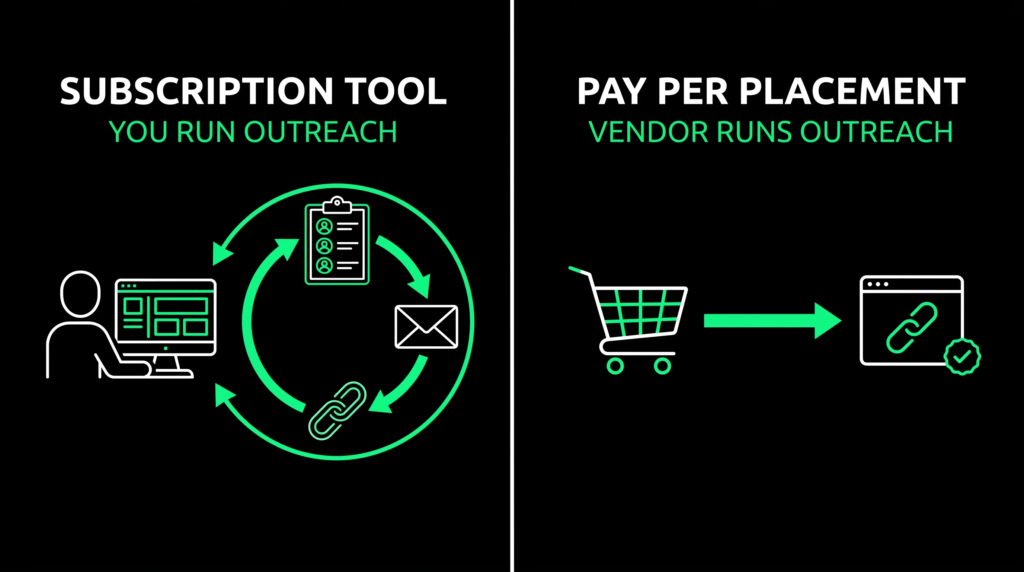
Quick answer: BuzzStream suits small teams that want an outreach CRM at a modest price. Pitchbox suits agencies running high volume across many clients. Respona no longer sells software seats; it now sells guaranteed placements, which makes it a link vendor rather than a tool.
BuzzStream
BuzzStream is an outreach CRM. It keeps prospects, contact details, email history, and relationship stage in one place, so two people on your team never pitch the same editor twice. The Starter plan is $49 a month for one user and 500 contacts, with monitoring for 1,000 links. Automated follow-ups, bulk sending, and the Ahrefs integration start on Growth at $174 a month for three users. Its contact discovery can miss the right person, so most teams pair it with a dedicated email finder.
Pitchbox
Pitchbox is built for scale. It combines prospecting, multi-step sequences, a unified inbox, link monitoring, and team workflows, and it pulls metrics from Ahrefs, Semrush, Moz, and Majestic. The Pro plan costs $300 a month billed monthly, and every plan carries a one-year commitment. Google index checks on built links start on the Advanced plan at $600 a month. For a solo link builder sending a few dozen pitches a month, it is more tool than you need.
Respona
Most 2026 roundups still list Respona as outreach software priced between $198 and $399 a month. Its pricing page now shows a pay-per-placement model instead: $100 per placement on sites with DR 20+, rising to $500 for DR 60+, with a standard 28-day turnaround. That is a link vendor, not a tool. Evaluate it the way you would any service provider, by reviewing sample placements before you order.
What Do You Need for Contacts, PR, and Free Prospecting?
Hunter.io
Hunter finds professional email addresses by domain or by name and verifies them before you send. Verified lists cut bounces, and bounces hurt deliverability for every campaign that follows. Hunter’s pricing page lists a free plan with 50 credits a month, and Starter costs $49 a month (or $34 a month billed yearly) for 2,000 credits. A verification uses half a credit, and every plan includes unlimited team members.
HARO and Featured
HARO connects journalists with expert sources. Featured acquired and relaunched it in April 2025, so disregard older articles that say it was replaced by Connectively. HARO is free for sources, while Featured adds a question dashboard and paid tiers from $19 a month. Expect competition: many sources answer each query, and results are unpredictable.
Google Search Operators
Google itself is a free prospecting engine. Queries like intitle:”write for us” plus your topic, or inurl:resources plus your keyword, surface sites that already accept contributions or curate resource lists. It takes manual review, but every result is a live, indexed page in your niche.
How Do You Confirm Which Links Google Actually Counts?
Quick answer: Use the Links report in Google Search Console. It is free and shows the backlinks Google has found, your top linked pages, top linking sites, and top linking text. It is a sample rather than a full list, so pair it with a third-party index.
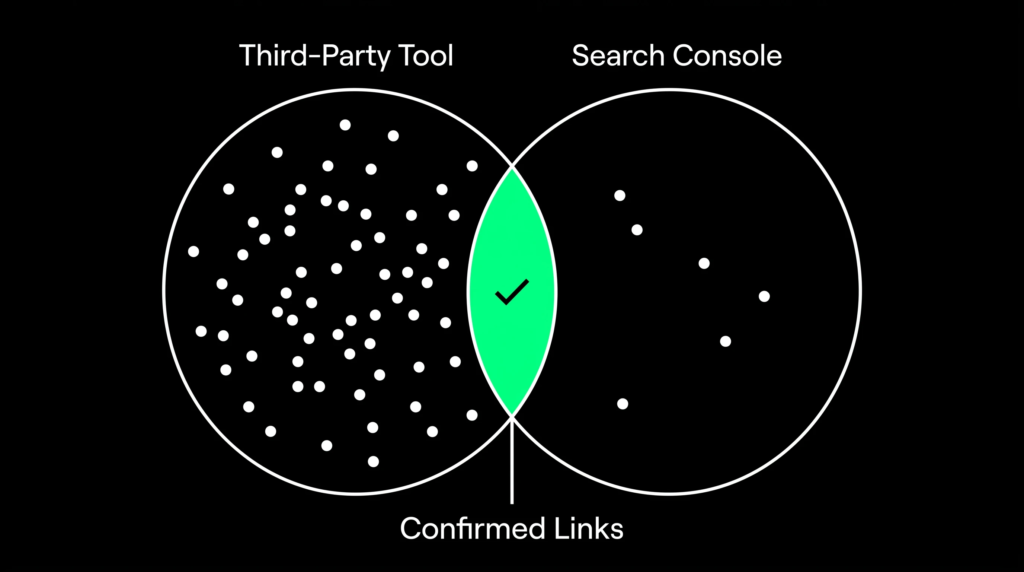
Third-party tools crawl the web on their own schedules, so their link counts rarely match Google’s. The Search Console Links report is the closest thing to Google’s own view. Google’s documentation lists a few limits worth knowing: tables cap at 1,000 rows, exports cap at 100,000 rows, the report does not flag nofollow links, and it can include links that have since been removed. Use it to confirm new placements and to spot unfamiliar or spammy domains among your top linking sites.
How Do These Tools Fit Into One Workflow?
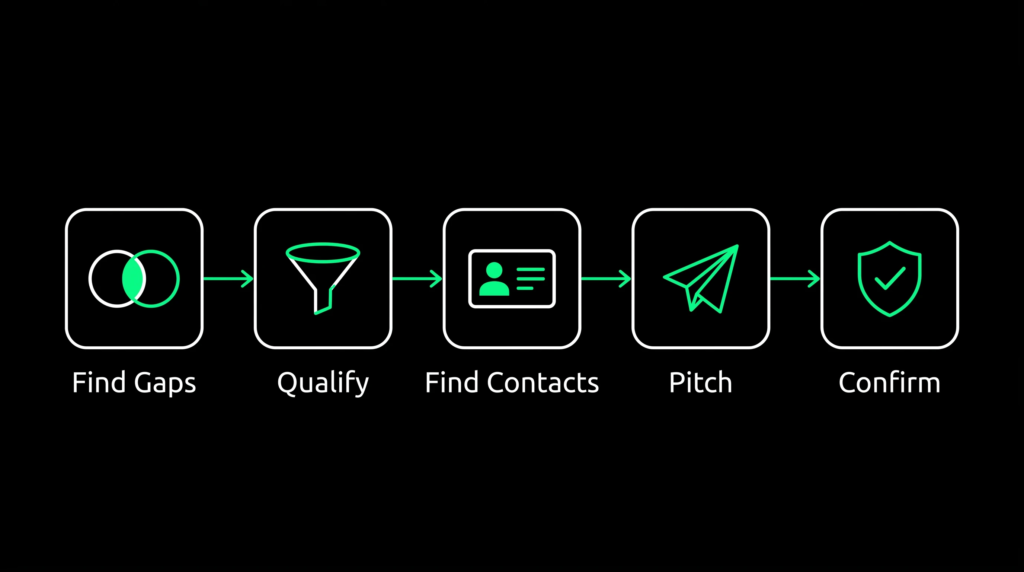
No single tool covers the whole job. This five-step sequence works for most campaigns:
- Find gaps. Run Semrush Backlink Gap or Ahrefs Link Intersect against three or four competitors.
- Qualify prospects. Filter by topical relevance, real organic traffic, and Moz Spam Score, and drop anything with PBN footprints.
- Find contacts. Run the shortlist through Hunter and verify every address.
- Pitch. Load the list into BuzzStream or Pitchbox, segment by tactic, send a first email with one or two follow-ups, and answer relevant HARO queries in parallel.
- Confirm and monitor. Check new links in Search Console and set lost-link alerts in your research tool.
What Should You Check Before Paying for a Tool?
Start lean: one research suite, one outreach tool, and one email finder. Add more only when a real bottleneck shows up. Then judge each tool by cost per qualified link, not by monthly price. A $300 tool that lands a few relevant, high-authority links each month can cost less per link than a $49 tool that fills your profile with weak domains.
Watch the anchor mix as links come in. Tools report anchors but do not judge them, and our guide to anchor text distribution covers what a natural profile looks like. Links also shape visibility beyond classic rankings, which we cover in our AI search optimization guide. If you want the plain-English version of how AI answers pick their sources, start with our explainer on generative engine optimization.
Tools also do not replace judgment. They find prospects and send emails, but they cannot tell you whether a site’s audience matches yours or whether its outbound links look sold. If your team would rather skip the stack, our link building services handle prospecting, vetting, and outreach end to end, and our SEO services cover the on-page work that makes a page worth linking to.
Frequently Asked Questions
Do I need both Ahrefs and Semrush?
No. Most teams start with one. Agencies often run both because their indexes and feature sets differ, but a single suite covers research for most sites.
Can I build links with free tools only?
You can start that way. Google Search Console, search operators, HARO, Hunter’s free plan, Ahrefs Free, and the Semrush free plan cover verification, prospecting, and light research. Scaling past a handful of links a month usually takes a paid research suite and a paid outreach tool.
Which link building tool is best for beginners?
Semrush’s Link Building Tool, free for one project, is the cheapest way to learn the full flow from prospect to pitch. BuzzStream Starter adds a proper outreach CRM at $49 a month once you outgrow it.
Can link building tools get my site penalized?
The tools do not cause penalties; how you use them does. Automated mass outreach and links from irrelevant or spammy sites carry the risk, not the software itself.
Why don’t tool prices in other articles match this one?
Vendors change plans often. BuzzStream, Pitchbox, Ahrefs, and Semrush all list different prices today than many 2026 roundups show, so check the vendor’s pricing page before you set a budget.