
Anchor text distribution is the ratio of different anchor text types across all the backlinks pointing to a website. It tells Google, and increasingly AI search systems, whether a link profile grew naturally through editorial mentions or was built through manipulation.
A site with 60% of its backlinks using the exact phrase “best running shoes for women” looks manufactured. A site with a mix of branded mentions, naked URLs, partial matches, and a small share of exact match terms looks like something real publishers actually created.
Since Google’s Penguin update in 2012, anchor text ratio has been one of the clearest fingerprints separating natural link growth from paid or manipulated link building. Getting this distribution right protects existing rankings and prevents new content from being flagged before it has a chance to rank at all.
What Is Anchor Text Distribution?
Anchor text distribution refers to the percentage breakdown of anchor text categories, branded, exact match, partial match, generic, and naked URL, across a website’s full backlink profile. Search engines analyze this mix to judge whether links were earned naturally or built through deliberate keyword manipulation.
Every backlink carries clickable text between its HTML link tags. That text is the anchor. When hundreds or thousands of backlinks accumulate over time, the pattern across all of them forms a signature. Google’s algorithms compare that signature against what a normal, organically grown link profile looks like in a given industry.
Why Does Anchor Text Distribution Matter for SEO?
Before 2012, exact match anchor text worked extremely well. Site owners built backlinks using the precise keyword they wanted to rank for, and rankings followed almost automatically. Google’s Penguin update changed that permanently. Sites with a high concentration of money keyword anchors were penalized heavily, some losing the majority of their organic visibility overnight, while sites linked from irrelevant or low quality pages were hit especially hard.
Penguin still runs today as part of Google’s core algorithm, not as a standalone filter. That means an anchor text profile that leans too heavily on commercial keywords remains a liability years after a site first builds those links. The risk is not just a penalty. It is also a slower, quieter form of suppression where a site simply never gets the ranking lift its content quality deserves because the link signals look manipulated.
Anchor text quality is also one of several trust signals search engines weigh as part of Google’s E-E-A-T framework when evaluating a domain. A poorly distributed anchor text profile can quietly undercut even strong technical SEO services work, since ranking signals from links and on-page optimization are evaluated together.
What Are the Main Types of Anchor Text?
A healthy backlink profile blends several anchor categories rather than relying on one. Each type serves a different function and carries a different level of risk.
Branded Anchors
Branded anchors use the company or website name, such as a brand name on its own. These links are low risk because they cannot be interpreted as an attempt to manipulate rankings for a specific keyword. Branded anchors typically form the largest share of a natural link profile and are especially common on homepage links, press mentions, and citations.
Exact Match Anchors
Exact match anchors use the precise target keyword as the clickable text, for example “link building services” pointing directly to a link building service page. These anchors send a strong relevance signal, but they are the riskiest category. A profile with too many exact match links is the single clearest pattern Penguin was built to catch.
Partial Match Anchors
Partial match anchors combine the target keyword with additional descriptive words, such as “affordable link building services for startups” instead of the bare keyword. This approach captures much of the relevance benefit of exact match while reading more naturally to both users and algorithms.
Generic Anchors
Generic anchors include phrases like “click here,” “this guide,” or “learn more.” They carry little direct keyword value but play an important role in making a link profile look human. Real writers use generic phrasing constantly, so their near total absence from a backlink profile is itself a red flag.
Naked URL Anchors
Naked URL anchors are simply the raw web address used as the clickable text. These appear frequently in forum posts, citations, and press mentions, and they are one of the strongest natural growth signals a profile can show.
Image and Co-occurrence Anchors
When an image is used as a link, the anchor value is drawn from its alt text. Search engines also read the words surrounding a link, sometimes called co-occurrence text, as a secondary relevance signal, which is why context around a link matters almost as much as the anchor itself.
What Does a Healthy Anchor Text Ratio Look Like?
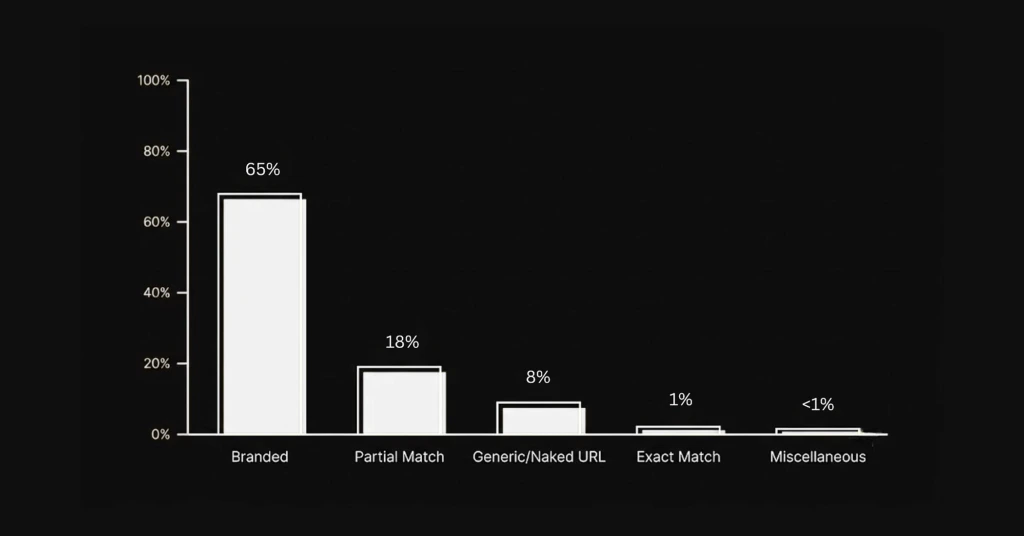
There is no single universal ratio that applies to every website, since acceptable distribution varies by industry competitiveness and site age. That said, most SEO practitioners converge on a similar range when they reverse engineer the backlink profiles of pages that rank well without being penalized. Agencies often reverse engineer competitor anchor text ratios using backlink tools before finalizing a target range for a new campaign.
| Anchor Type | Recommended Range | Risk Level |
| Branded | 30% – 50% | Low |
| Partial Match | 15% – 25% | Low to Moderate |
| Generic / Naked URL | 15% – 25% | Low |
| Exact Match | 5% – 10% | High |
| Miscellaneous / Other | 5% – 10% | Low |
Younger websites without an established history of organic backlinks should stay conservative and lean further toward branded and naked URL anchors, since they have less trust built up to absorb an aggressive keyword-rich profile. Competitive industries such as finance, insurance, and legal services warrant even more caution, since these niches receive closer algorithmic scrutiny.
How Do You Audit Your Current Anchor Text Distribution?
An anchor text audit starts with exporting the full backlink list from a tool such as Ahrefs, Semrush, or Google Search Console. Each link gets categorized into branded, exact match, partial match, generic, or naked URL, then the totals are converted into percentages of the overall profile.
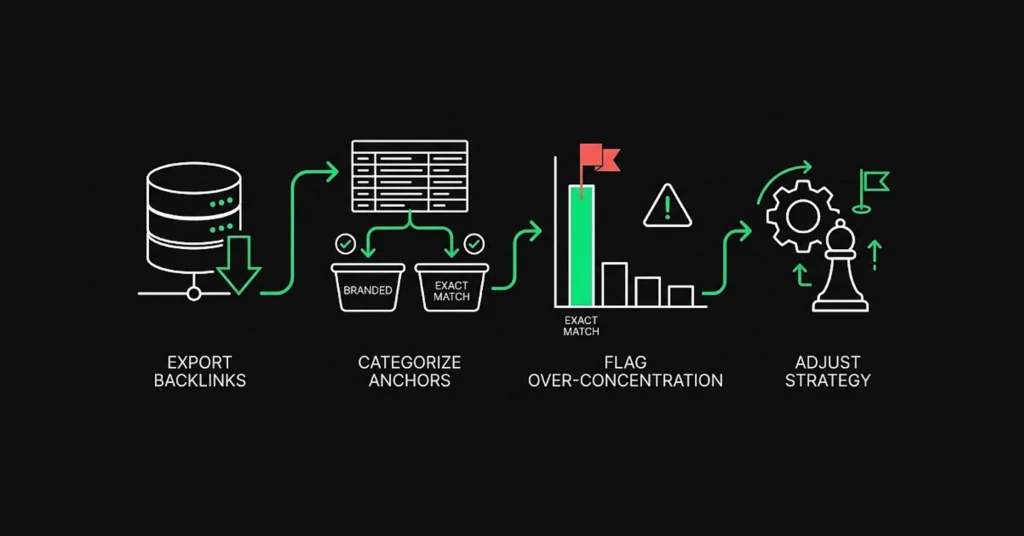
The audit should flag two things. First, any single keyword phrase that appears as anchor text on more than roughly five to ten percent of total backlinks, since concentration in one phrase is a stronger risk signal than the category percentages alone. Second, links coming from clearly irrelevant pages, since a backlink from a site with no topical connection carries little value regardless of what anchor text it uses. Running this audit quarterly makes it possible to catch drift before it becomes a pattern Google’s systems flag. Most teams monitor anchor ratios with backlink audit tools on a recurring schedule rather than relying on a single one-time check.
How Do You Build a Natural Anchor Text Strategy Going Forward?
The most reliable approach is treating anchor text diversity as a deliberate output of the link building process, not an afterthought. Before starting outreach for a new page, list five to ten anchor text variations spanning branded, partial match, and generic phrasing, and rotate through them across placements rather than defaulting to the same exact match phrase every time.
Internal links work differently than external backlinks. Since a website owner controls the anchor text on their own internal links completely, they can be more descriptive and keyword rich without the same manipulation risk that applies to earned backlinks from other domains. This makes internal linking a useful lever for reinforcing topical relevance around a target keyword without adding risk to the external profile.
Context matters as much as the anchor phrase itself. A link reading “anchor text distribution” makes sense inside a paragraph about SEO strategy but looks forced inside an unrelated article about recipes or travel. Search engines evaluate the surrounding sentence, not just the two or three words inside the link tag, so relevance of placement should guide every outreach decision.
What Mistakes Trigger Anchor Text Penalties?
The most common mistake is over-optimization: building a large share of links using the exact commercial keyword a business wants to rank for. A profile where the majority of anchors match target keywords is one of the fastest ways to trigger a manual action or an algorithmic Penguin-style demotion.
A second mistake is ignoring relevance. Links from sites with no topical connection to the destination page, regardless of the anchor text used, weaken a profile and can look like paid placements. A third mistake is static anchor text across time. Natural link growth shows gradual shifts in anchor phrasing and category mix as new content gets published and different writers describe it differently. Sudden spikes in one exact phrase, especially across many different referring domains in a short window, are easy for algorithms to flag as coordinated link building.
Internal Links vs External Links: Does the Ratio Change?
Yes. Internal link anchor text can be more keyword focused since a site owner has full control over that text and no third party is involved in creating it. External backlinks require the natural, diversified approach described above because those links come from other domains and are evaluated as independent votes of confidence. Treating both link types with the same strategy either wastes the flexibility available internally or takes unnecessary risk externally.
Does Anchor Text Distribution Affect AI Search Visibility Too?
Anchor text still matters for AI-driven search and generative engine optimization, though its function has shifted from a keyword-matching signal to a context signal. Large language models retrieving content through retrieval-augmented generation read the sentence surrounding a link, not just the two or three words inside the anchor tag, to decide how one page relates to another. This context-first evaluation is a core part of how GEO differs from traditional SEO, since AI systems weigh surrounding meaning more heavily than keyword placement alone.
A backlink profile with descriptive, varied anchor text gives AI systems clearer entity relationships to work with. A link that reads “how anchor text distribution affects rankings” tells a model far more about the destination page than a bare naked URL does, even though both are considered natural. This is one of the areas where traditional SEO and generative engine optimization overlap rather than conflict, since both reward anchor text that is descriptive, varied, and contextually placed rather than stuffed with a single repeated phrase.
Real Distribution Example: What a Balanced Profile Looks Like
Consider a page targeting the keyword “link building services” that has earned fifty backlinks over eighteen months. A balanced profile for that page might look like eighteen branded anchors using the company name, twelve partial match anchors like “affordable link building for SaaS companies,” ten naked URL anchors, seven generic anchors like “this resource” or “read more here,” and only three exact match anchors reading the bare target keyword.
That distribution keeps exact match at 6 percent of the total, well under the danger threshold most practitioners cite, while still sending enough topical relevance signal through the partial match and branded categories to support rankings. A profile that instead had thirty of those fifty links using the exact phrase “link building services” would sit at 60 percent exact match, a ratio that closely resembles the patterns Penguin was originally built to catch.
Frequently Asked Questions
What percentage of exact match anchor text is safe?
Most practitioners recommend keeping exact match anchors under 5 to 10 percent of a total backlink profile, with branded anchors making up the largest share instead.
Does Penguin still affect anchor text today?
Yes. Penguin was folded into Google’s core ranking algorithm and continues to evaluate anchor text patterns in real time rather than running as a periodic standalone update.
How often should I audit my anchor text profile?
A quarterly audit is enough for most sites, though competitive industries or sites running active link building campaigns benefit from monthly checks.
Can I fix a bad anchor text ratio after the fact?
Existing links cannot usually be edited, but a site can dilute an unhealthy ratio over time by earning new links with branded, generic, and partial match anchors, and by disavowing clearly toxic or spammy links.
Is anchor text still a ranking factor in 2026?
Yes, though its role has shifted. Anchor text remains a relevance signal, but the sentence and paragraph surrounding a link now carry comparable weight, particularly as AI search systems evaluate context rather than isolated keyword matches.