
You publish a blog post. It’s well-written, it’s relevant, and it covers the topic thoroughly.
And it still doesn’t rank.
If that sounds familiar, E-E-A-T might be the missing piece of the puzzle.
Google doesn’t just look at what your content says. It also considers who’s saying it, whether they have genuine experience with the subject, and whether the website behind that content has built enough credibility to be trusted.
That framework is called E-E-A-T. And in 2026, with the web filling up with AI-generated text at a rapid pace, it matters more than ever.
This guide breaks down what E-E-A-T actually means, how Google uses it, and what you can do to improve it, whether you run a small business website, a content-driven brand, or a growing company trying to compete in search.
Why Google Created E-E-A-T in the First Place
Google’s goal is to return the most helpful, accurate, and trustworthy result for every search query.
For a long time, that mostly meant ranking pages based on keywords and backlinks. The system worked reasonably well, until it didn’t. Low-quality sites figured out how to game it. Thin content, stuffed with the right words and backed by enough links, could outrank genuinely useful pages written by real experts.
That created a trust problem.
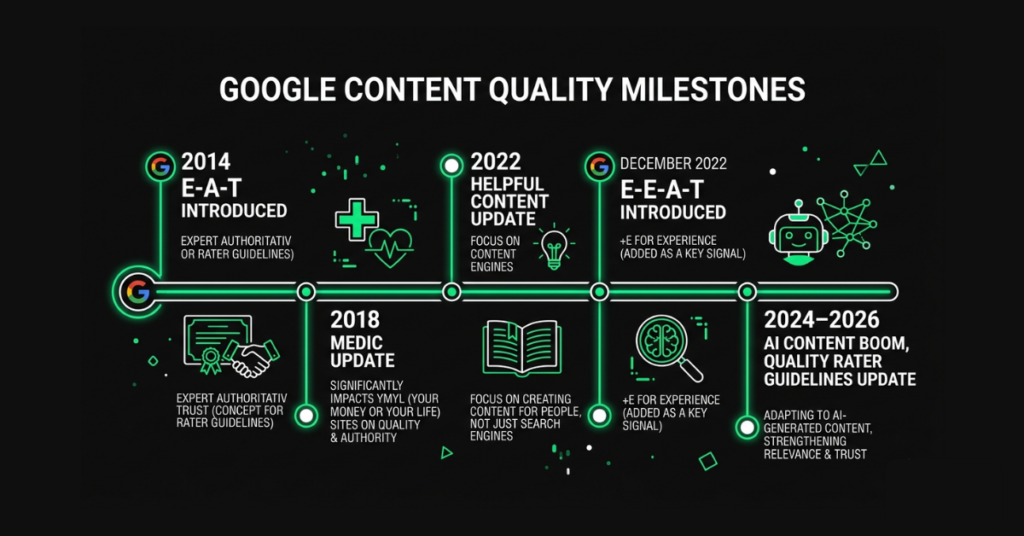
So Google brought in a framework for human quality raters (real people hired to evaluate search results) to assess content quality beyond what an algorithm could catch on its own. That framework started as E-A-T (Expertise, Authoritativeness, Trustworthiness) and was outlined in Google’s Search Quality Rater Guidelines, a document Google makes publicly available.
In December 2022, Google added a second E, this one for Experience, updating the framework to E-E-A-T.
The reason was pretty straightforward. AI tools had started producing content that could mimic expertise convincingly on paper, but lacked something a machine can’t fake: first-hand experience with the actual topic. The update sent a clear signal that Google values not just knowledge, but lived engagement with a subject.
The timing wasn’t accidental. It arrived just as large language models were beginning to flood the web with generated text. Google was drawing a line.
What Does E-E-A-T Stand For?
E-E-A-T stands for Experience, Expertise, Authoritativeness, and Trustworthiness.
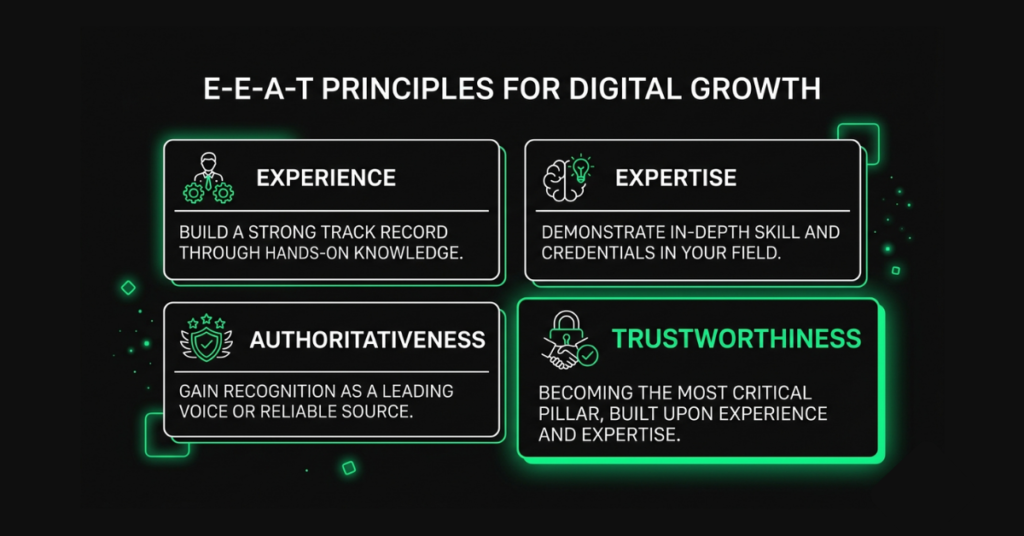
Each pillar represents a different dimension of content quality. Together, they form the lens through which Google’s quality raters assess whether a page deserves to rank for the query it’s targeting.
Here’s what each one actually means.
Experience
Experience is about whether the person who created the content has direct, first-hand involvement with the topic they’re writing about.
A review of a project management tool written by someone who’s used it daily for two years carries more weight than one written by someone who skimmed the product page. A guide to hiking a specific trail written by someone who’s walked it is more valuable than one assembled from other guides.
This is the pillar that AI genuinely can’t satisfy on its own. AI tools don’t have experiences. They can process and reproduce information about experiences, which is a meaningful difference.
For your website, Experience shows up in a few ways. An author bio that mentions real-world use of the tools or services they write about. Case studies from actual client work. Original data collected by your own team. Specific, concrete detail that only someone who’s actually been there would know.
The test is simple: does this content read like it was written by someone who has actually done this? Or does it read like a summary of other people’s descriptions of doing it?
Expertise
Expertise is the formal or demonstrated knowledge someone brings to a topic. It’s about credentials, qualifications, and depth of understanding, especially for subjects where being wrong carries real consequences.
For topics like medical information, financial advice, or legal guidance, Google expects content to come from verified professionals. A blog post about managing high blood pressure is held to a very different standard than a post about choosing the right font for a website.
But expertise isn’t always about formal qualifications.
For a topic like “how to grow a following on LinkedIn,” genuine expertise might come from someone who’s grown their own account to a significant size and can explain specifically what worked. For a topic like “the best hiking boots for wet terrain,” expertise might come from a long-distance hiker with documented experience, not a podiatrist.
The real question is: does this person demonstrably know more about this topic than the average person? And can a reader, or Google’s quality rater, actually verify that?
Authoritativeness
Authoritativeness is about recognition. It’s whether your website, your brand, or your authors are acknowledged by others in the field as credible sources.
You can be an expert in something privately. Authority requires that others in your industry confirm that expertise externally.
This shows up as high-quality backlinks from relevant, credible websites in your space. It shows up in media mentions, citations in AI and other sites, guest contributions, interviews, and industry recognition. It shows up when other trustworthy sources reference you as worth citing.
Authority isn’t built quickly, and it’s not built just by posting frequently. It’s built by creating content others find valuable enough to reference, by earning links because your work is genuinely useful, and by consistently showing up in conversations that matter to your field.
A useful way to think about it: if someone in your industry were looking for the definitive source on a topic you cover, would they point to your website? If not yet, that gap is your authority gap.
Trustworthiness
Trustworthiness is the most important pillar of the four. Google says this directly in its Search Quality Rater Guidelines.
The logic: a page can have solid experience, deep expertise, and strong authority, but if it can’t be trusted, all of that becomes irrelevant. Untrustworthy pages with impressive credentials are actually more dangerous, not less.
Trustworthiness covers a few different things.
It includes the accuracy and honesty of your content, whether what you say is factually correct, properly sourced, and updated when things change. It includes the transparency of your website, whether visitors can easily identify who’s behind the content, how to get in touch, and what your business actually does. It includes the security and technical integrity of your site, whether it uses HTTPS, protects user data, and functions the way it should. Helping you converting those visitors into customers.
It also includes your reputation. What do third-party reviews say about your business? How do you handle negative feedback? Is your site free from misleading claims or deceptive practices?
Trust is the foundation the other three pillars rest on. Build it first.
Is E-E-A-T a Direct Ranking Factor?
This is one of the most common questions about E-E-A-T, and it deserves a clear answer.
E-E-A-T itself is not a direct ranking factor in the traditional sense. There’s no “E-E-A-T score” in Google’s algorithm, and you can’t measure it with a tool the way you’d measure Domain Authority or page speed.
What E-E-A-T is, is a framework. It shapes how Google trains its systems to recognise content quality. It guides what human quality raters look for when evaluating search results. And that feedback, over time, influences how Google’s algorithm gets refined.
Think of it as a description of what high-quality content looks like, rather than a lever you can directly pull.
The practical takeaway: sites that demonstrate strong E-E-A-T signals tend to rank better and bounce back more quickly after algorithm updates. Sites with weak E-E-A-T signals tend to be the ones hit hardest when Google rolls out core updates focused on content quality.
You can’t rank for E-E-A-T. But you can build a website that genuinely deserves to rank, and E-E-A-T tells you what that looks like.
E-E-A-T and YMYL: When the Stakes Are Higher
Not all content is held to the same E-E-A-T standard. Google applies stricter scrutiny to content it classifies as YMYL, short for Your Money or Your Life.
YMYL topics are those where inaccurate or misleading information could have serious consequences for a reader’s financial stability, physical health, safety, or general wellbeing.
Common YMYL categories include medical information and healthcare advice, financial planning and investing guidance, legal information and consumer rights, news and current events that could influence public understanding, and safety or emergency information.
If your website covers any of these areas, the bar for E-E-A-T is significantly higher. This isn’t arbitrary. A person who follows incorrect medical advice because a poorly qualified website ranked at the top of search results could be genuinely harmed.
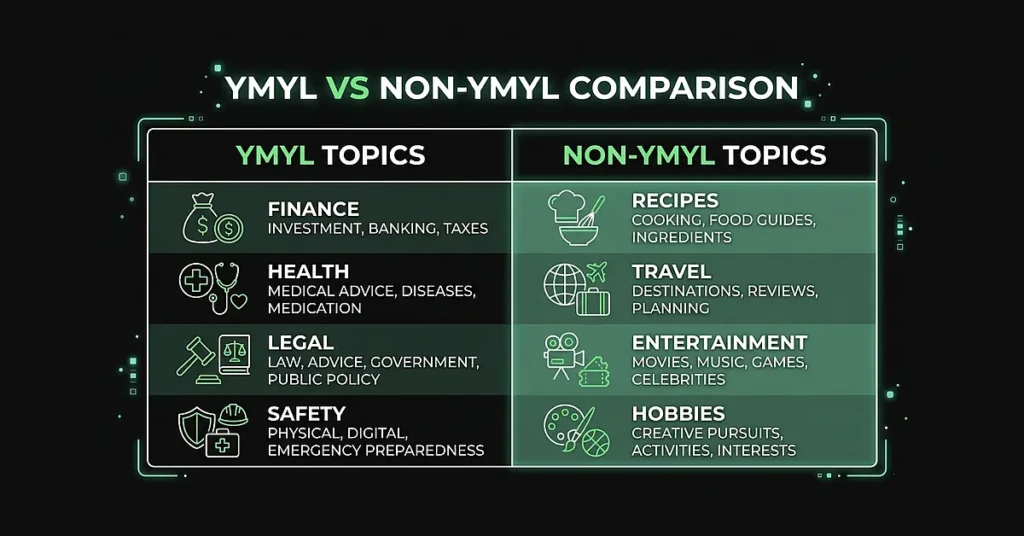
For YMYL content, demonstrable credentials are close to mandatory. Author bios should include professional qualifications. Content should be reviewed by certified professionals where appropriate. Sources should be verifiable. And the content itself should be updated regularly to reflect current guidance.
For non-YMYL content like recipes, product reviews, or travel guides, the standards still apply, but there’s more room for flexibility. Demonstrated enthusiasm and direct experience can substitute for formal credentials in these areas.
How to Improve E-E-A-T on Your Website
Understanding E-E-A-T is useful. Improving it is what actually moves results.
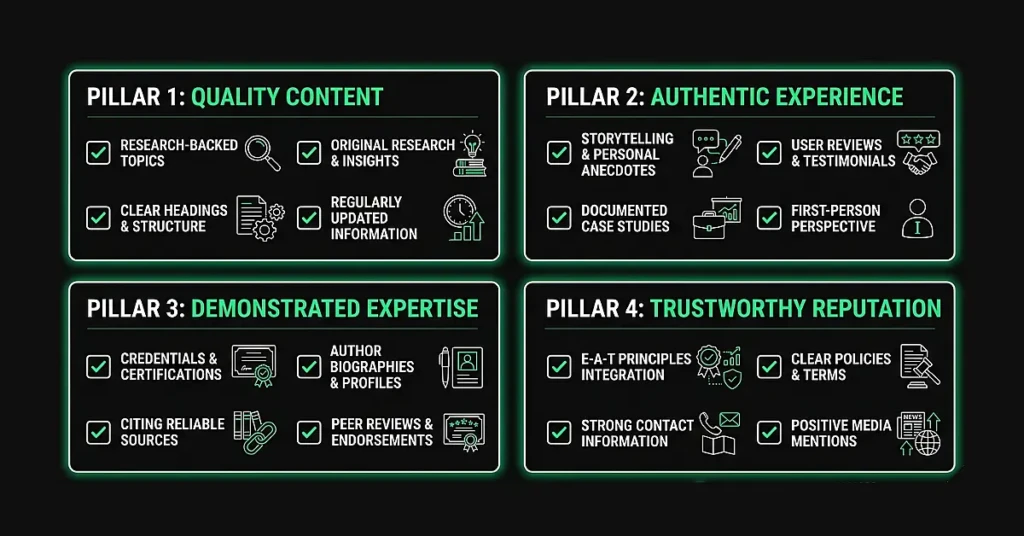
Here’s what that looks like in practice.
Show Real Experience in Your Content
Don’t just explain how to do something. Show that you’ve done it.
To save yourself from content investment with no return, reference specific tools, outcomes, timelines, and decisions from your own work. Include original data from your own research, client results, or internal analysis rather than just citing what others have published. Use case studies that describe real situations with real outcomes, including what went wrong and how you adjusted.
Add original images where possible. Screenshots from your own work. Photos from your own projects. Data visuals built from your own findings. These are experience signals that a competitor can’t fake just by copying your content structure.
If you bring in guest authors or contributors, prioritise those with direct, demonstrable experience in the specific topic they’re covering. A post about email marketing written by someone who has run email campaigns for ten years reads very differently than one written by a generalist.
Make Expertise Visible, Not Just Implied
Your content might genuinely demonstrate expertise, but if visitors can’t verify that, it doesn’t fully count.
Create proper author biography pages for everyone who contributes content to your site. Use real names. List relevant qualifications, years of experience, specific areas of focus, and links to external profiles like LinkedIn where they can be independently verified. Don’t use a generic author profile or publish content anonymously.
For YMYL topics, have content reviewed by a qualified professional and make that review visible on the page. Medical articles should note medical review. Financial content should note review by a qualified advisor. This isn’t just good practice for Google; it builds genuine trust with your readers too.
Back up claims with sources. Link to original research, government data, peer-reviewed studies, and other authoritative references when you’re making factual assertions. This shows that your knowledge is grounded in evidence, not just opinion.
Build Authoritativeness Over Time
Authority can’t be manufactured overnight, but it can be built with a consistent approach.
Focus your content strategy on becoming genuinely comprehensive in your area. Cover your core topics in depth. Create content that answers not just the top-level question, but the follow-up questions a knowledgeable reader would ask. Over time, this builds what SEOs call topical authority, a recognition by both Google and your readers that your site is a reliable source on a specific subject.
Go after high-quality, relevant backlinks from publications and websites your audience actually reads. Not directories. Not paid placements on unrelated sites. Genuine mentions from credible sources in your industry, through guest contributions, original research that others cite, or commentary where your perspective adds something real.
Be active in your industry beyond your own website. Contribute to industry publications. Participate in relevant discussions. Show up in conversations that matter to your field. Every external mention strengthens the signal that your brand is one worth listening to.
Earn and Demonstrate Trustworthiness
Trustworthiness is partly about behaviour and partly about signals.
On the behaviour side: be accurate. Update content when it becomes outdated. Correct errors visibly when you make them. Don’t make claims you can’t support. Write about what you know, and be transparent about the limits of your knowledge.
On the signals side, your website should make it easy for visitors to confirm you’re a real, legitimate business. Your About page should identify who’s behind the organisation with enough detail for a stranger to feel confident. Your Contact page should list genuine contact options, not just a form. Your physical address should be findable if you operate from a physical location.
Collect and display authentic customer reviews. Don’t cherry-pick or manipulate them. Respond to negative reviews professionally because how you handle criticism is itself a trust signal.
Make sure your site uses HTTPS. Remove broken links, fix technical SEO issues, load quickly, and work properly on mobile. These are baseline trust signals that Google’s systems notice, and that your visitors notice even faster.
E-E-A-T and AI-Generated Content
This is the question most marketers are sitting with right now.
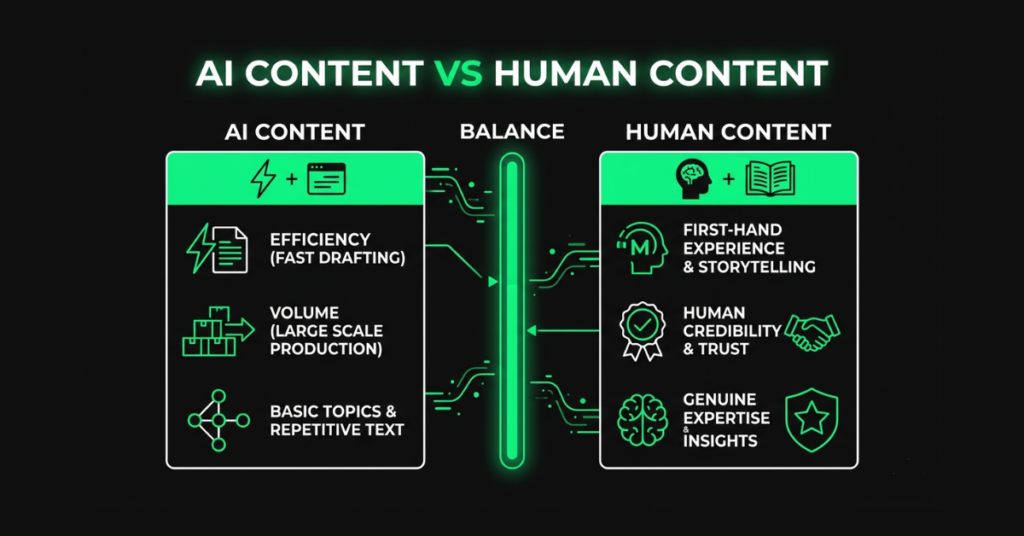
Google has been clear: AI-generated content isn’t automatically penalised. What matters is the quality and helpfulness of the content, not the tool used to produce it.
But here’s the complication.
AI can produce content that looks like it meets E-E-A-T criteria. It can write in a confident, credible tone. It can include statistics and source references. It can structure an article the way an expert would.
What it can’t do is provide first-hand experience. It can’t offer original insights from work that was actually done. It can’t build a reputation in an industry or earn the kind of recognition that authoritativeness requires. And it can’t take responsibility for accuracy the way a named, qualified human author can.
That means AI-generated content, used without significant human oversight and genuine expert contribution, will consistently underperform on Experience. For YMYL topics, it also falls short on Expertise and Trustworthiness.
The smarter approach is to use AI as a production tool, not a substitute for genuine knowledge. AI can help structure content, research background information, draft first versions, and fill in factual sections efficiently. The experience, the judgment, the real-world context, and the accountability for accuracy still need to come from a person.
The websites winning in search right now aren’t the ones publishing the most AI content. They’re the ones using AI to produce content faster while making sure every piece still demonstrates genuine expertise and first-hand knowledge.
A Quick Self-Audit: Where Does Your Website Stand?
Before changing anything, it helps to see clearly where you are.
Run through these questions for your website as it currently stands.
On Experience: Can a visitor tell whether the people behind your content have actually done what they’re writing about? Is there specific, original detail in your articles that couldn’t have been copied from another source? Do you publish original research, real case studies, or data gathered by your own team?
On Expertise: Does every piece of content have a named author with a visible, detailed bio? Are qualifications and professional backgrounds clearly stated? For any YMYL topics, is there a qualified reviewer credited on the page?
On Authoritativeness: What does your backlink profile look like? Are you earning links from genuinely relevant, respected publications in your field? Does your brand appear in industry conversations beyond your own website?
On Trustworthiness: Can a stranger easily identify who runs your business, how to contact you, and what your privacy practices are? Is your site on HTTPS, free of technical errors, and loading at a reasonable speed? Are your customer reviews visible, genuine, and representative?
Read and follow our Technical SEO Checklist to perform technical audit by yourself.
If you have clear gaps in any of these areas, those are your starting points. Not a full redesign. Not a new content strategy. Just the specific signals that are currently missing. If you’re struggling with SEO then do let us know and we will guide you through how we approach SEO.
The Bottom Line
E-E-A-T isn’t a checklist you complete once and move on from.
It’s a description of what it means to be a genuinely credible source on the web. The businesses that treat it as such, investing in real expertise, building a real reputation, demonstrating real experience, and operating with genuine transparency, are the ones that benefit most from it, both in search and in the trust of their audience.
Google is getting better at telling the difference between content that looks authoritative and content that actually is.
The gap between the two is where most websites are currently losing ground.
Frequently Asked Questions About E-E-A-T
What’s the difference between E-A-T and E-E-A-T?
E-A-T was Google’s original three-pillar framework: Expertise, Authoritativeness, and Trustworthiness. In December 2022, Google added a first E for Experience, creating E-E-A-T. The addition recognised that first-hand, lived experience with a topic is a distinct quality signal, separate from formal expertise. Someone can be an expert in theory without ever having done the thing in practice.
Does E-E-A-T affect all types of websites equally?
No. Websites covering YMYL topics (health, finance, legal, safety) are evaluated much more strictly against E-E-A-T standards. For non-YMYL topics like hobbies, entertainment, or lifestyle content, the bar is lower and demonstrated enthusiasm or direct experience can substitute for formal credentials.
How long does it take to improve E-E-A-T?
Authoritativeness takes the longest, often months to years depending on your starting point and how actively you pursue it. Experience and Expertise signals can be improved more quickly through content updates, improved author bios, and the addition of original research or case studies. Trustworthiness improvements like HTTPS, contact information, and review visibility can often be addressed within days.
Can AI content rank well under E-E-A-T standards?
AI content can rank well when it’s human-reviewed, factually accurate, supplemented with genuine expert contribution, and not relying on AI to fulfil the Experience pillar. Pure AI output without meaningful human expertise layered in will struggle, especially in competitive or YMYL categories.
Is E-E-A-T only relevant for written content?
No. E-E-A-T principles apply across all content formats, including video, podcasts, social content, and any other medium Google can index or evaluate. The same questions apply: who is behind this content, do they have genuine knowledge and experience, is the source credible, and can the information be trusted?
What’s the most important pillar of E-E-A-T?
Google’s own documentation states that Trustworthiness is the most critical component. A page that scores highly on Experience, Expertise, and Authoritativeness but can’t be trusted (due to inaccuracy, deception, or lack of transparency) will still score poorly overall.