
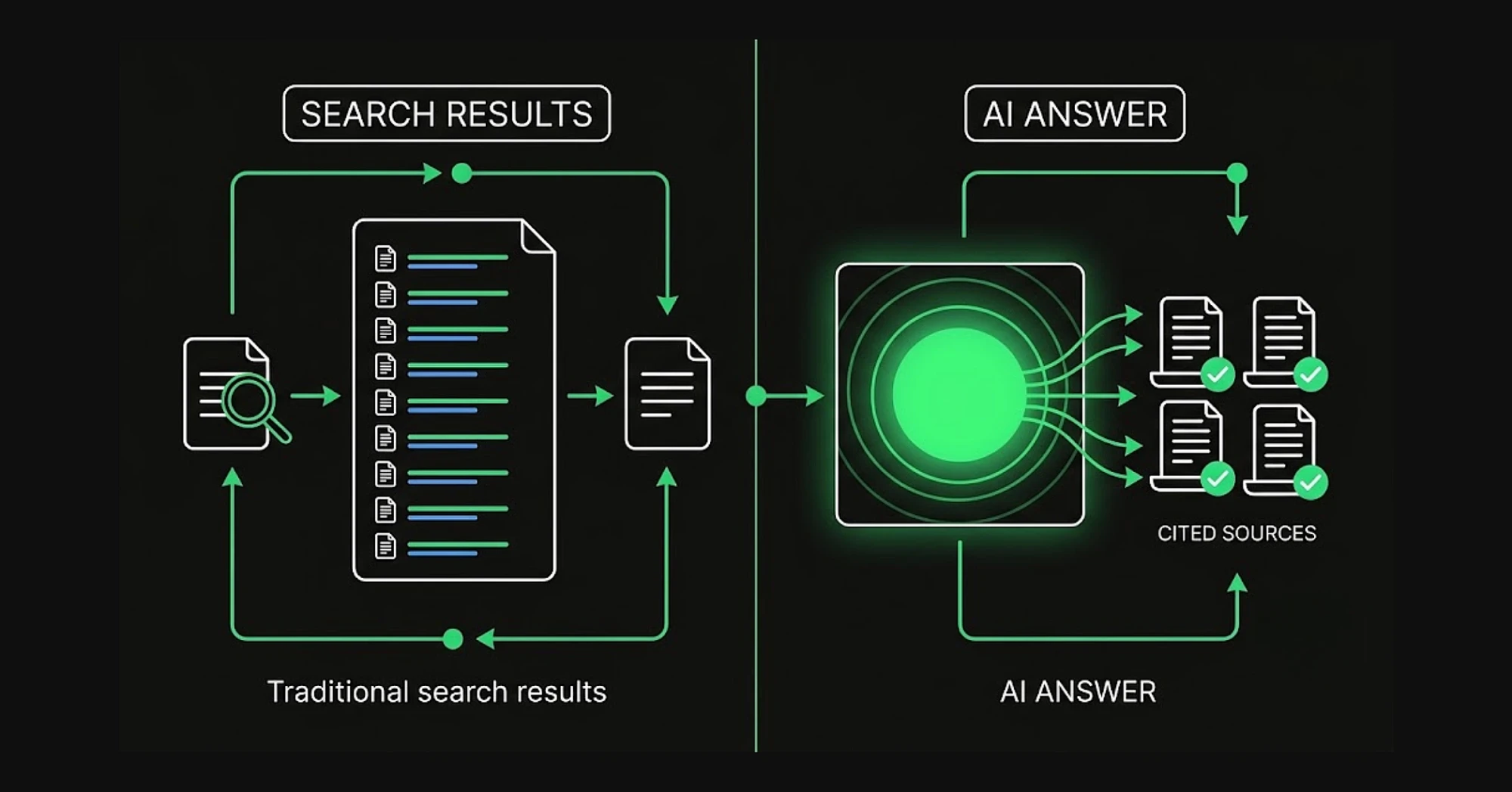
Generative Engine Optimization, or GEO, is the practice of structuring content so AI systems such as ChatGPT, Perplexity, and Google’s AI Overviews can find it, understand it, and cite it in their generated answers.
Traditional SEO chases a spot on a results page. GEO chases a mention inside the answer itself, whether or not the reader ever clicks through to the source site. That shift is already measurable: research from GEO firm Brandlight found that the overlap between top-ranking Google links and the sources AI models actually cite has fallen from roughly 70 percent to under 20 percent. In other words, ranking well in classic search no longer guarantees a seat at the table when an AI model writes its answer.
For agencies and in-house teams running SEO Services campaigns, GEO is quickly becoming a parallel discipline that runs alongside, not instead of, traditional optimization.
What Is Generative Engine Optimization?
Generative Engine Optimization is the process of structuring digital content so large language models can retrieve, interpret, and cite it accurately when answering user queries, covering technical crawler access, semantic clarity, source credibility, and factual specificity throughout the page.
The term traces back to the 2023 Princeton University research paper that first coined it. Since then, GEO has grown from an academic concept into a working discipline that touches technical SEO, content structure, and brand mention strategy.
The core idea is simple. An AI model cannot cite what it cannot read, and it will not cite what it does not trust. GEO addresses both problems, first by confirming crawlers can access and parse a page, then by making sure the content carries enough factual density and source credibility to earn a citation.
How Is GEO Different From Traditional SEO?
GEO and traditional SEO share the same foundation of quality content, technical accessibility, and authority signals, but GEO optimizes for a citation inside an AI-generated answer rather than a position on a results page, and it weighs unlinked brand mentions more heavily.
| Factor | Traditional SEO | Generative Engine Optimization |
| Success metric | Ranking position, click-through rate | Citation or mention inside an AI-generated answer |
| Primary target | Search engine crawler and ranking algorithm | LLM retrieval and reranking system |
| Content unit | Full page | Self-contained chunk or paragraph |
| Link value | Backlinks as the primary authority signal | Backlinks plus unlinked brand mentions |
| Freshness weight | Moderate | High, especially for time-sensitive queries |
Google’s own guidance on generative AI search states that optimizing for generative AI features is still, at its core, optimizing for the search experience, meaning it remains SEO. The company also advises marketers to prioritize established SEO fundamentals over so-called AEO or GEO hacks, such as artificially chunking content or publishing an llms.txt file, since neither tactic has been shown to move visibility on its own. GEO is best understood as a refinement of SEO fundamentals, not a replacement for them.
How Do AI Engines Actually Choose What to Cite?
Most AI answer engines rely on retrieval-augmented generation, a two-stage process that first finds content semantically similar to a query through vector search, then reranks the shortlist using recency, authority signals, and content quality before feeding sources to the model.
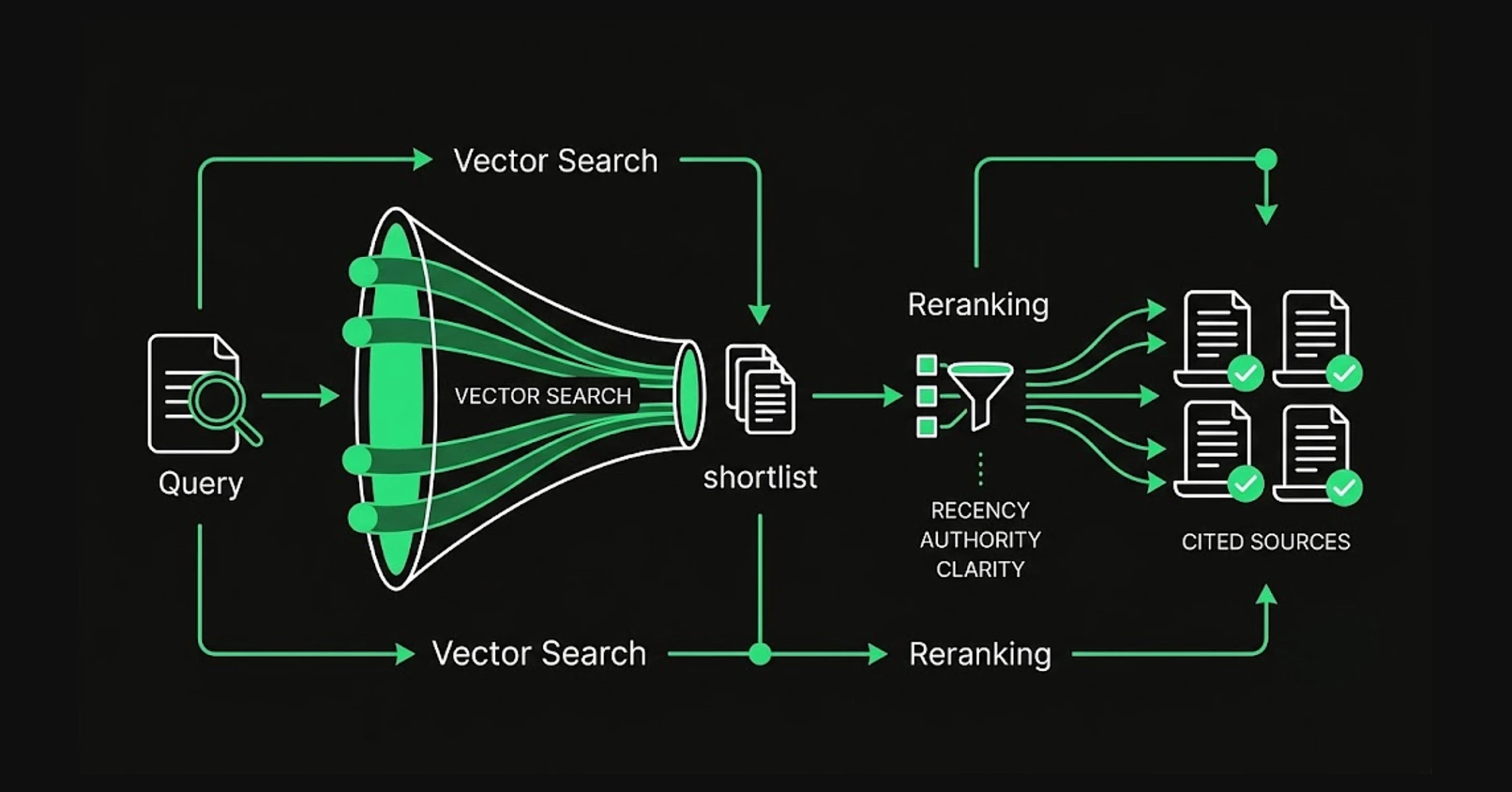
Once a query arrives, the system converts it into a vector and compares it against an index of content chunks pulled from across the web. The chunks scoring highest for semantic similarity move into a shortlist. A re-ranking step then applies filters, including how recent the content is, how credible the source appears, and how clearly it answers the question.
Factors influencing citation include content comprehensiveness, structural clarity, factual specificity, and consistency across platforms. This is why a page that reads well to a human can still fail to get cited. If the content is not chunked logically, or is missing a clear factual claim near the top, the retrieval system may never surface it in the first place.
What Makes Content GEO-Friendly?
GEO-friendly content is technically accessible to AI crawlers, structured into self-contained paragraphs that answer one question each, backed by named sources, and refreshed regularly, since AI citation frequency tends to drop sharply once a page passes a few months without an update.
- Confirm crawler access. Many sites unintentionally block AI bots through robots.txt rules or a Cloudflare default that shuts off crawler traffic without notice.
- Write self-contained paragraphs. RAG systems retrieve chunks of a few hundred words, not entire pages, so each paragraph needs to make sense on its own.
- Lead with the answer. Put the most citation-worthy claim in the opening sentences of a section instead of building up to it.
- Keep content current. AI citation rates for a page tend to fall off once it passes roughly three months without an update, which makes a quarterly refresh cycle worth the effort.
- Earn unlinked mentions. AI systems weigh brand mentions across the web even without a hyperlink attached, which is exactly the kind of coverage a focused Link Building & Digital PR program is built to generate.
- Name sources. Citing specific studies, dates, and named authors gives an AI model a verifiable fact to point to instead of a vague claim it has to take on faith.
Does GEO Replace Traditional SEO?
No. GEO builds on the same foundation as traditional SEO, including fast load times, mobile usability, and authoritative content, and businesses that already invest in solid SEO tend to be most of the way toward strong GEO performance already.
Semrush’s research on GEO and SEO overlap frames the relationship simply: a business that has been doing solid SEO for years is already much of the way there with GEO, since both disciplines draw from the same pool of quality signals. Gartner’s projection on AI search adoption estimates that by 2026, roughly a quarter of user searches will run through generative AI tools rather than classic search engines, which makes ignoring GEO a real business risk rather than a hypothetical one. For a deeper side-by-side look at where the two disciplines overlap and where they diverge, see our full breakdown of traditional SEO vs GEO.
How Should a Business Start With GEO?
Start by confirming AI crawler access, auditing existing content for clear structure and factual density, adding schema markup and verified author credentials, then building a quarterly refresh cycle so citation-worthy pages stay current as facts and figures change.
- Audit crawler access. Check robots.txt and server logs to confirm AI bots can reach your pages.
- Map topical coverage. Identify the questions your audience actually asks an AI assistant, not just the keywords they type into Google.
- Restructure for retrieval. Break long sections into shorter, self-contained paragraphs with the answer stated up front.
- Add structured data. Article, FAQ, and Organization schema give AI models a verified reference point instead of forcing them to infer meaning.
- Build author credibility. Clear bylines and author bio pages with real credentials reinforce the E-E-A-T signals both Google and AI systems rely on for trust scoring.
- Track brand mentions. Monitor where your brand gets mentioned across the web, since unlinked mentions still influence AI visibility.
- Refresh on a schedule. Revisit cornerstone content quarterly, updating statistics and examples so it stays inside the freshness window AI systems favor.
For agencies managing this across dozens of client pages, the discipline looks a lot like the test, measure, and refine cycle already used in Performance Marketing campaigns.
Frequently Asked Questions
Is GEO the same as AEO?
They overlap heavily. AEO, or answer engine optimization, typically refers to optimizing for direct question-and-answer formats, while GEO covers the broader practice of getting cited across generative AI systems. In practice, most practitioners use the terms interchangeably.
Do backlinks still matter for GEO?
Yes, though their role shifts. Backlinks still influence whether a model was trained on content that treats a domain as authoritative, and they remain a factor in how RAG systems weigh source credibility during retrieval.
How long does it take to see GEO results?
There is no fixed timeline. AI answer engines refresh their retrieved sources continuously, so improvements to crawler access and content structure can show up in citations within weeks, while gains from brand authority and E-E-A-T signals tend to build over months.
Does a small business need to worry about GEO?
Yes. GEO does not require the domain authority that traditional SEO often rewards, since RAG-based engines like Perplexity can surface a well-structured page regardless of its age or backlink profile.