
AI search optimization is the practice of structuring a website so its content can be found, understood, and cited inside AI Overviews, AI Mode, and other generative search features.
In May 2026, Google Search Central published its first official guide to the topic, titled “Optimizing your website for generative AI features on Google Search”. The message is direct: Google’s generative AI features run on the same core Search ranking and quality systems as classic results, so there is no separate AI index and no parallel playbook to chase. That single statement should reshape how marketing teams approach AI search work for the rest of 2026. I
nstead of treating answer engine optimization and generative engine optimization as new disciplines, the priority becomes strengthening the SEO fundamentals that already decide whether a page is even eligible to appear inside an AI-generated answer.
What is AI Search Optimization?
AI search optimization is the process of making a website eligible for generative AI features such as AI Overviews and AI Mode by meeting the crawlability, indexing, and content quality standards Google already requires for traditional Search results, since both systems draw from the same ranking index.
For roughly two years, the SEO industry built a wave of frameworks around acronyms such as AEO (answer engine optimization) and GEO (generative engine optimization), each claiming a new playbook was needed for a search landscape where AI answers questions before anyone clicks a link.
Google’s official position settles the terminology debate. The guide defines AEO and GEO by name, then states that from Google Search’s perspective, optimizing for generative AI search is optimizing for the search experience, and therefore remains SEO. Agencies marketing GEO or AEO as standalone services are describing a subset of SEO applied to a newer interface, not a separate technical discipline.
How Do Google AI Overviews and AI Mode Actually Retrieve Content?
Google’s generative features rely on retrieval-augmented generation, which pulls grounded passages from the existing Search index, combined with query fan-out, a process that breaks one question into several related sub-queries and merges the results into a single synthesized answer.
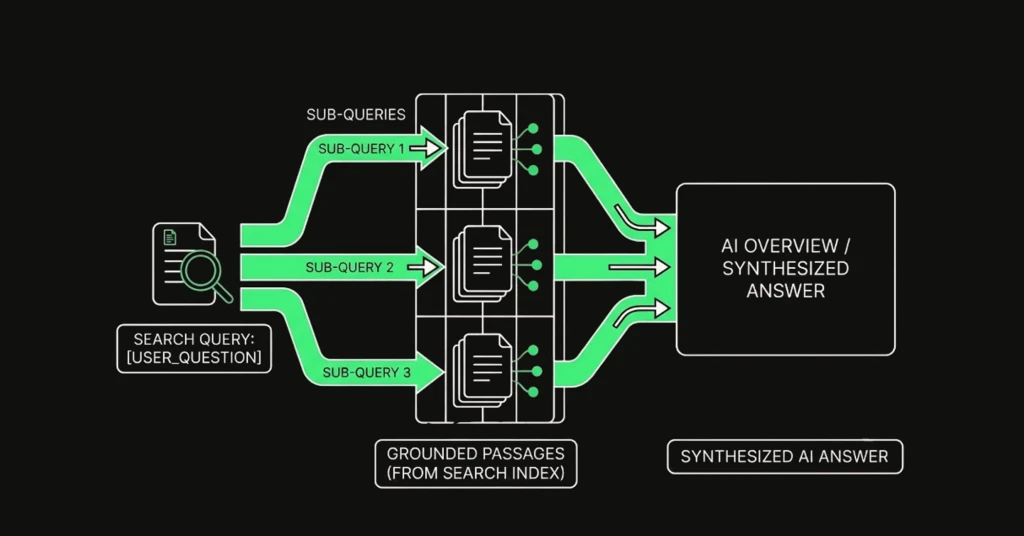
Retrieval-augmented generation, or RAG, is the technique Google uses to keep AI answers accurate and current by grounding them in indexed web content rather than relying only on a trained model’s internal knowledge. Query fan-out adds another layer. When someone searches something like “how to fix a lawn that’s full of weeds,” Google’s systems can generate related sub-queries such as best herbicides for lawns, remove weeds without chemicals, and how to prevent weeds in lawn, then pull relevant results for each before combining them into one response.
A single page rarely wins an AI citation on the strength of one keyword. It wins by covering the semantic neighborhood around a topic completely enough that it keeps surfacing across multiple fan-out branches.
AI Overviews vs. AI Mode
These two features behave differently enough that they deserve separate tracking and separate content decisions.
| Feature | AI Overviews | AI Mode |
|---|---|---|
| Experience type | Static AI summary at the top of standard results | Conversational, opt-in interface that replaces the SERP |
| Interaction | Linked citations as a jumping-off point | Follow-up questions with retained context |
| Best for | Quick answers to a direct question | Exploratory tasks, comparisons, and planning |
| Reported scale | Over 2 billion monthly users (Q2 2025) | 1 billion+ monthly users one year post-launch |
AI Mode is now built into a redesigned, AI-powered search box that Google introduced at its I/O 2026 Search announcement, running on the Gemini 3.5 Flash model as the new global default. One year after launch, AI Mode passed one billion monthly users, with query volume more than doubling every quarter since debut.
Does Traditional SEO Still Matter for AI Search Visibility?
Yes. Google’s guide states plainly that generative AI features are rooted in core Search ranking and quality systems, which means a page must be indexed and eligible to appear with a snippet in classic Search before it has any chance of surfacing inside an AI Overview or AI Mode answer.
This eligibility requirement is the most overlooked part of AI search optimization. There are no additional technical requirements to unlock AI visibility, but there are no shortcuts around the existing ones either. A page needs to be crawlable, since Google’s AI models rely on publicly accessible content the same way classic indexing does. Sites built on JavaScript frameworks need extra attention to render correctly. Page experience factors, including mobile-friendliness and load speed, still separate winners from also-rans, and duplicate content still wastes crawl budget instead of building topical authority.
None of this is new advice, but the stakes have changed. By March 2026, close to half of Google searches already displayed an AI answer at the top of the results page, which means the SEO foundation a domain built for classic rankings is now doing double duty as its AI visibility foundation. Freako’s SEO services build from this same premise: fix the technical and content fundamentals first, because that is what both ranking systems reward.
What Does Google Say You Don’t Need for AI Search?
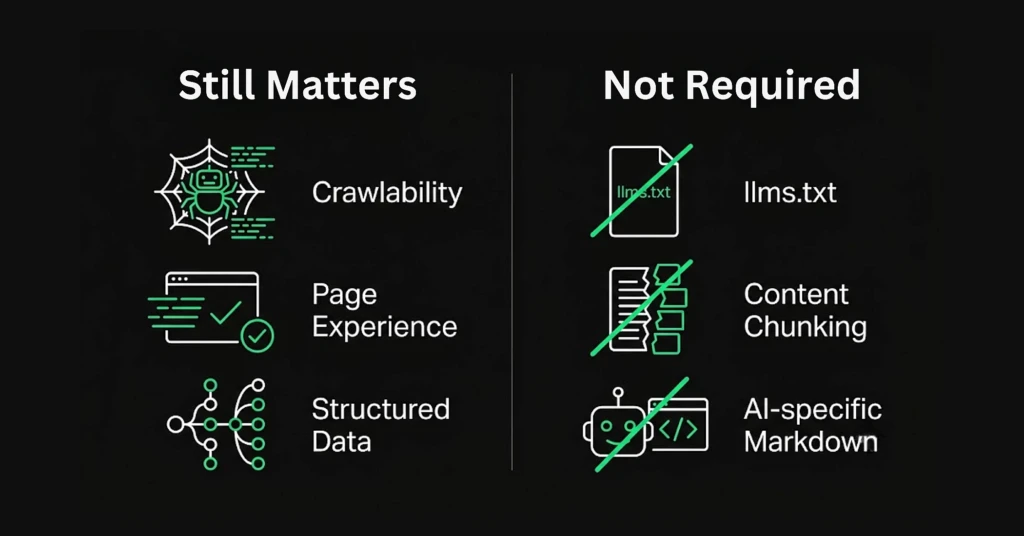
Google’s mythbusting section names five tactics site owners can stop worrying about: llms.txt files, breaking content into micro-paragraphs for easier citation, AI-specific rewriting or Markdown versions of pages, specialized AI schema markup, and chasing inauthentic brand mentions across blogs and forums.
- llms.txt: Pitched by parts of the industry as a robots.txt equivalent for language models, but Google’s crawler can discover the file like any other text document and assigns it no special meaning for inclusion in generative answers.
- Chunking: The idea that content needs to be pre-fragmented into short paragraphs so an AI system can cite it more easily is explicitly denied. Google says its systems already understand multi-topic pages and extract the relevant passage without an author needing to pre-fragment the article. Danny Sullivan made a similar comment in January 2026 after speaking with Google engineers who recommended against chunking, and the guide adds there is no ideal page length; optimizing purely for the chunk tends to produce thin content that loses editorial value without gaining visibility.
- Rewriting for AI: Google’s systems understand synonyms and general meaning, so there is no requirement to capture every long-tail keyword variation or write in a special register just for generative search.
- Special schema: Standard structured data, such as Article and FAQPage markup, remains good practice for search appearance generally, but Google does not require AI-specific schema beyond what already applies to classic Search results.
- Inauthentic mentions: AI features can surface what is said about a brand across blogs, videos, and forums, but Google notes that manufacturing mentions is not as effective as it sounds, since core ranking systems focus on quality and other systems are built to catch spam.
For a plain-language walkthrough of every mythbusting point, Search Engine Journal’s breakdown of the guide is a useful companion read for teams deciding what to deprioritize.
What Actually Improves AI Search Visibility?
The strongest lever is content only your business could produce: first-hand case data, named practitioner commentary, and original analysis, because AI systems already have access to generic advice and increasingly favor sources that add something a model cannot generate on its own.
Google frames this with a simple test for site owners to apply to their own content: would your visitors find this satisfying? If the honest answer is that a page mostly restates common knowledge, it has little to offer either a human reader or a model synthesizing an answer from dozens of sources. Original insight is what closes that gap. A first-hand review, a documented process, or a real client result gives an AI system something it cannot fabricate.
Google’s own quality raters lean on a related framework, E-E-A-T, to judge whether a source shows genuine experience, expertise, authoritativeness, and trustworthiness, and that scoring increasingly doubles as a proxy for AI citation trust. Authority signals still matter here too. Earned citations from other credible sites in a niche, built through ethical link building rather than volume tactics, continue to reinforce the trust scoring that both classic rankings and AI citation selection rely on.
Freako’s guide on Traditional SEO vs GEO goes deeper into how these authority signals carry over between the two systems.
Where AI Overviews Show Up Most
Not every query type triggers a generative answer at the same rate, and the pattern is useful for prioritizing which pages to strengthen first, per E2M Solutions’ analysis of AI Mode citation data, which draws on an SE Ranking study of AI Overview activation.
| Query Pattern | Reported Figure |
|---|---|
| Long-tail queries (4+ words) triggering an AI Overview | 60.85% of the time |
| Legal queries appearing in AI-generated results on page one | 28.32% |
| Healthcare queries appearing in AI-generated results on page one | 17.09% |
| Finance queries appearing in AI-generated results on page one | 10.08% |
| Domains cited in AI Mode that also rank in the top 10 organic results | About 53% |
| Specific URLs cited in AI Mode that match the top 10 organic URLs | About 35% |
This gap between organic rank and AI citation is why brands can no longer treat the two as interchangeable goals. A page can hold organic position ten and still lose the AI answer to a different, better-structured source.
How Should You Track AI Search Performance?
Google Search Console began rolling out generative AI performance reports in June 2026, so that clicks originating from AI Mode count as clicks, page appearances inside AI-generated responses count as impressions, and Google calculates a position metric similar to standard search results.
The rollout is staggered, so not every property has full reporting yet. Until it does, a practical workaround is to watch for a familiar warning pattern: impressions climbing while click-through rate falls on a query where an AI Overview has started appearing above the organic result and intercepting clicks. Pair that signal with manual spot checks of priority keywords in an incognito browser window, since Search Console alone will not always confirm whether your specific page is the one being cited inside the answer.
Frequently Asked Questions
Is GEO a separate discipline from SEO?
No. Google’s official generative AI guide states that optimizing for generative AI search is optimizing for the search experience, and treats GEO and AEO as SEO applied to a newer interface rather than standalone technical fields.
Do I need an llms.txt file for Google AI search?
No. Google’s guide explicitly says llms.txt is not required and receives no special treatment, even though the crawler can technically discover the file like any other text document on a site.
Should content be chunked into short paragraphs for AI Overviews?
No. Google’s systems already parse multi-topic pages and extract the relevant passage without pre-fragmentation, and pre-chunking content for citation purposes tends to weaken editorial quality without improving visibility.
Does ranking in the top 10 organic results guarantee an AI Mode citation?
Not automatically. Industry research shows only about 53% of domains cited in AI Mode also appear in the top 10 organic results for the same query, so AI Mode selection weighs formatting and source trust alongside rank.
How can a team measure whether its content appears in AI Overviews or AI Mode?
Through Google Search Console’s generative AI performance reports, which began a staggered rollout in June 2026 and track AI-specific clicks, impressions, and position, supplemented by manual keyword checks while full reporting rolls out.