
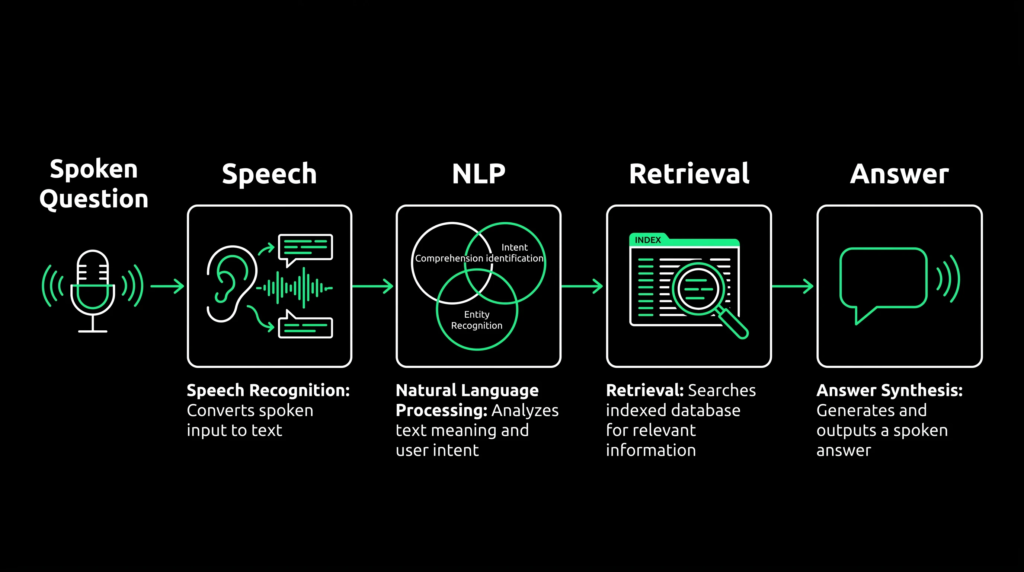
Voice search optimization is the practice of structuring website content, schema, and technical performance so voice assistants and AI answer engines can confidently read your content aloud as the answer to a spoken question. In 2026, that practice covers more ground than Siri or Alexa alone. ChatGPT’s voice mode, Gemini Live, and Perplexity’s voice search now pull from the same pool of public web pages that Google Assistant does, which means the work of ranking for a spoken query and the work of getting cited inside an AI-generated answer have become nearly the same project.
That convergence matters because voice queries behave differently than typed ones. When someone types, they clip a question down to a keyword fragment. When someone speaks, they ask a full question the way they would ask a coworker. Search engines and AI assistants respond to that shift by pulling short, direct answers from featured snippets, knowledge panels, and AI overviews rather than a list of ten blue links. A brand that wants to be the spoken answer needs to write for that retrieval pattern from the first paragraph onward.
What is Voice Search Optimization?
Voice search optimization is the process of preparing a website so voice assistants and AI answer engines select its content as the spoken response to a conversational query. It combines conversational structure, schema markup, local data, and mobile speed into one coordinated effort.
The discipline grew out of traditional SEO but now operates as its own layer of strategy. A page can rank on page one of Google and still lose the voice answer to a competitor with a cleaner featured snippet or better structured FAQ content. Winning the click and winning the spoken answer are related but separate goals, and 2026 content strategy has to account for both.
Why Does Voice Search Matter for SEO in 2026?
Voice queries now account for roughly a quarter of all searches, with more than 8 billion voice assistants active worldwide and about half of US adults using voice search daily. Voice commerce is on pace to reach roughly 80 billion dollars globally by the end of 2026.
The growth is not just about convenience. Voice commerce, meaning purchases completed by voice command, is on pace to reach roughly 80 billion dollars globally by the end of 2026. That number signals a shift from voice as a research tool to voice as an actual sales channel, which raises the stakes for brands that ignore it.
Three forces are driving this growth at once. Phones have replaced desktops as the primary way most people search, and voice-activated devices such as smart speakers, earbuds, and car systems have moved into spaces where typing was never an option. Natural language processing has also improved enough that assistants now handle follow-up questions and casual phrasing instead of breaking on anything but a simple command. Finally, conversational AI platforms have become search interfaces in their own right, with hundreds of millions of weekly users asking questions by voice instead of typing them into a search bar.
How is Voice Search Different From Typed Search?
Voice queries average four to seven words and are almost always phrased as complete questions, while typed queries usually run two to three words as keyword fragments. This length difference changes which pages get selected as the answer.
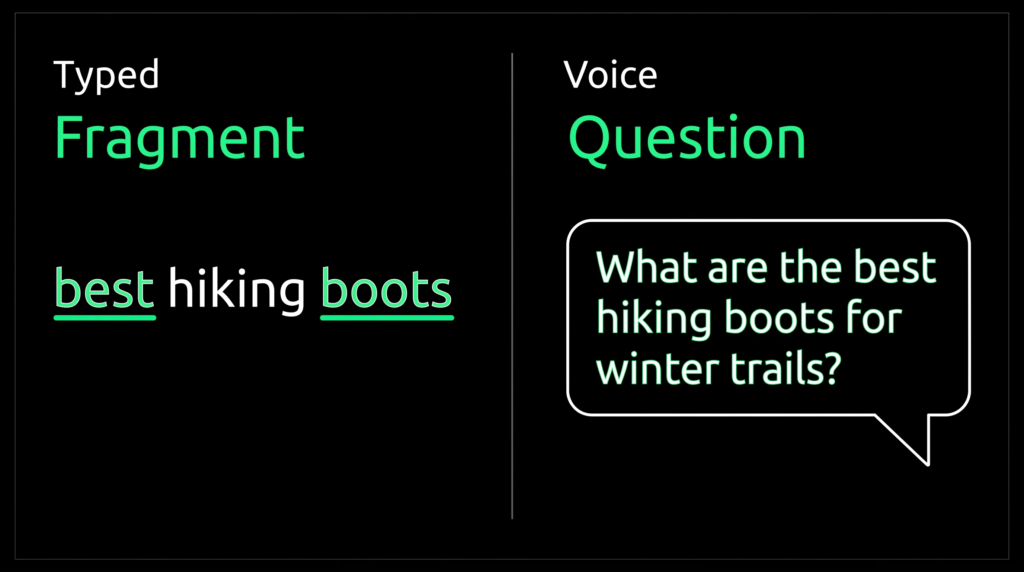
The practical gap between the two search styles shows up in nearly every part of a page.
| Typed Search | Voice Search |
| Two to three words, keyword fragments | Four to seven words, complete sentences |
| Query built as a keyword string | Query phrased as a conversational question |
| Returns a ranked list of links | Returns one spoken answer, usually from a snippet |
| Intent often broad and exploratory | Intent specific and frequently action oriented |
| Happens mostly on desktop and mobile keyboards | Happens on phones, smart speakers, and car systems |
This is not a small stylistic difference. A page built around a keyword-optimized product comparison can rank well in typed search while completely missing voice search, because the voice query needs a direct conversational answer that the keyword-focused page never provides.
Which Businesses Benefit Most From Voice Search Optimization?
Local businesses see the largest impact, since roughly three-quarters of voice searches carry local intent, but ecommerce, content publishers, B2B firms, and SaaS companies all compete for the same shrinking set of spoken answer slots.
Local businesses win or lose largely based on the completeness of their Google Business Profile and the consistency of their name, address, and phone number across the web. A restaurant, dental practice, or law firm that keeps this information accurate and current has a real shot at being the answer when someone asks a smart speaker to find a nearby option. For a deeper look at building local visibility for AI discovery, see our guide on how local businesses can build a social media presence for AI discovery.
Ecommerce brands rarely close a sale by voice alone, but shoppers increasingly use voice to compare brands, check shipping policies, or look up reviews on the way to a decision. That makes product schema and clear buying-question content valuable even when the final purchase happens by tap or click.
Content publishers and SEO teams benefit because question-led, well-structured content earns both featured snippets and AI overview citations, and those two outcomes now feed the same voice answers. B2B and professional services firms are seeing prospects research vendors hands free between meetings, which rewards long-form content that answers a specific question in plain language. Pairing this with strong SEO services keeps the technical and content sides of voice visibility aligned. Local businesses that want their social presence to support this kind of AI-era discovery can look at how a coordinated social media marketing strategy reinforces the same local trust signals that voice assistants rely on.
How Do You Optimize Content for Voice Search?
Optimizing for voice search means writing conversational, question-based content, winning the featured snippet for that question, adding the right schema, strengthening local signals, and meeting mobile performance standards.
Each piece reinforces the others, and skipping one weakens the rest of the effort.
Use Conversational, Question-Based Keywords
Start keyword research with the words who, what, where, when, why, and how, since these words form the backbone of most voice queries. Tools such as AnswerThePublic and Google’s People Also Ask panel surface real question phrasing, but sales call transcripts, support tickets, and customer interviews often reveal more accurate language than any keyword tool. Pull the exact phrasing customers use and turn it into section headers.
Structure Content for Featured Snippets
Featured snippets remain the primary source for voice answers, with roughly 41 percent of voice responses pulled directly from them. Lead each section with a question-based H2 or H3, follow it with a direct answer of about 40 to 60 words, and expand with supporting detail afterward. Use numbered lists for processes and bullet points for unranked items, since both formats are easy for an assistant to read aloud cleanly.
Add Speakable and FAQ Schema
FAQPage schema wraps question-and-answer content in a format voice platforms are built to extract, and Speakable schema tells an assistant which specific passages are safe to read aloud. Apply Speakable markup to introduction paragraphs that answer the primary question, FAQ answers, and how-to step summaries.
Strengthen Local SEO Signals
Claim and fully complete a Google Business Profile, including hours, categories, and the often-ignored Q&A section. Keep name, address, and phone number identical across every directory, since inconsistencies actively confuse the systems that aggregate local data. Add LocalBusiness schema to contact and location pages, and use neighborhood-level language rather than city-wide phrasing wherever it fits naturally.
Meet Core Web Vitals on Mobile
Pages that win voice answers load roughly 52 percent faster than average, and voice search happens overwhelmingly on mobile devices and smart speakers. Aim for a Largest Contentful Paint under 2.5 seconds, an Interaction to Next Paint under 200 milliseconds, and a Cumulative Layout Shift below 0.1. Sitewide HTTPS and clean, semantic HTML that renders without heavy JavaScript round out the technical baseline.
How Does Voice Search Connect to AI Answer Engine Optimization?
Voice search and AI answer engine optimization reward the same content qualities, including direct answers, question-based structure, and clear entity signals, so investing in one strengthens the other.
Recent research suggests the overlap between top Google links and AI-cited sources has fallen from roughly 70 percent to under 20 percent, meaning a page that ranks well in Google no longer guarantees it gets cited by ChatGPT, Gemini, or Perplexity.
Building topical depth across a content cluster, rather than publishing isolated posts, helps AI systems treat a site as a genuine authority instead of a one-time visitor to a subject. Publishing original data or a named framework increases citation odds further, since AI systems favor distinct, attributable sources over generic summaries. Freako’s guide to AI search optimization for Google AI Overviews and AI Mode covers the citation side of this shift in more depth, and the plain-English breakdown of generative engine optimization explains how GEO fits alongside traditional SEO and voice work rather than replacing it.
How Can You Measure Voice Search Performance?
There is no dedicated voice search report in Google Search Console, so measurement relies on proxy signals: featured snippet ownership, long-tail question keyword growth, local pack visibility, and AI citation tracking.
Start by tracking which queries currently trigger a featured snippet for your site, since that ownership is the closest available proxy for a voice search win on Google-powered assistants. Inside Google Search Console, filter for queries five or more words long that start with a question word, then watch whether impressions and clicks on those queries rise after a content update.
For local businesses, monitor local pack rankings and near-me visibility alongside review velocity, since both correlate closely with voice answer selection. Tools that track AI citation share across ChatGPT, Gemini, and Perplexity add a further layer of visibility into how the same content performs across voice assistants and AI answer engines together.
Frequently Asked Questions
What is voice search optimization?
Voice search optimization is the process of structuring a website’s content, schema, and technical setup so voice assistants and AI answer engines select it as the spoken response to a conversational query. It blends conversational writing, structured data, local business signals, and mobile performance into one strategy.
Why does voice search matter for SEO in 2026?
Voice search now accounts for roughly a quarter of all queries, and the content practices that win voice answers largely overlap with the practices that win AI Overview and chatbot citations. Ignoring voice search increasingly means losing visibility across both channels at once.
How is voice search different from typed search?
Voice queries are longer, phrased as complete questions, and carry stronger local and action-oriented intent, while typed queries are usually short keyword fragments with broader intent. Content built for one does not automatically perform well for the other.
Do I need Speakable schema to rank for voice search?
Speakable schema is not required, but it gives voice assistants a direct, machine-readable signal about which passages are appropriate to read aloud, which can improve selection odds for FAQ answers and direct-answer paragraphs.
How do I know if my content is winning voice search traffic?
Since there is no dedicated voice search report in standard analytics tools, track proxy signals instead: featured snippet ownership, growth in long-tail question keywords inside Search Console, local pack visibility, and AI citation monitoring across major AI platforms.