
You searched for something on Google recently and got a full answer before you even saw the first website link. Or someone asked ChatGPT which agency to hire, and a competitor’s name came up. Yours didn’t.
That is not random. It is the result of decisions being made by AI systems, and most businesses have no idea those decisions are happening.
This article explains exactly how AI engines decide who to cite, why your competitors may be winning that game right now, and what you can do about it. No theory-heavy jargon. Just a practical breakdown of what works.
Search Has Already Changed
Search behavior shifted faster than most marketing teams noticed. When someone asks ChatGPT “what’s the best SEO agency in Austin” or asks Google “how do I file freelance taxes,” they get a direct answer. One answer. Sometimes two. Not ten links to click through.
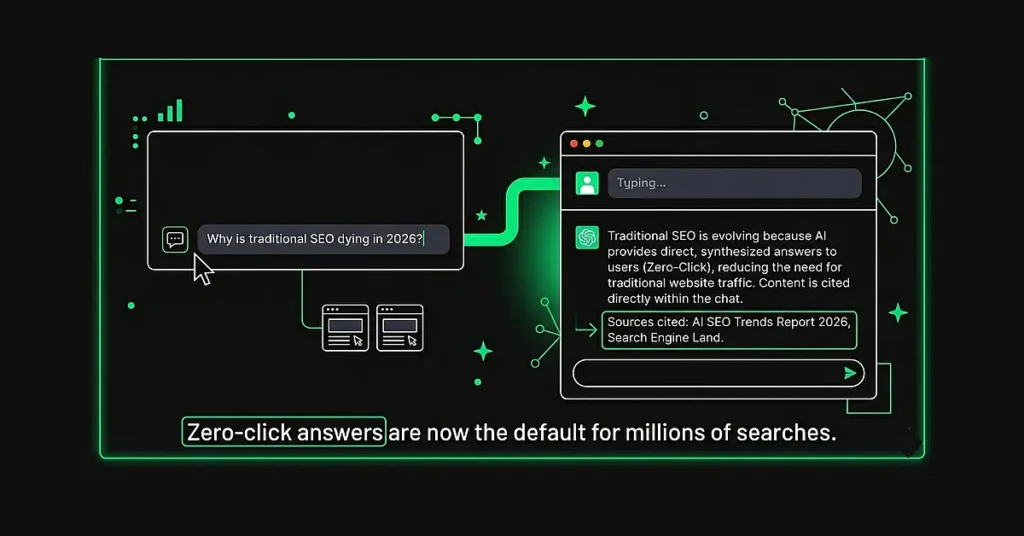
This shift is not small. Google AI Overviews now appear on more than half of all search results pages. ChatGPT handles over 800 million searches every week. Perplexity is growing rapidly as a default research tool for professionals.
The businesses being named in those answers are getting significant exposure to high-intent users. People who ask AI for a recommendation are usually ready to act. Being in the answer is not just about visibility. It is about being trusted before a prospect even visits your website.
The businesses being left out are not necessarily worse at what they do. They just have not structured themselves to be trusted by machines.
Why AI Picks Some Businesses Over Others
Here is the part most articles skip past. AI engines do not evaluate businesses the way humans do. They are not impressed by a beautiful homepage or a clever tagline. They are looking for verifiable, structured signals that tell them: this business is real, it knows what it is talking about, and other credible sources agree.
Think of it like this. An AI is a very literal reader that only trusts sources it can check. It looks for four things.
Can it access your content? If your site hides content behind JavaScript or blocks AI crawlers in your robots.txt file, you simply do not exist to those systems.
Is your content clear? Not clever. Clear. AI systems pull from content that answers questions directly, without burying the answer in five paragraphs of context first.
Do other sources confirm you exist? Reviews, directories, mentions in articles, LinkedIn presence, niche forums. These are all verification signals. Consistency matters. If your business name appears differently across platforms, that registers as unreliable.
Have you covered your topic area deeply? AI systems increasingly favor sources that cover a topic from multiple angles across multiple pages, not businesses with one good blog post and nothing else.
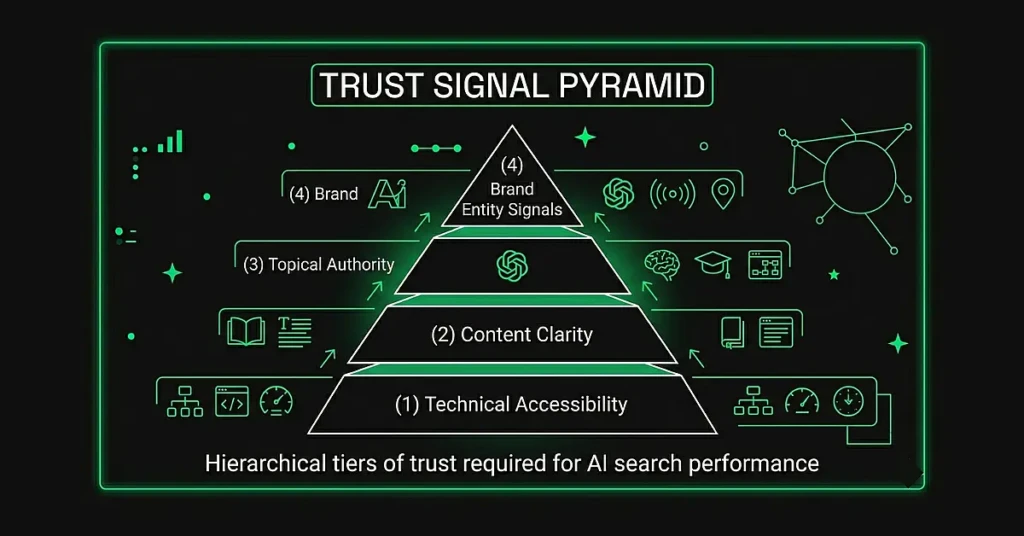
The gap between businesses that get cited and those that do not often comes down to these four areas. The good news: all four are within your control.
The Five Steps to Getting Your Business Cited by AI
Step 1 – Test Where You Stand Right Now
Before doing anything, spend fifteen minutes on this. Open ChatGPT and type: “Who are the best [your service] companies in [your city or industry]?” Then check Perplexity. Then search your main service keyword on Google and look for the AI Overview box.
Write down what you find. Are competitors named? Which ones? Do any of their patterns stand out (more reviews, more press mentions, more structured content)? This baseline will tell you where the gap is and help you prioritize what to fix first.
Do this once a month after you implement changes. It will show you which actions are working.
Step 2 – Write Content That AI Can Actually Extract
This is the biggest lever most businesses are not pulling.
AI systems scan web pages looking for extractable answers. They prefer content that opens with the answer, then expands. This is called the BLUF method: Bottom Line Up Front. If someone searches “what is [your service]” and your page starts with three paragraphs about your company’s journey before getting to an explanation, the AI moves on.
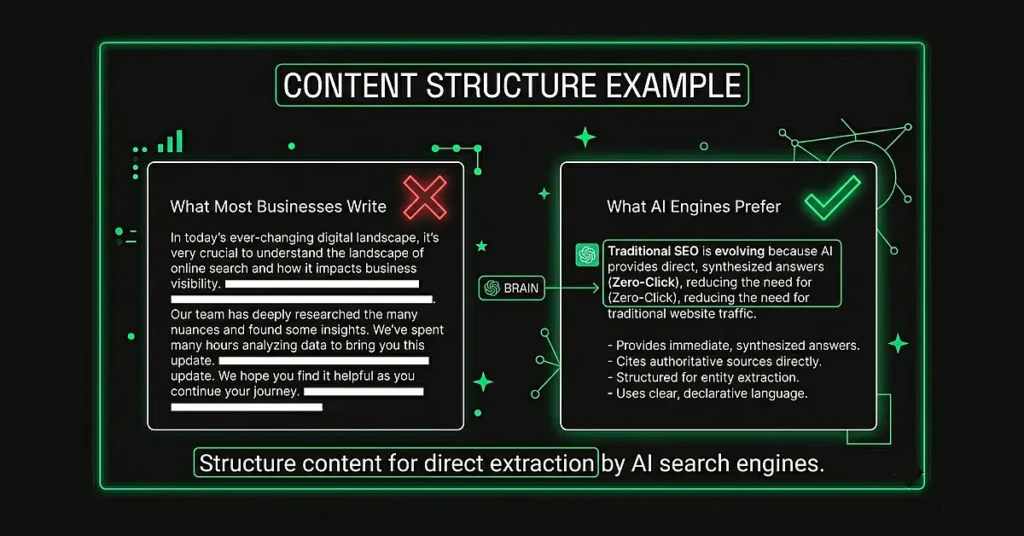
Here is what AI-ready content actually looks like:
Your main question answered in the first one to two sentences. No warm-up, no storytelling before the answer. Supporting detail after. A clear heading structure that mirrors the real questions your customers ask. Not “Our Services.” Something like “What does an SEO audit include?” or “How long does web design take?”
FAQ sections: These are one of the highest-value additions you can make to any page. Perplexity and Google AI Overviews regularly pull directly from FAQ-structured content, especially when it has FAQ schema markup attached. Every service page and major blog post should have a four to six question FAQ at the bottom.
Original data or insights: AI engines are looking for sources worth citing. If your content repeats what everyone else already says, there is no reason for an AI to pick you over an established site. A short original study, a client data point, a survey result, or even a well-articulated professional opinion gives the AI something citable that only you have.
Keep answers short where possible. Opening answers under 40 words are ideal for AI extraction. Detail can come after, but the hook needs to be concise.
Step 3 – Add the Technical Signals AI Systems Trust
You do not need to become a developer to handle this. But a few technical items are genuinely high-impact.
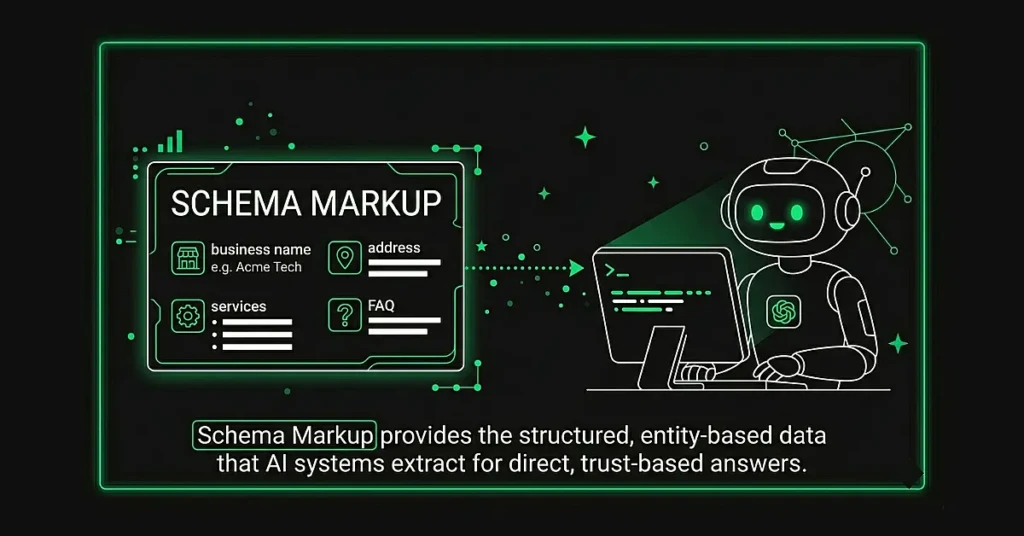
Schema markup: It tells AI systems exactly what your business is and what each piece of content covers. Think of it as a structured label on your page that says: “This is a business. Here is our name. Here is what we do. Here is a frequently asked question and its answer.” Without schema, the AI has to guess from your text. With schema, it knows for certain.
As per Google’s structured data guidelines, the three schema types that matter most are Organization schema (your business basics), FAQ schema (your question-and-answer content), and LocalBusiness schema if you serve a geographic area. These are all free to implement. If your site runs on WordPress, plugins like Rank Math or Yoast handle most of this without touching code.
Your robots.txt file: It needs to allow AI crawlers. Check that GPTBot (OpenAI’s crawler), ClaudeBot, and PerplexityBot are not blocked. Many sites have accidentally blocked these bots through broad disallow rules. If an AI cannot read your site, none of the content improvements matter.
An llms.txt file: It is optional but worth considering if your site has a lot of content. It is similar to a sitemap but specifically designed for AI tools. It guides AI crawlers toward your most important pages. Not all AI systems use it yet, but adoption is growing.
Page speed and Core Web Vitals: AI engines prefer sources that are technically clean and fast. If your site is slow, it is a credibility signal against you.
Step 4 – Build Your Brand Across the Web, Not Just Your Website
This is where a lot of businesses stop. They optimize their own site but ignore everything else. That is a problem, because AI engines build their picture of your brand from dozens of sources, not just your homepage.
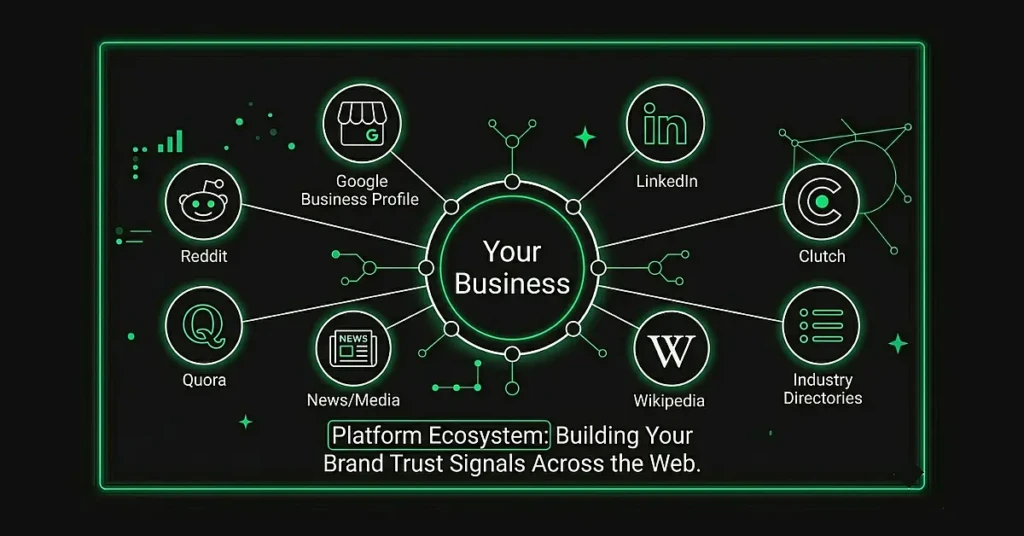
The most impactful places to establish your presence:
Google Business Profile: If you have not fully completed this, do it today. AI Overviews pull from GBP data for local and service queries. Your name, address, phone number, services, and description need to match what appears on your website exactly. Inconsistency registers as unreliable.
LinkedIn: A strong company page with regular thought-leadership posts is one of the most reliable signals for B2B businesses. AI systems reference LinkedIn frequently for professional credibility.
Industry directories: For most businesses in the US, UK, Canada, and Australia, this includes Clutch, G2, Yelp, and relevant niche directories. For India-based businesses serving global clients, JustDial and Crunchbase also carry weight.
Community platforms: Reddit and Quora are cited more often by AI engines than most marketers expect. Answering real questions on these platforms, with genuine helpful detail rather than a sales pitch, builds brand presence in exactly the kind of conversational content AI models train on and reference.
Media mentions: Being quoted in an industry article, getting a press mention, or contributing a guest piece to a credible publication creates the kind of third-party endorsement that AI systems weigh heavily. If this feels out of reach, start small. Niche newsletters, local business publications, and industry-specific blogs all count.
Consistency is the rule across all of these. Your business name, description, and contact details should be read identically everywhere. Variation signals to AI systems that the sources may not all be referring to the same entity.
Step 5 – Track AI Visibility the Same Way You Track Rankings
Most marketing dashboards are not set up to capture AI visibility. That does not mean you cannot measure it.
Start with manual testing. Once a month, ask ChatGPT, Perplexity, and Google the questions your customers would ask. Record whether your brand appears and in what context. Track this over time. You will start to see which content improvements are making a difference.
Watch your branded search volume in Google Search Console. When AI tools mention your brand, people often search for it directly. A lift in branded queries is one of the earliest signs that your AI visibility is improving.
Watch for direct traffic increases and contact form submissions that mention “I saw you on Google” or “I found you through AI.” These are qualitative signals that show up before any tool can quantify them.
For more automated tracking, tools like Semrush, SE Ranking, and Gumshoe are building AI mention tracking into their platforms. These are worth exploring if you want to monitor your presence at scale.
How Long Does This Actually Take?
Honest answer: it depends on which AI engine you are targeting and what changes you make first.
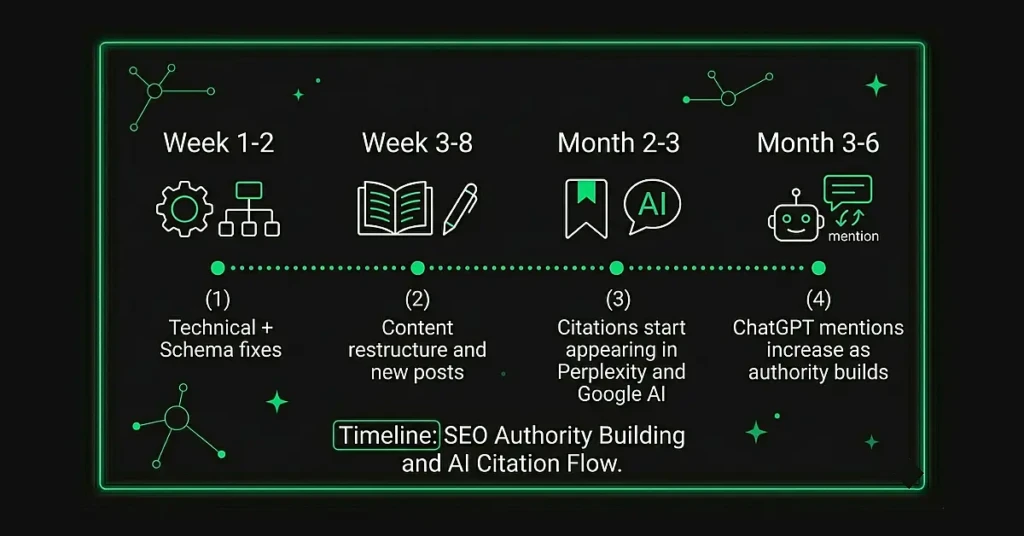
Google AI Overviews tend to move the fastest. They pull from pages already indexed in organic search, so if your SEO fundamentals are solid, schema fixes and content restructuring can produce results within two to six weeks.
Perplexity crawls the live web in near real time. Fresh, well-structured content can appear in Perplexity citations within two to four weeks.
ChatGPT is slower. It relies more heavily on training data, which means building third-party citations and consistent brand authority across the web takes longer to filter through. Expect three to six months before seeing meaningful changes in how ChatGPT represents your brand.
The businesses that start now will have a meaningful head start by the end of 2026. Most of your competitors have not started yet.
A Note on What Does Not Work
A few tactics that sound logical but do not move the needle:
Keyword stuffing for AI: AI systems are better at recognizing genuinely useful content than keyword-optimized filler. Writing content structured around real questions and real answers outperforms any attempt to game language patterns.
Creating pages “for AI” separate from your main content: One-off pages built purely to attract AI citations underperform compared to a well-developed content cluster that covers your topic area thoroughly across multiple interconnected pages.
Ignoring traditional SEO: This is important. Google AI Overviews pull almost exclusively from pages that already rank in organic search. Strong traditional SEO is the foundation that AI visibility is built on, not an alternative to it. Read our blog on the difference between Traditional SEO and GEO to understand why SEO still matters.
Inconsistent brand information: If your name or description appears differently on different platforms, AI systems see conflicting signals and lose confidence in recommending you.
Google recently released its first official guidance on optimizing content for generative AI experiences in Google Search. In this guide for Generative AI Search Optimization, we’ve broken down the key takeaways to help you understand what matters most.
Quick-start Checklist
If you want to start this week, here are the seven highest-impact actions:
One: Test your current AI visibility on ChatGPT, Perplexity, and Google. Record what you find.
Two: Check your robots.txt file to confirm AI crawlers (GPTBot, ClaudeBot, PerplexityBot) are not blocked.
Three: Add FAQ schema markup to your top five pages if it is not already there.
Four: Rewrite the opening paragraph of your three most important service pages so the answer comes first.
Five: Complete and optimize your Google Business Profile with exact matching information to your website.
Six: Post two genuinely helpful answers on Reddit or Quora in your niche this week, with no sales pitch.
Seven: Add a four to six question FAQ section to your homepage and main service page.
These seven changes address all four of the trust signals AI systems look for. Do not wait until everything is perfect. The sites building authority right now are the ones that will be cited in six months.
Where this is all going
AI-powered search is not a phase. Forty-five percent of consumers are already using AI platforms to help make purchasing decisions. That number will grow. The businesses that establish themselves now as trusted, citable sources will benefit from a compounding advantage as AI engines continue to learn from the same signals.
This is genuinely one of the few areas in digital marketing where being an early mover has a disproportionate payoff. The foundational work of making your content clear, your schema complete, and your brand consistent across the web is not something you can shortcut later. It takes time to build. The best time to start was last year. The second-best time is now.
If you want a proper audit of where your business stands and a clear plan for what to fix first, talk to the team at freako.io.
Frequently Asked Questions
What is the difference between AEO and GEO?
AEO stands for Answer Engine Optimization. GEO stands for Generative Engine Optimization. Both describe the same goal: structuring your content and brand presence so that AI tools like ChatGPT, Perplexity, and Google AI Overviews cite and recommend your business. Some practitioners use AEO when referring specifically to appearing in answer-style results, and GEO when referring more broadly to optimization across all AI-powered search. In practice, the strategies overlap almost entirely.
Does traditional SEO still matter if AI search is growing?
Yes, more than ever. Google AI Overviews pull citations almost exclusively from pages that already rank in organic search. Strong traditional SEO is the infrastructure that AI visibility is built on. The two are complementary, not competing.
Can a small business actually appear in AI search results?
Yes. AI systems evaluate content quality and trust signals, not budget or domain size. A small business with clear, consistent, well-structured content can outrank a larger competitor in AI citations, especially for niche or local queries. The playing field is more level than it appears.
How do I know if ChatGPT is already mentioning my brand?
The simplest way is manual testing. Ask ChatGPT: “Tell me about [your business name]” and “Who are the top [your service type] companies in [your area]?” For ongoing monitoring, tools like Gumshoe, Semrush, and SE Ranking are adding AI mention tracking features.
What is schema markup and do I actually need it?
Schema markup is code that tells search engines and AI platforms exactly what your page contains. FAQ schema, Organization schema, and LocalBusiness schema are the most impactful for AI visibility. You do not need to write code by hand. If your site is on WordPress, plugins like Rank Math or Yoast handle this. If you are on another platform, a developer can add it in a single session. Yes, it is worth doing.
How is GEO different from regular SEO?
Traditional SEO focuses on ranking your page as a link in Google search results. GEO focuses on getting your brand cited in the answer itself, before a user even sees any links. GEO is an extension of SEO, not a replacement. Businesses that already invest in good SEO are well-positioned to layer GEO on top.