
A good link building outreach template does two jobs. It gets a reply, and it gets a link that looks like an editor chose it. Most templates online handle the first job and undercut the second by asking for a specific keyword as the anchor.
This guide gives you five short templates built around one rule: tell the editor where the link fits and why, then let them write the anchor. That keeps your anchor text distribution looking earned, keeps you clear of Google’s link rules, and makes the ask smaller.
What Makes an Outreach Template Produce Natural Anchor Text?
Short answer: A template produces natural anchor text when it points to a specific spot on the editor’s page and explains the fit, but leaves the clickable words to them. Editors describe your page in their own language, which creates the variety search engines expect.
Google’s link best practices describe good anchor text as descriptive, reasonably concise, and relevant to both the page it sits on and the page it points to. The same page tells writers not to cram keywords into links and points out that the words before and after a link matter as much as the link itself.
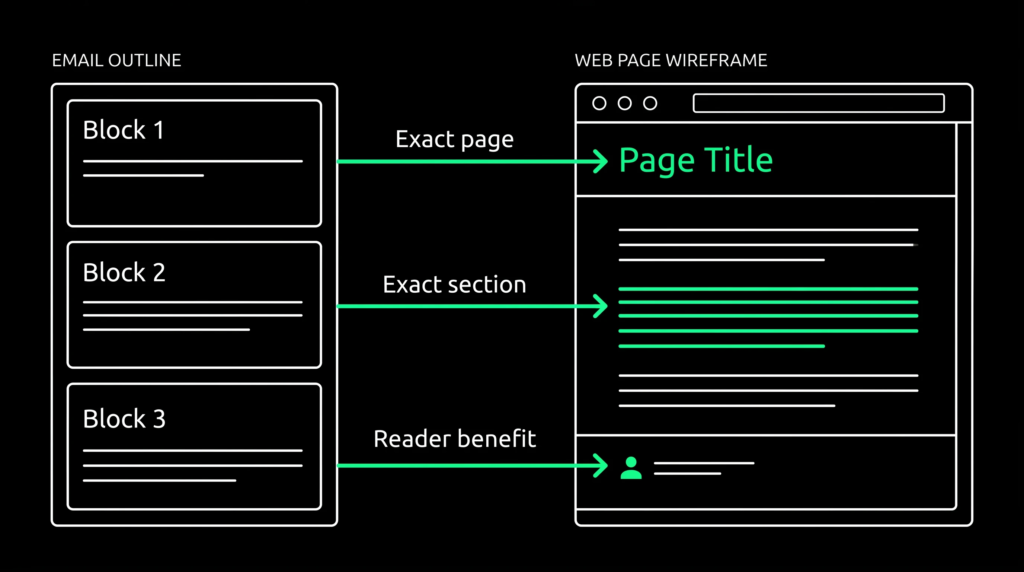
An editor who adds your link on their own terms usually meets that standard without trying. They know their readers, they write in their own voice, and they pick words that fit the sentence. Your template should make that easy by giving three things: the exact page, the exact section where the link belongs, and one line on what readers get when they click.
Why Does Asking for Exact Match Anchor Text Backfire?
Short answer: Requesting a keyword anchor turns an editorial link into something that looks placed. Google names optimized anchor text in guest posts and articles as a link spam example, and a campaign full of identical phrases leaves a pattern that is easy to spot.
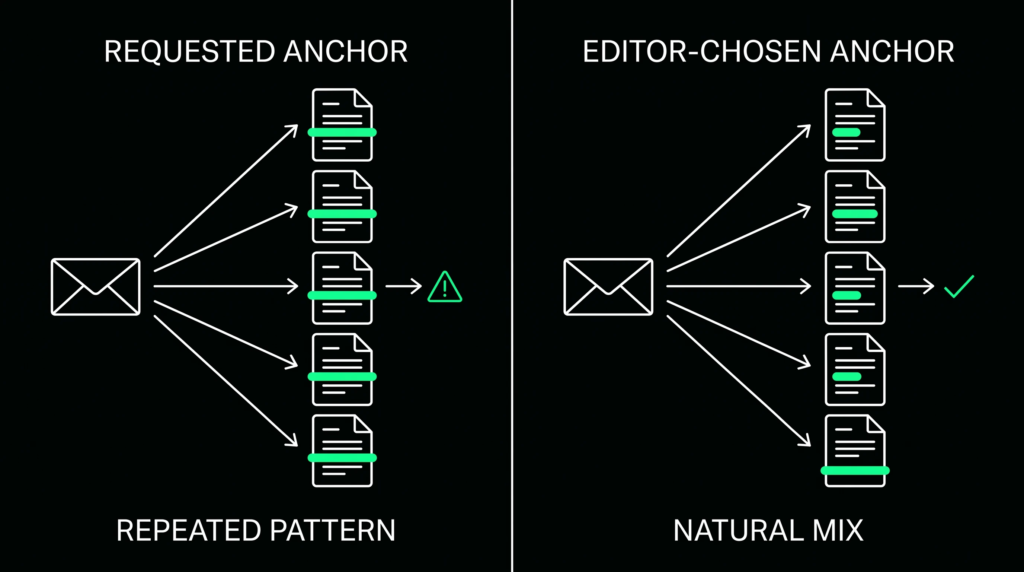
Some popular templates still tell you to suggest the anchor in the email. One agency template for unlinked brand mentions includes a line naming the anchor the sender had in mind, on the logic that it saves the editor a step. It does. It also leaves the same phrase on every site that says yes.
Google’s spam policies list links with optimized anchor text in articles, guest posts, or press releases as an example of link spam, next to buying links and excessive link exchanges. Twenty publishers all linking with one commercial phrase is the exact pattern that rule describes.
There is a practical cost too. Ahrefs points out that for anyone to link to you, they have to read the email, check your content, open their CMS, and edit the page. Every extra instruction adds friction to a favor you are asking from a stranger.
Link Building Outreach Templates You Can Copy
Each template below stays under 100 words, which sits inside the 75 to 150 word range Averi recommends for outreach, and each makes one ask. Replace the bracketed fields with real details. None of them names an anchor.
1. Broken Link Replacement
Subject: Dead link in your [article title]
Hi [First name],
I was reading your piece on [topic] and noticed the link in the [section name] section, the one pointing to [dead resource], now returns a 404.
We published a guide that covers the same ground and adds [one specific thing]: [URL]
If you are updating that section, it could work as a replacement. Either way, the part about [specific point] was useful.
[Your name]
Why it works: the editor already chose the anchor when they first linked the dead page. Swapping the URL usually keeps their original wording.
2. Resource Page Addition
Subject: Possible addition to your [topic] resources
Hi [First name],
Your [resource page name] is one of the better curated lists on [topic] I have found. I noticed it does not cover [specific subtopic].
We put together [resource title], which walks through [one concrete angle]: [URL]
Would it fit alongside the [existing category] links on that page?
[Your name]
Why it works: resource pages tend to use the title of each resource as the link text, which is descriptive by default.
3. Unlinked Brand Mention
Subject: Thanks for mentioning [Brand] in [article title]
Hi [First name],
Thanks for including [Brand] in your article on [topic]. Your point about [specific detail] was spot on.
Readers who want to try what you described might find this page useful: [URL]
If you are open to linking the mention, wherever it reads best is fine with us.
[Your name]
Why it works: the editor will almost always link the brand name they already wrote, and branded anchors carry the lowest risk of any anchor type.
4. Guest Post Pitch With an Editor-Led Link
Subject: Article idea for [publication]: [working title]
Hi [First name],
I read your recent piece on [topic], especially the part on [detail]. I would like to pitch a related article for your readers: [working title].
It would cover [point one], [point two], and [point three], drawn from [your experience or data].
I would include one link to [your site] only where it supports a point, and your team is welcome to reword or remove it.
Interested in an outline?
[Your name]
Why it works: it tells the editor the link serves the article, not the other way around, which is the difference between editorial guest content and the keyword-loaded guest posts Google warns about.
5. Single Follow-Up
Subject: Re: [original subject]
Hi [First name],
Bumping this in case it got buried. [One sentence restating the fit.]
No worries if it is not a match.
[Your name]
Why it works: Ahrefs recommends one polite follow-up and no more, and both Averi and LSEO suggest waiting 5 to 7 business days before sending it.
What Reply and Link Rates Should You Expect?
Short answer: Expect low single digits. A poll of more than 800 people by Ahrefs put average outreach conversion at 1 to 5 percent. Targeted campaigns do better, but prospect quality and sending volume still move results more than clever wording.
When Ahrefs polled more than 800 people on X and LinkedIn about their outreach results, the average conversion rate came back at only 1 to 5 percent. In its own link building case study, Ahrefs sent 515 outreach emails and reported a 17.55 percent reply rate and a 5.75 percent conversion rate.
| Benchmark | Figure | Source |
|---|---|---|
| Average outreach conversion rate (poll of 800+ people) | 1% to 5% | Ahrefs poll |
| Reply rate, 515-email case study | 17.55% | Ahrefs case study |
| Conversion rate, 515-email case study | 5.75% | Ahrefs case study |
| Reply rate target for targeted outreach | 10% to 25% | Averi tracking metrics |
| Link acquisition target, share of emails sent | 3% to 10% | Averi tracking metrics |
| Reply rate for mass-templated outreach | 2% to 5% | Averi FAQ |
Ahrefs is open that its 5.75 percent result benefited from a recognizable brand, so newer sites should plan volume around the lower end of these ranges. The math is simple: 1,000 emails at a 1 percent success rate gets you 10 links. Ahrefs also reports running hyper-personalized campaigns that got no results, and it now favors templates with dynamic variables over fully custom emails.
How Do You Keep Anchor Text Natural Across a Whole Campaign?
Short answer: Track the anchor each publisher actually used, not the one you hoped for. Log it next to the placement, review the mix every month, and if one phrase starts repeating, shift your next pitches toward pages where branded or descriptive wording fits better.
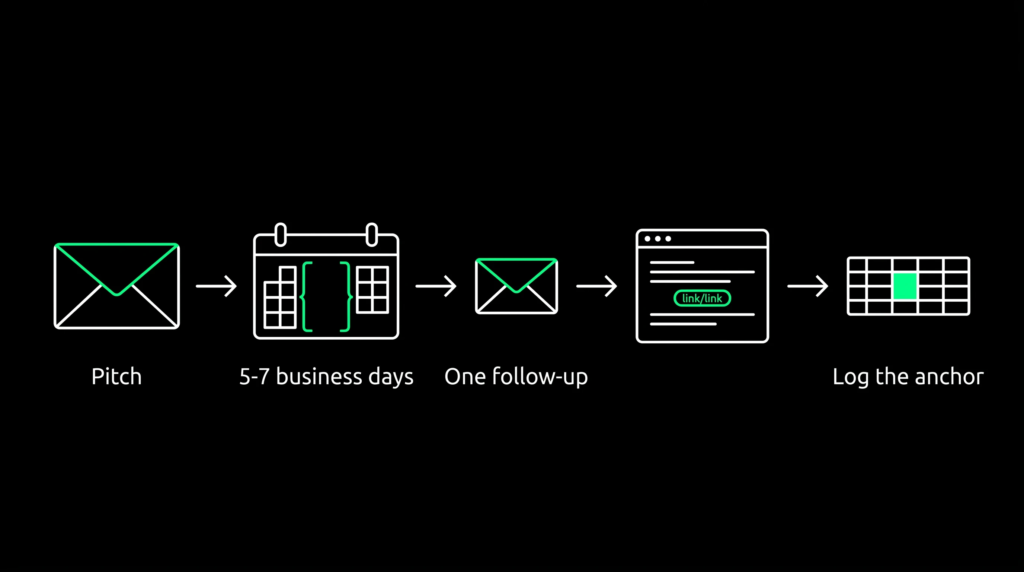
Whatever tracker you use, add an anchor text column next to the prospect, the page where the link sits, the outreach type, and the date. A link placed in a section that actually discusses your topic reads naturally whatever the anchor says, which is one reason link builders pay close attention to topical authority when choosing prospects.
If a publisher asks for payment, Google’s guidance is that paid links should be qualified with rel=”sponsored” or nofollow, so keep those placements out of your editorial outreach numbers. Freako’s link building services run on personalized outreach rather than automated link networks, and every placement is tracked.
Frequently Asked Questions
What is a link building outreach template?
It is a reusable email structure for asking a site owner to link to your content. Good ones keep fields for the prospect’s page, the section where the link fits, and the reason it helps their readers.
Should I suggest anchor text in my outreach email?
Generally no. Point to the section and let the editor write the link. Google lists optimized anchor text in articles and guest posts as link spam, and wording chosen by different editors varies naturally.
How long should an outreach email be?
Short. Averi recommends 75 to 150 words, and Woodpecker suggests subject lines of 6 to 10 words. Every template in this guide stays under 100 words.
How many follow-ups should I send?
One. Ahrefs recommends a single polite follow-up, and Averi suggests waiting 5 to 7 business days. Averi also warns that more than one can hurt your reputation in small niches.
Is it okay to pay for a link if the editor asks?
Google treats buying links for ranking purposes as link spam. Paid placements are acceptable only when marked with rel=”sponsored” or nofollow, so do not count them as editorial links.