
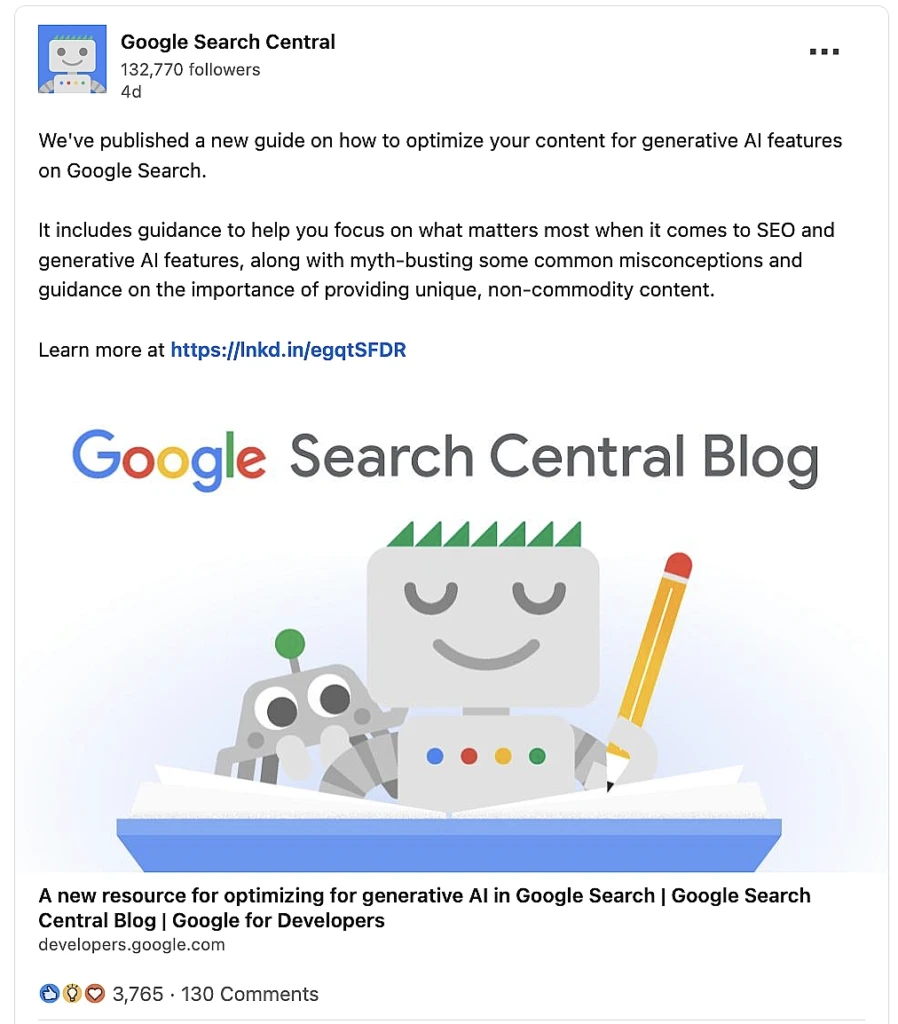
Google published its first official guide to generative AI search optimization on May 15, 2026. The guide, titled “Optimizing your website for generative AI features on Google Search,” was announced by John Mueller through Google Search Central Blog and now lives under a new “Generative AI fundamentals” section in Google’s documentation. It is the most direct statement Google has made about what determines content visibility inside AI Overviews and AI Mode, and it closes the door on a long-running industry debate over whether AEO and GEO require their own optimization playbook.
If you want a practical breakdown of citation mechanics, see our guide on how to get cited by ChatGPT and Google AI Overviews.
What Is Generative AI Search Optimization?
Generative AI search optimization is the practice of structuring, writing, and publishing content so it surfaces inside AI-generated responses on search engines, including Google AI Overviews, AI Mode, and equivalent features on other platforms. According to Google’s May 2026 guide, generative AI search optimization is not a separate discipline from standard SEO. Google states directly: optimizing for generative AI search is optimizing for the search experience, and thus still SEO. AI features inside Google Search are built on the same core ranking and quality systems used to generate traditional results, which means the same foundational practices that produce organic visibility also drive inclusion in AI-generated answers.
What Does Google’s New AI Optimization Guide Actually Cover?
The guide is organized into five areas, each addressing a different dimension of how content performs in AI-generated search features.
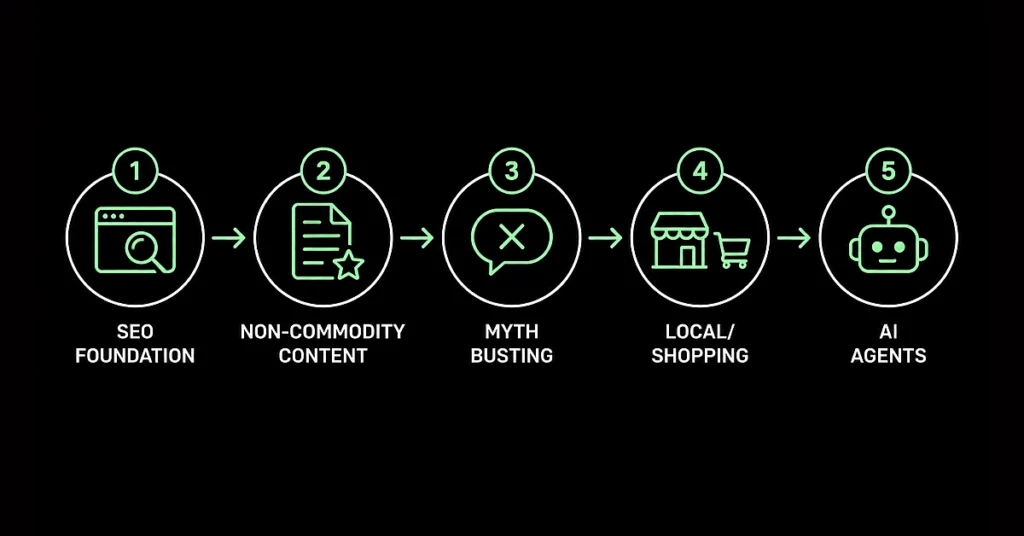
1. Non-Commodity Content as the Core Signal
Google’s primary emphasis is on content that could not be produced by an AI system synthesizing generic web information. The guide positions unique perspective, first-hand experience, and original data as the factors that separate citable content from content that gets passed over. This is consistent with Google’s quality guidance from the past several years, but takes on direct relevance in an AI context because generative systems have already processed most of the generic information on the web. If your content restates consensus, it adds nothing the model does not already have.
2. Local, Shopping, Image, and Video Formats
Google acknowledges that AI features do not operate identically across content formats. The guide includes specific guidance for local businesses, e-commerce listings, and visual content. For businesses whose product prices, hours, or availability change frequently, the gap between live content and the data layer AI features draw from carries direct commercial risk. Google’s inclusion of this section signals that structured, format-specific signals remain important inputs for AI visibility.
3. Mythbusting Common AEO and GEO Tactics
This section names widely circulated tactics that Google says are not necessary for generative AI search inclusion. The guide specifically identifies the following as non-requirements: creating chunked pages designed for LLM consumption, building special schema or Markdown versions of pages, targeting every long-tail sub-query variation an AI might generate, and seeking inauthentic brand mentions to influence what AI systems say about a product or service.
4. AI Agents: New Territory in Google’s Documentation
The guide includes initial guidance on AI agents, which Google describes as a quickly emerging and evolving space. AI agents that complete tasks autonomously on behalf of users create content accessibility requirements that standard SEO guidance has not addressed. Google’s acknowledgment that this is preliminary territory is notable. Whether an AI agent completing a task credits or cites a source website is a different question from whether a user visiting that site found the content useful, and Google’s documentation does not yet resolve this distinction.
Building brand presence across social platforms, a core part of Freako’s social media marketing offering, becomes a complementary visibility channel as agentic search evolves.
5. Why Foundational SEO Still Governs AI Visibility
The guide’s fifth area explains the connection between standard SEO practice and AI search inclusion. Google’s AI features rely on RAG (retrieval-augmented generation) to pull content from the live search index. Content that fails crawlability requirements, carries thin or duplicate signals, or lacks clear topical structure cannot be retrieved for AI response generation regardless of any AI-specific optimization applied on top of it.
| Guide Section | Core Claim |
| Non-commodity content | Unique perspective and first-hand experience drive AI citation over generic summaries |
| Format-specific signals | Local, shopping, image, and video formats each carry distinct signals for AI features |
| Mythbusting | Chunking, special schema, sub-query targeting, and inauthentic mentions are not required |
| AI agents | An emerging area with preliminary guidance; accessibility requirements differ from standard SEO |
| SEO as foundation | AI features rely on the same ranking and quality systems as traditional search results |
What Does This Mean for Content Strategy in 2026?
The practical implication of Google’s guide is that there is no shortcut to AI visibility that bypasses content quality. The tactics that have circulated under the AEO and GEO labels, including question-formatted headers, artificial chunking, and LLM-targeted schema, are not supported by how Google’s systems actually work.
What does work is the same thing that has always worked in search: content that provides specific, verifiable information from a credible source, structured so that both crawlers and humans can extract meaning from it, which is why Freako’s SEO services are built around topical authority and content depth rather than surface-level optimization. For practitioners who have been applying strong topical authority and E-E-A-T principles, this guide confirms rather than redirects their approach. For a full breakdown of how Google evaluates source credibility, see our explainer on what is E-E-A-T in SEO.
For sites that have been chasing AI-specific tactics at the expense of content depth, the guide is a correction. AI Overviews now reach over 2 billion monthly users globally, according to figures Google disclosed during Alphabet’s Q2 2025 earnings report. The scale of AI search surfaces makes visibility in these features commercially significant, which makes quality-first strategy more important, not less.
Mythbusting: What Google Says You Can Ignore
Google’s guide includes a dedicated mythbusting section, the first time the company has formally named AEO and GEO misconceptions in official documentation. The following table summarizes what Google explicitly identifies as unnecessary for generative AI search optimization. For a deeper comparison of how the two frameworks overlap, read our post on Traditional SEO vs GEO.
| Tactic | Google’s Position |
| Creating chunked, LLM-formatted pages | Not required; targeting ranking systems rather than readers |
| Special schema versions for AI features | Not required; standard structured data practices apply |
| Targeting every long-tail sub-query variation | Not required; equivalent to keyword stuffing for AI |
| Seeking inauthentic brand mentions | Not effective; AI features use same spam safeguards as core ranking |
| Writing content specifically for AI scanning | Not required; human-readable quality content performs identically |
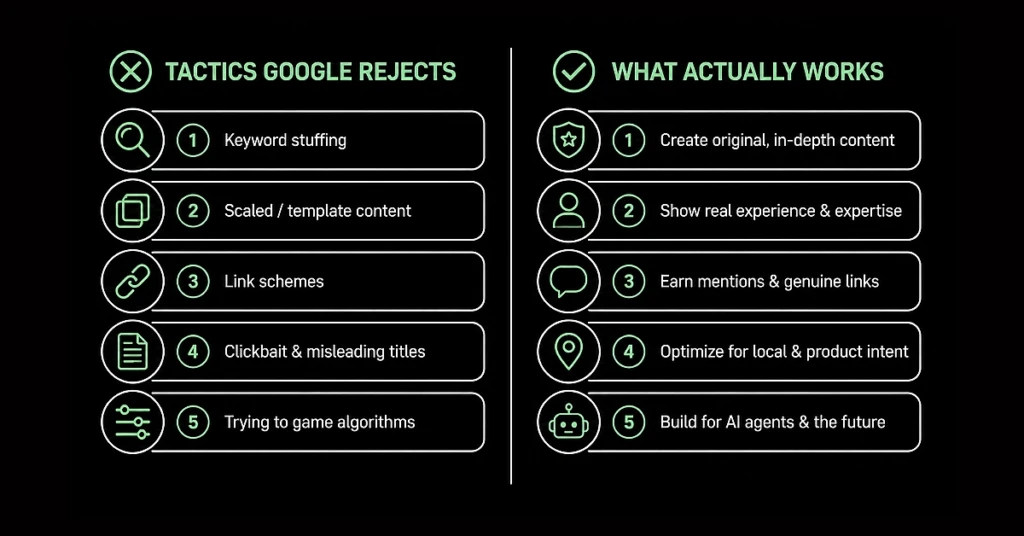
Danny Sullivan, Google’s public Search Liaison, issued a related warning in January 2026, specifically cautioning against content fragmentation designed to optimize for LLM consumption. Google’s view is that such tactics prioritize manipulating the system over serving the reader, and the system is designed to detect and discount that intent.
What Google’s Guide Does Not Address
Two significant gaps remain in the May 2026 documentation. First, Google has not introduced granular controls that let site owners distinguish between traditional search inclusion and AI feature inclusion. Publishers who have requested opt-out mechanisms for AI Overviews specifically, rather than broad noindex or snippet controls, do not have that option from this guide.
Second, the guide does not address the traffic impact of AI features. A Chartbeat study shared with Axios in 2025 found referral traffic from search dropped 60% for small publishers and 47% for mid-sized publishers as AI Overviews expanded. SISTRIX data from March 2026 showed click-through rates at position one collapsing from 27% to 11%. The guide confirms how to get into AI features. It does not resolve whether that visibility translates to the referral traffic that has historically supported publisher business models.
For brands concerned about organic traffic loss, Freako’s performance marketing services offer a paid channel strategy that compensates for reduced referral traffic from AI-driven search.
Frequently Asked Questions
Does Google treat AEO and GEO as separate from SEO?
No. Google’s May 2026 guide states explicitly that from Google Search’s perspective, optimizing for generative AI search is optimizing for the search experience, and is therefore still SEO. The company frames AEO and GEO as informal terms for applying existing SEO principles to an AI search context, not as distinct disciplines with separate requirements.
Do you need special schema markup to appear in AI Overviews?
No. Google’s guide identifies special schema versions of pages as unnecessary for generative AI search inclusion. Standard structured data practices apply. Schema markup improves how Google understands content, and that benefit carries into AI features, but AI-specific schema configurations are not a recognized requirement.
Does content length affect visibility in Google AI Overviews?
Google’s documentation does not identify content length as a direct ranking factor for AI features. The signal is content quality and topical completeness, not word count. Thin content that lacks original perspective performs poorly regardless of length, while dense, specific content that covers a topic with genuine depth performs well at any reasonable length.
Can you block your content from appearing in Google AI Overviews?
Site owners can use standard controls including noindex and max-snippet directives to limit how content is indexed and previewed. However, Google has not introduced a mechanism that specifically excludes content from AI Overviews while allowing it to appear in traditional search results. The May 2026 guide does not change this.
How do AI agents affect SEO content strategy?
Google’s guide acknowledges that AI agents represent an evolving space with preliminary guidance available. Agents that complete tasks on behalf of users create accessibility requirements beyond standard SEO, particularly for e-commerce and local businesses. Whether an agent transaction cites a source differs from whether a user visit occurs. The full strategic implications are still developing as agent behavior matures.