
Brand campaigns are marketing efforts built to increase awareness, recognition, and emotional connection with an audience, rather than to drive an immediate click or sale. For a performance marketer, someone whose job is measured in cost per acquisition and return on ad spend, that framing can feel uncomfortable.
Research from Analytic Partners found that brand marketing outperforms performance marketing on sales and ROI in 80 percent of the cases the firm studied, largely because it shapes the underlying decision to buy rather than the timing of a purchase that performance campaigns tend to capture. That finding matters for anyone managing a marketing budget in 2026, because it reframes brand campaigns as a measurable growth lever rather than a nice-to-have, provided the investment is structured and tracked correctly.
What Is a Brand Campaign, and How Does It Differ From Performance Marketing?
A brand campaign is a marketing effort designed to build awareness, trust, and recall for a company or product over time, using consistent messaging across channels. Performance marketing, by contrast, targets an immediate, trackable action such as a click, lead, or sale. The distinction is one of the most common points of confusion in marketing planning, and getting it right shapes how a budget should be allocated in the first place.
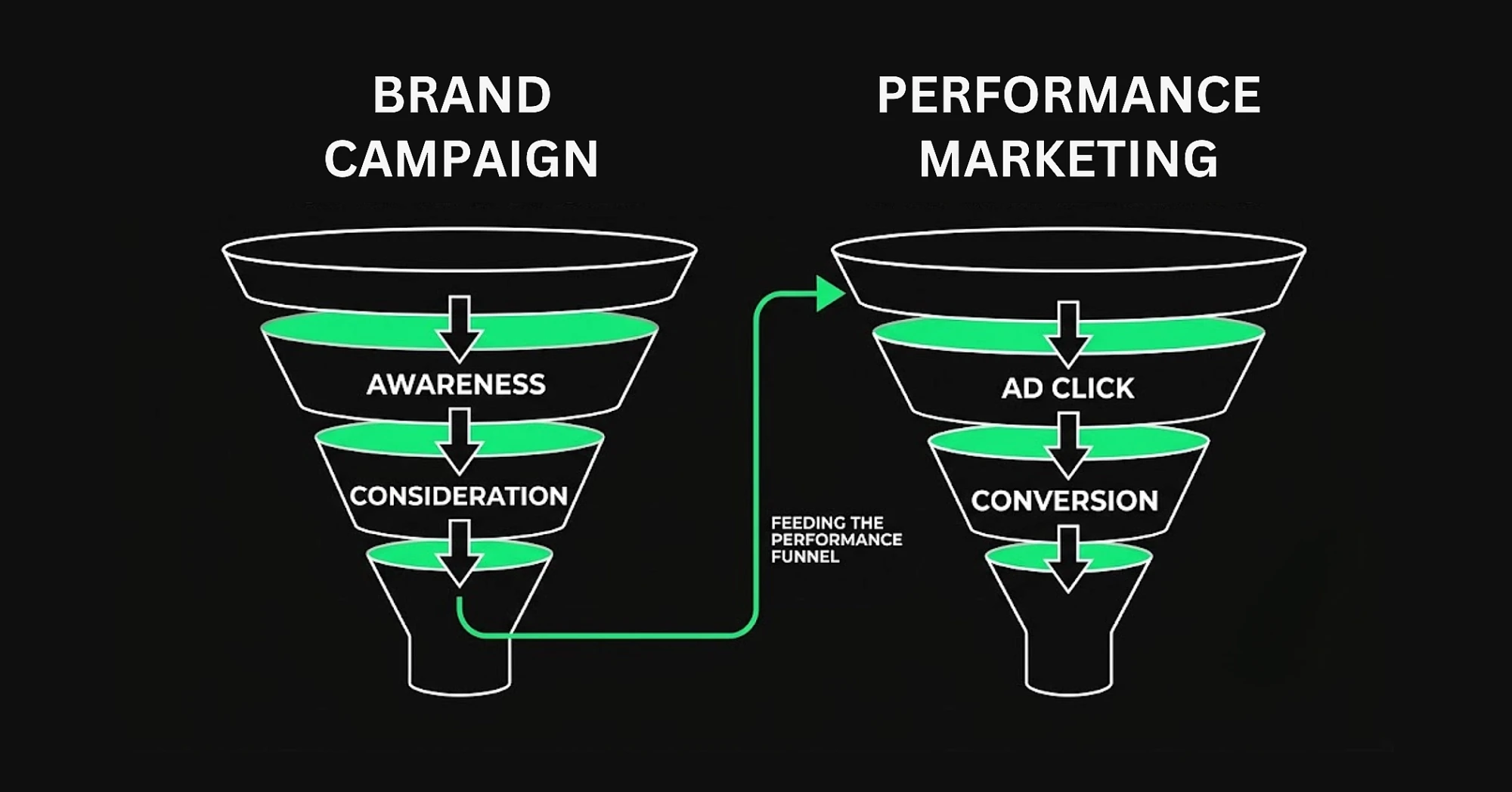
Brand campaigns typically run across TV, streaming and connected TV, out-of-home placements, YouTube, and social awareness formats. The goal is repeated exposure to a consistent message, not a single conversion event. Performance marketing lives in a different set of channels, primarily Google Ads and Meta conversion campaigns, where every dollar is tied to a specific action and reported on a dashboard the same day.
Our team clarifies this split in objectives with every new client before a single ad goes live, through Freako.io’s performance marketing services. A brand campaign judged by next-day conversion rate will always look like it failed, because it was never built to answer that question.
Are Brand Campaigns Worth the Investment?
Yes, when measured over the right time horizon. Brand campaigns rarely produce next-day conversions, but multiple independent studies tie brand investment to higher long-term ROI, lower acquisition costs, and stronger performance marketing results months later.
Les Binet and Peter Field’s research, published in “The Long and the Short of It”, found that a portfolio of individual sales activation campaigns does not add up to the same long-term growth as sustained brand investment. Each activation campaign produces a short sales spike that fades, while brand equity compounds. A statistic often cited alongside this research, from Harvard Business Review, notes that 90 percent of buyers choose a brand they already have in mind before they start actively shopping.
That single number is the strongest practical argument for brand campaigns: if your company is not in the consideration set before the buyer starts searching, performance ads compete for a smaller, more price-sensitive slice of demand.
What Does the Research Say About Brand and Performance Budget Splits?
Most rigorous studies land on a similar range. Roughly 60 percent of budget goes to brand-building and 40 percent to performance activation, though the exact split shifts with budget size, sales cycle length, and category.
| Source | Recommended Brand Allocation | Recommended Performance Allocation | Basis |
|---|---|---|---|
| Les Binet & Peter Field, “The Long and the Short of It” | 60% | 40% | Long-term brand equity growth outperforms short-term activation lifts |
| Noa Consulting / Sveriges Annonsörer | 40-70% | 30-60% | Range varies by category, market maturity, and competitive intensity |
| Analytic Partners, ROI Genome | Not stated as a split | Not stated as a split | Brand marketing outperforms performance marketing on sales and ROI 80% of the time studied |
These are starting benchmarks, not fixed rules. A business launching in a new category with no brand recognition faces a different equation than an established company defending market share, and budget allocation should reflect that. Paid media platforms shift constantly, and keeping performance allocation current with what is changing in Google Ads each year matters just as much as the brand and performance split itself.
How Do Brand Campaigns Improve Performance Marketing Results?
Strong brand recognition lowers cost per click, raises conversion rates on performance ads, and reduces reliance on discounting, because audiences already trust the company before they see a direct-response offer.
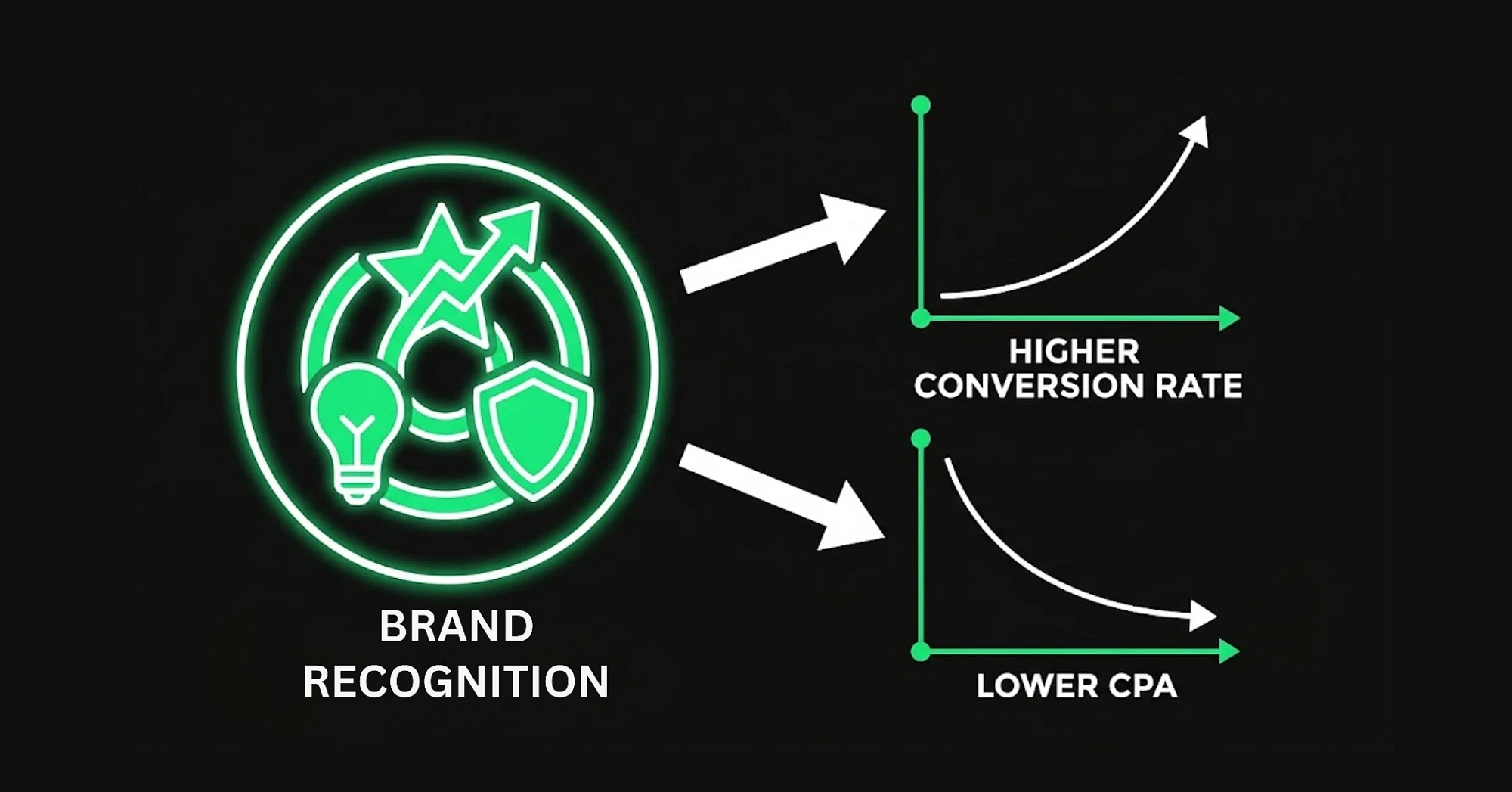
System1 Group’s Multiplier Effect research, conducted with WARC, found that brand equity acts as a force multiplier on performance marketing: lower acquisition costs because recognized brands earn more clicks and trust, higher conversion rates because familiarity reduces friction, and greater pricing power because customers pay a premium for brands they already respect. This explains a pattern we see often when auditing new client ad accounts: targeting is accurate and creative is solid, yet cost per acquisition stays stubbornly high.
Frequently the missing variable is not the campaign structure, it is that the brand has no existing recognition to lean on, a gap that shows up as clicks without conversions in the funnel gap behind underperforming paid ads.
When Should a Business Prioritize Brand Campaigns Over Performance Campaigns?
Smaller budgets tend to favor performance marketing first, because it produces trackable results that justify further spend. Larger budgets create room for both brand-building and performance tactics running in parallel, and long B2B sales cycles benefit disproportionately from early brand investment.
An early-stage company with a limited budget usually needs performance marketing to generate revenue and prove the offer works before it can justify a brand campaign with a longer payback window. Once that foundation exists, shifting a portion of budget toward brand-building compounds the performance results already in motion rather than replacing them. For businesses without the budget for TV or out-of-home, a well-run social media presence is often the most affordable entry point into brand-building, since it builds recognition without the production costs of traditional brand media. This is also where budget discipline matters most.
Teams that chase short-term performance metrics without reserving spend for brand tend to hit a ceiling, a pattern that shows up as one of the more common ways marketing budgets get leaked without anyone noticing.
How Can You Measure the ROI of a Brand Campaign?
Track branded search volume, direct traffic, share of voice, and assisted conversions using a marketing efficiency ratio, rather than judging brand spend by last-click attribution alone, since brand touches rarely appear as the final conversion event.
Last-click reporting systematically undercounts brand marketing because it only credits the final touchpoint in a customer journey, not the earlier brand impression that built trust and consideration. A more accurate approach measures total marketing spend against total revenue over a defined period, known as the marketing efficiency ratio, rather than isolating each channel’s individual ROAS. Combine that with branded search volume tracking, since a rising trend in searches for your company name is one of the clearest signals that a brand campaign is working even when it never shows up as a direct conversion.
For companies serious about connecting brand lift to organic performance, this is also where SEO tracking and brand campaign reporting should sit in the same dashboard, not separate ones.
Frequently Asked Questions
Do brand campaigns work for small businesses?
Yes, but scale matters. Small businesses typically see better early results from a lighter, consistent brand presence, such as recognizable social content and a clear visual identity, rather than large TV or out-of-home spends built for national reach.
How long before a brand campaign shows measurable results?
Most research points to a window of several months to a year before brand campaigns produce a measurable shift in metrics like branded search volume, direct traffic, or assisted conversions. Judging a brand campaign after two or three weeks will almost always understate its impact.
What is the ideal budget split between brand and performance marketing?
Research from Binet and Field, along with Noa Consulting, points to roughly 60 percent brand and 40 percent performance as a reasonable starting benchmark, adjusted for budget size, category, and how established the brand already is.
Can brand campaigns be tracked like performance campaigns?
Not with the same precision. Brand campaigns can and should be measured, but through indicators like branded search growth, share of voice, and marketing efficiency ratio rather than last-click attribution, which was built to measure direct-response activity.