
Google Ads in 2026 has shifted from a manually managed bidding panel into an AI-run decision system, where automation handles auction-level choices and advertisers shift attention to strategy, data quality, and creative input. The clearest signs of this shift are AI Max for Search, an expanded Performance Max with stronger reporting controls, Demand Gen’s rise as a mid-funnel channel, and Gemini-powered ad formats announced at Google Marketing Live 2026 that place ads directly inside AI Mode conversations. Advertisers who adapt their account structure and conversion data now will use these systems well. Those still running 2023-era campaign setups will see results grow less predictable as the gap between AI-fluent accounts and legacy accounts widens. Getting this right is now a core part of any performance marketing strategy, not a side experiment.
What Is Driving Change in Google Ads in 2026?
The core driver behind Google Ads changes in 2026 is the platform’s move from optional automation to default automation across nearly every campaign type. Smart Bidding, AI Max, Performance Max, and Demand Gen now make most auction-level decisions, while advertisers focus on strategy and signal quality instead of manual bid adjustments.
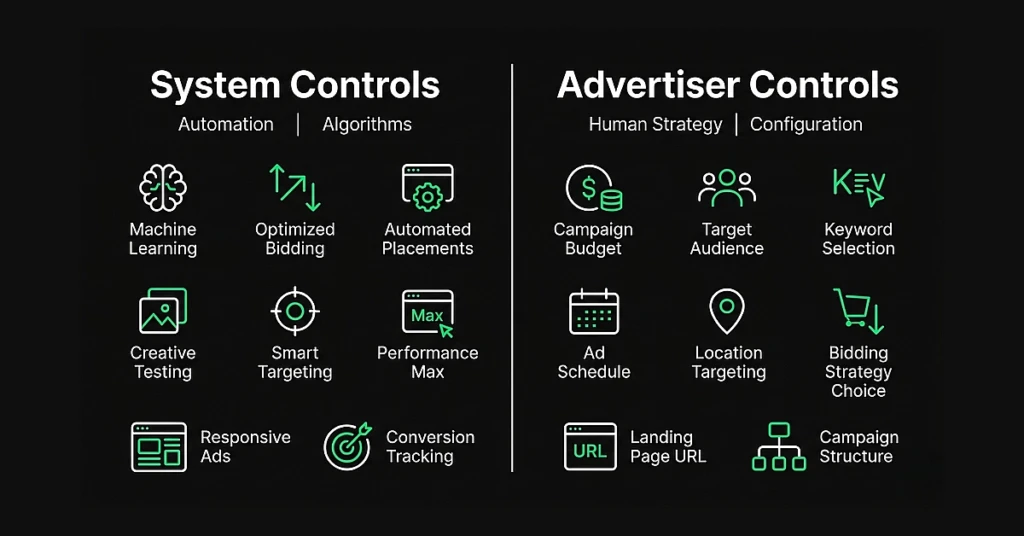
For most of Google Ads’ history, a specialist’s job was to manage bids and exclude poor placements one by one. That workflow has largely disappeared, with industry coverage describing this period plainly: manual settings becoming the exception rather than the rule across nearly every account. Bidding algorithms now evaluate the conversion probability of nearly every impression in real time, weighing thousands of signals no human could track manually across multiple ad surfaces at once. The system controls bid adjustments by device and location, along with creative and placement combinations, while the advertiser still controls campaign strategy, conversion definitions, and creative direction.
This does not mean specialists have less to do. An account manager who spends hours adjusting bids by hour of day adds little value anymore. One who defines clean conversion events and feeds the algorithm strong creative assets is doing the work that moves performance in 2026.
What Is AI Max for Search and How Does It Work?
AI Max for Search is Google’s newest Search campaign expansion, layering AI-generated ad copy and broad URL targeting on top of existing Smart Bidding. It lets Google write headline combinations from a site’s content and route clicks to whichever page it judges most relevant, not just the URL set in the ad group.
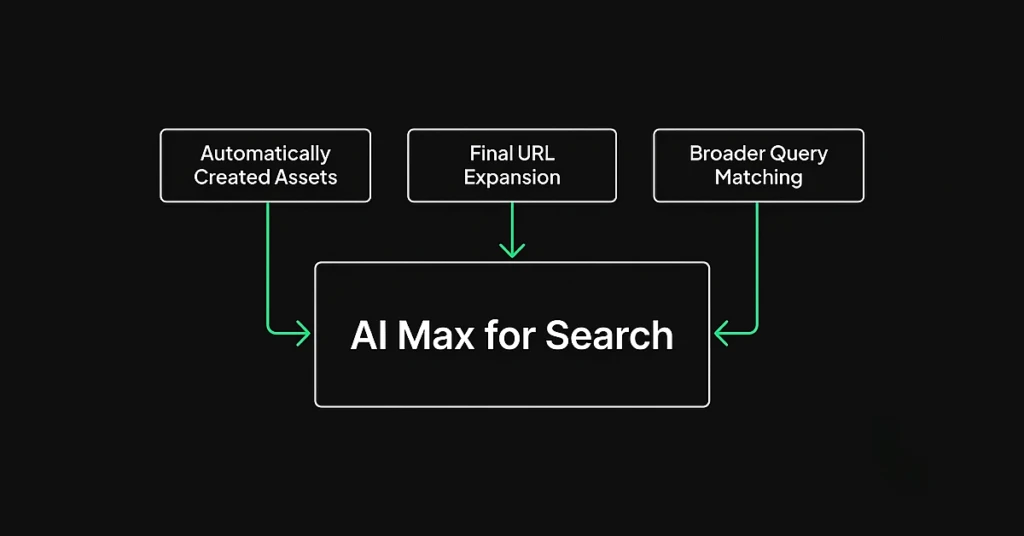
AI Max extends two capabilities once exclusive to Performance Max into standard Search campaigns. The first is automatically created assets, where Google generates extra headlines from landing pages and existing ads, then runs them alongside anything an advertiser pins in place. The second is final URL expansion, where Google can override an ad’s destination and send the click to a different page on the same domain if it predicts better conversion. A third component, broader query matching, surfaces incremental search volume beyond the keyword list, though it raises the risk of irrelevant traffic without active negative keyword management. Left unmanaged, this kind of broad matching is a common path to clicks but no conversions.
Advertisers getting strong results pin their primary value proposition into the first headline position so it appears in every generated combination, while letting the algorithm fill the rest. Restricting URL expansion to a defined set of converting pages, and building a negative keyword list before turning on automatically created assets, has become a common safeguard. Many run AI Max alongside standard responsive search ads for a testing period, comparing cost per acquisition before consolidating budget toward the winner.
How Is Performance Max Changing in 2026?
Performance Max in 2026 is gaining the reporting transparency advertisers asked for in earlier years, including campaign-level negative keywords, placement reports, and brand exclusion lists, while remaining the fastest-growing share of Google Ads spend for most advertisers.
PMax adoption has moved from a minority tactic to a default one. Among more than 170 surveyed agency and in-house advertisers, the share running PMax rose from 60% in 2024 to 71% in 2025, according to Fluency’s 2026 benchmark report. PMax’s share of total ad spend across Fluency’s client base climbed from 6.7% to 19.9% over the same period, nearly a threefold jump in a single year.
| Metric | 2024 | 2025 | Change |
| Advertisers using PMax | 60% | 71% | +18% |
| PMax share of total ad spend | 6.7% | 19.9% | +19 points |
| PMax impressions (Fluency clients) | not tracked | 51.1 billion | n/a |
| Search impressions (Fluency clients) | not tracked | 7.8 billion | n/a |
| Advertisers using Shopping Ads | 32% | 40% | +25% |
| Shopping Ads average conversion rate | 10.9% | 15.3% | +40% |
Source: Fluency 2026 Trends and Performance Benchmarks for Google Ads and Meta Ads.
The volume gap is now substantial, with PMax generating 51.1 billion impressions across Fluency’s client base in 2025 compared to 7.8 billion for Search campaigns. A useful counterpoint is that Shopping Ads spend fell 20% over the same period while average conversion rate rose 40%, suggesting advertisers are using PMax for top-of-funnel discovery while pulling Shopping budget toward a smaller set of higher-intent placements.
What Role Does Demand Gen Play in a 2026 Media Mix?
Demand Gen has become one of the most underused channels in Google Ads despite strong mid-funnel performance, running across YouTube In-Feed, YouTube Shorts, Gmail, and Discover to reach users in a browsing mindset rather than an actively searching one. Spend on the format grew 192% year over year among Fluency’s client base, the fastest-scaling segment in their portfolio. It replaced the older Discovery campaign type and differs from standard Display in one key way: intent layering. Rather than relying purely on contextual placement, it applies Google’s interest and behavioral signals to target users with a higher likelihood of converting, a logic closer to lookalike audience modeling than traditional Display targeting.
YouTube Shorts is a meaningful part of this growth, generating over 70 billion daily views, with Demand Gen one of the few formats that can place conversion-focused ads inside that surface rather than treating it as awareness-only inventory. Advertisers running it successfully keep it separate from Search and PMax budgets and exclude existing customers so spend focuses on net-new acquisition.
What New Ad Formats Did Google Announce at Google Marketing Live 2026?
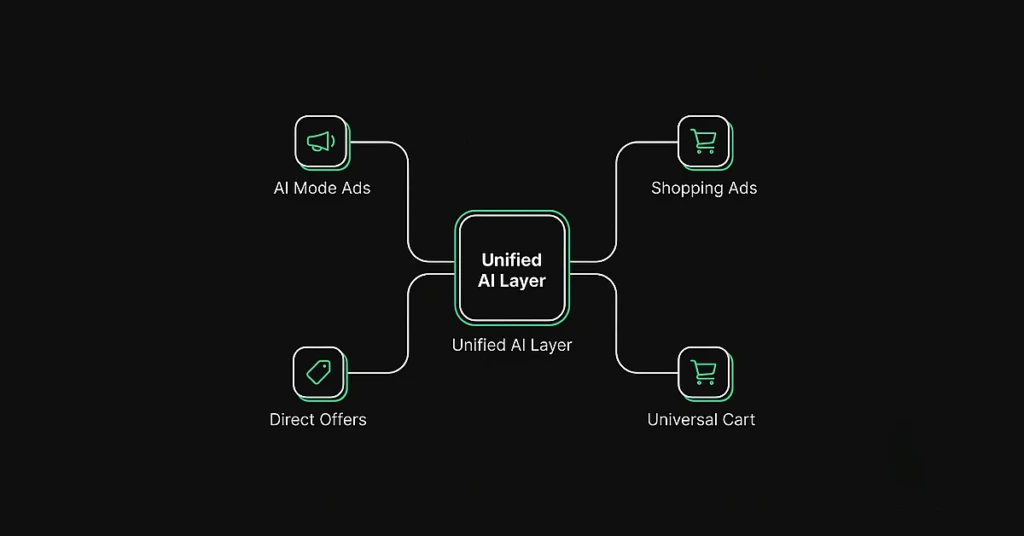
Google Marketing Live 2026 introduced Gemini-powered ad formats that appear directly inside AI Mode search results, alongside an expanded Direct Offers program and a new Qualified Future Conversions metric meant to measure value beyond the immediate click. The organizing theme was integration: rather than announcing isolated features, GML 2026 focused on connecting ad formats, checkout, and measurement under one AI layer spanning Search, Shopping, and YouTube.
Conversational Discovery ads appear as a native part of an AI Mode response rather than a separate slot above or below it. Gemini matches ad creative to both the query and the surrounding AI-generated answer, so a search for home fragrance ideas might surface an ad written to read like part of the response. A related format, Highlighted answers, lets a business appear directly inside a curated recommendation list, such as a search for the best apps for learning a language before a trip, rather than in a separate ad placement.
Google also introduced Gemini-written Shopping ad descriptions that respond to specific attributes a shopper searched for, and Business Agent for Leads, which embeds an AI agent inside an ad that can answer questions using the advertiser’s own site content before the user submits a pre-filled lead form. Google is testing the latter in education, automotive, and real estate.
Direct Offers, which launched as a pilot in January 2026, gained native checkout through Google’s new Universal Commerce Protocol, an open standard that lets inventory, pricing, and loyalty data flow between merchants and Google surfaces without custom integrations. The protocol also underpins Google’s new persistent Universal Cart.
How Should Advertisers Treat Conversion Data in 2026?
Clean conversion data has become the single largest competitive advantage in Google Ads, because every Smart Bidding decision is only as accurate as the signals behind it. This lines up with practitioner reporting on clean, well-structured data becoming the deciding factor in 2026 account performance.
A strong data foundation includes clearly defined primary conversions that represent genuine purchase or lead intent, enhanced conversions that fill gaps created by privacy restrictions, and value-based bidding that prioritizes profitability over raw volume. An account feeding the algorithm vague or inflated conversion events will see the system optimize toward outcomes that look good in a dashboard but fail to produce real revenue. This is one of the quieter reasons a marketing budget is leaking long before anyone notices the spend isn’t translating into sales. Accounts with accurate tracking see compounding returns instead, as competition for the same automated systems intensifies.
Why Does Human Strategy Still Matter When AI Runs the Auctions?
Human strategy matters more in 2026, not less, because the more powerful automation becomes, the more expensive a poor strategic decision gets. AI can optimize bids and creative combinations with precision, but it cannot define what counts as a valuable customer or catch when a campaign performs well on paper while quietly damaging brand perception. The advertisers seeing strong results use AI for what it does well, generating creative variations and reallocating budget in real time, while keeping firm control over campaign types, conversion definitions, and brand tone. Specific value messaging, like a stated turnaround time or a named certification, consistently outperforms generic promotional copy across AI-driven placements. Advertisers looking to reduce how much of this strategy rests on auction costs alone are increasingly pairing paid campaigns with dedicated SEO services to build a second, compounding growth channel.
Frequently Asked Questions
Is manual bidding still useful in Google Ads in 2026?
Manual bidding is now limited to brand keyword campaigns and small tests where a specialist needs full visibility into bid behavior. For nearly everything else, Smart Bidding strategies like target CPA and target ROAS outperform manual adjustment by processing far more real-time signals than a person can track.
Does AI Max for Search replace standard responsive search ads?
AI Max extends responsive search ads rather than replacing them, adding automatically created assets and URL expansion on top of existing Smart Bidding. Many advertisers run both formats in parallel during a testing period to compare results before shifting budget toward the stronger performer.
How is Performance Max different from Demand Gen?
Performance Max spans Search, Shopping, Display, and YouTube simultaneously to find converting audiences across Google’s ecosystem. Demand Gen is a dedicated mid-funnel channel focused on YouTube, Gmail, and Discover, built for reaching people who are browsing rather than actively searching.
What is the Universal Commerce Protocol in Google Ads?
The Universal Commerce Protocol, or UCP, is an open standard tied to Google Marketing Live 2026 that lets merchants, payment providers, and AI agents share inventory, pricing, and loyalty data without custom integrations. It underpins Google’s Universal Cart and the native checkout expansion within Direct Offers.
Why is clean conversion data more important in 2026 than in previous years?
A larger share of Google Ads decisions, including bids and creative selection, are now made automatically by algorithms that learn entirely from the conversion signals an advertiser provides. Inflated or poorly defined conversion events teach the system to optimize toward the wrong outcomes.