
User-generated content, or UGC, is any photo, video, review, social post, or piece of writing about a brand that a customer, fan, or employee creates instead of the brand’s own marketing team. It has become one of the fastest-growing categories in digital marketing because it offers something advertising cannot fake: a real person’s unscripted experience with a product.
Analyst estimates for the global UGC platform market vary widely, from roughly 7 billion to more than 12 billion dollars in 2026 depending on the research firm, but every major forecast agrees the category is expanding at a compound annual growth rate above 20 percent. This guide covers what UGC actually means, how it differs from influencer marketing, the formats it takes, the data behind why it converts, and the steps to build a program that supports search, social, and paid media at the same time.
What is User Generated Content (UGC)?
User-generated content is any content, such as a photo, video, review, or social post, created by a real customer or user rather than by a brand’s own team, and shared on a public platform such as social media, a review site, or a product page.
The term covers a wide range of formats: a five-star review left on a product page, an unboxing video posted to TikTok, a customer photo tagged in an Instagram story, or a detailed answer in a product Q&A section. What separates UGC from every other type of marketing content is authorship. The moment a brand’s employee writes, edits, or stages the piece, it stops being user-generated and becomes branded content instead.
This distinction matters because authenticity is the entire value proposition. Shoppers have become highly skilled at spotting polished advertising, and that skepticism has pushed trust toward peer recommendations. A customer’s honest post about a product carries a kind of credibility that no amount of production budget can buy, which is why UGC now sits at the center of most modern marketing strategies rather than at the edge of them.
How is UGC Different From Influencer Marketing?
UGC is content created for a brand’s own channels, usually by a customer acting without pay, while influencer marketing is paid promotion posted on the influencer’s own channels to their existing audience. The two overlap when brands hire UGC creators, but distribution and ownership remain different.
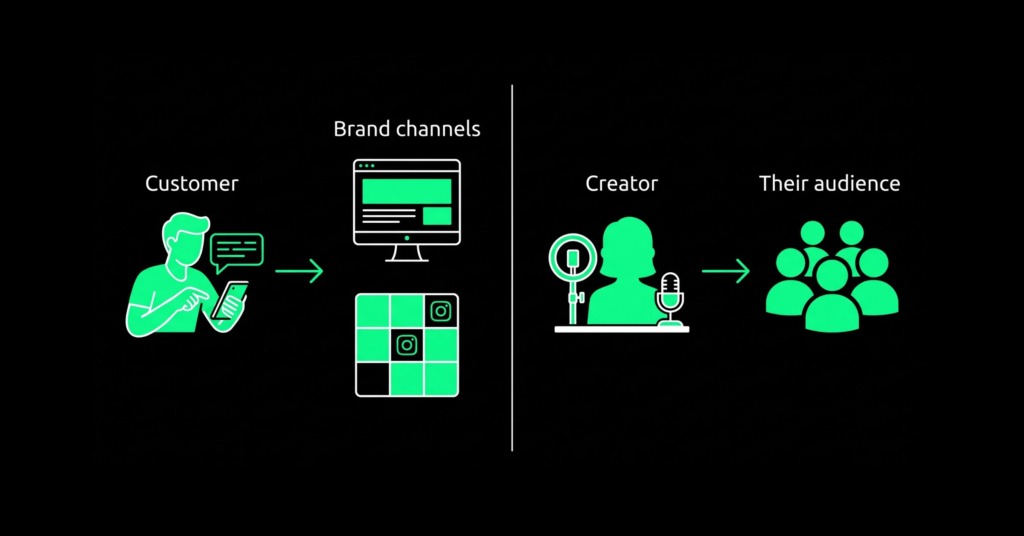
The confusion between these two categories is common because both involve outside creators, and both can involve payment. The clearest way to separate them is to ask two questions: who owns the content, and where does it get posted?
| Factor | User-Generated Content | Influencer Marketing |
| Who creates it | Customers, fans, employees, or hired UGC creators | Creators with an established following |
| Where it’s posted | The brand’s own website, social pages, and ads | The creator’s own social channels |
| What you’re paying for | The content itself and usage rights (if paid) | Access to the creator’s audience |
| Typical goal | Authentic proof to place on owned channels | Reach and awareness through borrowed trust |
Many brands run both at once. UGC keeps owned channels and ad accounts stocked with content that reads as authentic, while influencer partnerships put that same message in front of a new, warmed-up audience. A hired UGC creator who films a product demo but never posts it themselves is producing UGC, not influencer content, because the brand owns and distributes the asset.
What are the Main Types of User-Generated Content?
The main types of UGC are written reviews and ratings, customer photos, customer videos, social posts that tag or mention a brand, and community Q&A responses. Each format serves a different stage of the buying journey, from research to final purchase decision.
- Reviews and ratings: star ratings and written feedback on a product page or third-party site such as Google or G2, often the first UGC format shoppers encounter.
- Customer photos: real-world shots of a product in use, commonly collected through a branded hashtag or a photo upload field on the product page.
- Customer videos: unboxings, demos, and before-and-after clips, which tend to convert well because they show the product functioning outside a studio setting.
- Social posts: organic mentions or tags on platforms such as Instagram, TikTok, and X, whether solicited through a campaign or posted spontaneously.
- Questions and answers: community-submitted product questions and peer answers, which double as long-tail search content on the product page itself.
Most mature UGC programs pull from at least three of these five formats at once, since relying on a single type limits both the volume of content collected and the range of buying-journey moments it can support.
Why Does User-Generated Content Work So Well?
UGC works because it functions as digital word of mouth at scale. It builds trust faster than branded advertising, increases on-page engagement, lifts conversion rates, keeps content costs low, and gives brands direct insight into how customers actually use their products.
The performance gap between UGC and brand-produced content shows up consistently across independent research, even though exact figures vary by study and industry:
| Benefit | Supporting Data Point |
| Builds trust | Roughly 9 in 10 consumers say they trust recommendations from other people over branded content [ugc statistics] |
| Drives engagement | UGC posts have been shown to generate close to seven times more engagement than brand-created posts |
| Lifts conversion | Products with just five reviews are about 270 percent more likely to be purchased than products with none [Medill’s report] |
| Increases purchase intent | A large share of shoppers say they are more likely to buy a product they discovered through UGC |
| Keeps costs down | Sourcing content from real customers avoids the cost of a full studio shoot or paid campaign for every asset |
There is also a widening execution gap worth flagging for any marketing team weighing whether to invest here: most brands already use some UGC, yet only a small fraction have a documented, repeatable strategy behind it. That gap is where the real opportunity sits, because a structured program consistently outperforms a one-off hashtag campaign that fizzles out after a few weeks.
Fresh, customer-written language also carries a secondary benefit that is easy to overlook: it adds a steady stream of entity-rich, naturally worded text to product pages, which helps both traditional search engines and AI answer engines understand what a product actually does and who it works for.
What are Some Real Examples of UGC Campaigns?
Strong UGC campaigns give customers a clear, low-friction reason to participate. GoPro’s award challenges, Rare Beauty’s daily routine hashtag, Calvin Klein’s dedicated hub, and Lego’s idea-submission community each show a different collection method built around the same principle.
- GoPro runs seasonal awards challenges that invite customers to submit their best raw footage for a share of a prize pool, turning everyday users into the source of the brand’s top-performing YouTube content.
- Rare Beauty built the hashtag #rareroutine around unfiltered “get ready with me” videos, encouraging fans to share honest product applications rather than polished tutorials.
- Calvin Klein created a dedicated #MyCalvins hub that pulls customer photos directly onto a branded landing page, giving shoppers a wider range of real bodies and styles than a studio shoot could produce alone.
- Lego’s Ideas community lets fans submit and vote on future product concepts, which doubles as free product research while making participants feel like co-creators of the brand.
- Asics collects fan photos through the hashtag #soundmindsoundbody, turning a single searchable tag into an ongoing library of real-world product shots from around the world.
None of these campaigns required an enormous budget. What they share is a specific, repeatable ask (a hashtag, a challenge, or a submission hub) rather than a vague hope that customers will post about the brand on their own.
How Do You Build a UGC Strategy?
A UGC strategy needs a defined goal, a chosen set of content types and collection channels, a simple campaign hook, an approval and rights workflow, a distribution plan, and a way to measure results, so the program runs as a repeatable system rather than a one-time push.
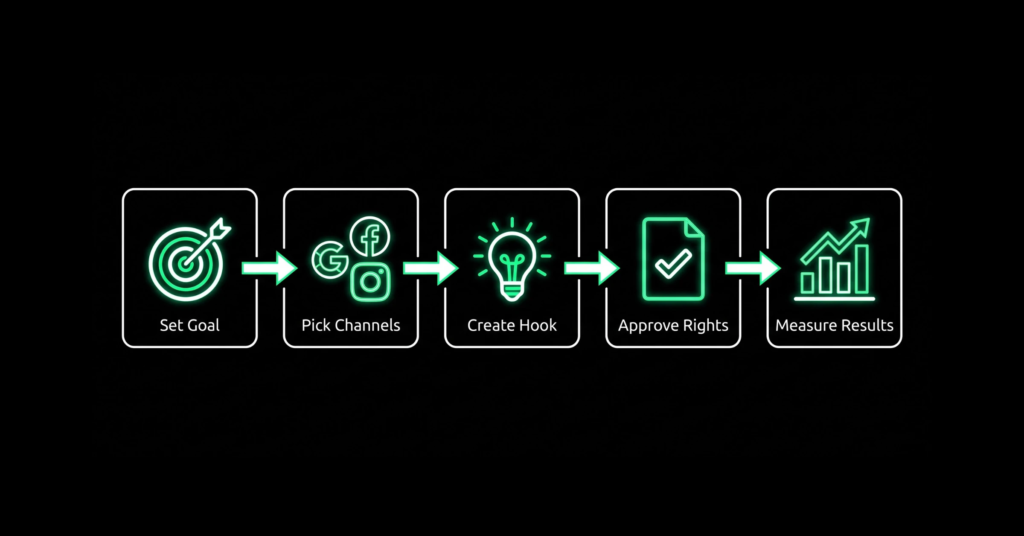
- Set one primary goal per campaign, such as conversion on a specific product page, awareness on a new channel, or a lower cost per acquisition in paid ads.
- Choose content types that match that goal. Conversion campaigns typically need product-in-use photos and short demo videos; awareness campaigns need shareable, personality-driven video.
- Pick two or three collection channels rather than trying to run every option at once, whether that’s tagged social posts, post-purchase review requests, or a submission form on the website.
- Create a short, memorable hashtag or campaign hook and place it everywhere a customer might see it: social bios, packaging, order confirmation emails, and in-store signage.
- Build a documented approval workflow that covers who reviews submissions, who requests permission, and where approved assets are stored before anything goes live.
- Distribute each approved asset across more than one channel, such as a product page, an email campaign, and a paid ad, as long as the usage rights cover every placement.
- Track UGC performance separately from branded posts so engagement rate, click-through, and conversion can be compared directly, then double down on whatever format performs best.
Hootsuite’s seven-step UGC strategy framework covers this same sequence in more operational detail, including how to route submissions through a legal or brand review step before publishing. If your team doesn’t have the bandwidth to run this across every channel at once, dedicated social media marketing support can keep the collection and distribution engine running instead of stalling out after the first campaign.
What Legal and Ethical Rules Apply to Using UGC?
The person who created the content owns the copyright, not the brand it features. A tag or hashtag does not transfer any rights, so brands need explicit permission before reposting, plus clear disclosure whenever payment, free product, or any other value changed hands.
- Get written permission naming the specific channels, formats, and time period the content will be used for. A comment reply or a verbal yes is not enough for paid placements.
- Disclose any paid relationship clearly, following the FTC endorsement guides, whenever a creator was compensated, gifted product, or given anything else of value.
- Check each platform’s terms of service before resharing or embedding content, since resharing rules differ between networks.
- Secure a model release if a recognizable person other than the creator appears in the content, with extra care and parental consent required for anything featuring minors.
- Confirm licensing on any trending audio or third-party asset before boosting UGC as a paid ad, since organic-post licenses often do not cover paid use.
- Document a lawful basis for collecting personal data from EU or UK submissions and give creators a clear way to withdraw consent, in line with GDPR.
The safest structure is a single documented permission step built into the workflow that captures consent, scope, and duration for every asset before it goes live, with legal review added for anything running in a large paid campaign.
What UGC Trends Should Marketers Watch in 2026?
The biggest shifts in 2026 are AI-assisted curation rather than AI-fabricated testimonials, UGC moving into shoppable product tags, short-form vertical video becoming the default format, and UGC-style creative taking over as the primary asset in paid social campaigns.
- AI-assisted curation: teams now use AI to surface, tag, and sort large volumes of mentions, though fabricating fake customer testimonials with AI remains a reputational and regulatory risk not worth taking.
- Shoppable UGC: customer photos and videos are moving directly into product pages and social storefronts with tagged products attached, shortening the path from proof to checkout.
- Short-form video by default: vertical, sound-on clips with a hook in the first few seconds are now the baseline format customers reach for first.
- UGC as paid ad creative: a growing share of marketers now run customer-style content as their primary ad creative because it blends into the feed better than a polished video.
That last trend is worth testing directly rather than assuming. Structured creative testing on Meta Ads is the fastest way to find out whether a UGC-style clip actually beats a polished video for a given audience before committing real budget to it. Because fresh, entity-rich customer language also feeds Google’s semantic ranking systems, pairing a UGC program with ongoing SEO services helps that content get indexed and discovered instead of sitting unseen on a single hashtag feed. UGC-driven brand campaigns also tend to post stronger cost-per-result numbers than fully produced creative, which is one reason teams running performance marketing now test UGC-style ads first rather than last.
Frequently Asked Questions
What is an example of user-generated content?
A customer posting an unboxing video on TikTok, leaving a five-star review on Google, or sharing a tagged product photo on Instagram all count as UGC. Brands such as GoPro, Lego, and Calvin Klein have each built entire campaigns around exactly this kind of customer content.
Do you need permission to use someone’s UGC?
Yes. The creator holds the copyright even if they tagged the brand or used a branded hashtag, so reposting or repurposing the content without explicit permission can expose a brand to copyright claims. Written permission naming the intended channels and duration is the safest approach.
Is UGC the same thing as influencer marketing?
No. UGC creators make content for a brand’s own channels, usually without an existing audience of their own, while influencers post to their own following. Brands are buying content and usage rights with UGC, and buying audience access with influencer marketing.
Can UGC actually improve SEO?
Fresh, naturally worded customer text, such as reviews and Q&A answers, adds unique content to product pages that can support keyword coverage and give search engines more entity-rich signal than static brand copy alone. It works best alongside, not instead of, a dedicated content and technical SEO plan.
How much does a UGC program typically cost compared to produced content?
Organic UGC costs little beyond the time spent on collection, moderation, and outreach, since customers create it without payment. Paid UGC, where a brand hires a creator for a flat fee per asset, still tends to cost far less than a full studio shoot while offering usage rights the brand controls.