
Most SaaS companies treat social media the way they treat a press release: post once, hope someone cares, move on. That approach produces low engagement, no pipeline, and a lot of wasted content hours. A real SaaS social media strategy is structured around one purpose: moving the right people from problem-aware to product-aware on platforms they already use every day.
This guide covers how to build that strategy from scratch: which platforms to prioritize, what content actually performs in B2B software markets, how to structure a content calendar, and how to measure whether any of it is working.
What Makes SaaS Social Media Different From Other Industries?
SaaS social media strategy differs from consumer or retail marketing because the product is intangible, the sales cycle is long, and the buyer is rarely a solo decision-maker. Unlike a physical product, a SaaS tool cannot be photographed on a shelf or shown in an unboxing video. The job of social content is to make an invisible product feel concrete, credible, and worth evaluating.
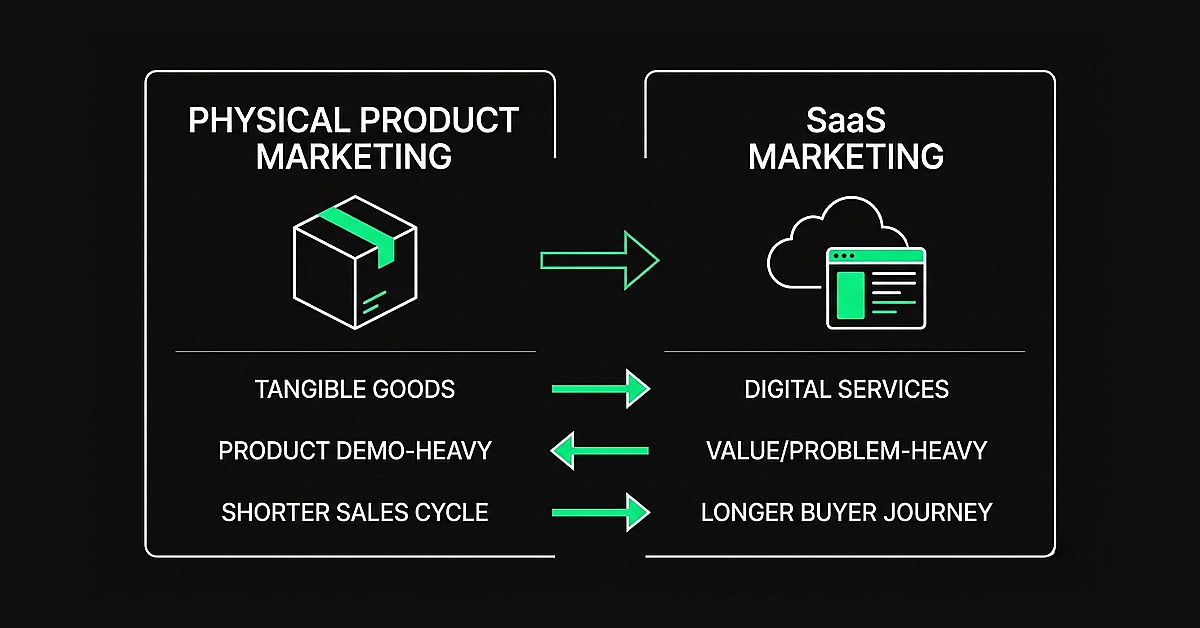
Most SaaS purchases involve between three and eight stakeholders, according to Gartner’s B2B buying research. Social media content needs to reach multiple roles at different stages of that process: the individual contributor who discovers the problem, the manager who approves the evaluation, and the finance or IT stakeholder who signs off. A one-size-fits-all post rarely serves all three.
The implication is that SaaS social content has to do heavier educational lifting than consumer content. Awareness posts should surface the problem the product solves. Consideration content should demonstrate how the product solves it. Decision-stage content should reduce friction with proof, such as customer results, integrations, and onboarding timelines.
Freako’s social media marketing services are built specifically for software companies navigating this challenge.
Which Platforms Should a SaaS Company Prioritize?
Platform selection should follow audience location, not marketing trend. For most B2B SaaS companies targeting mid-market or enterprise buyers, LinkedIn is the primary platform. For developer tools, API-first products, or technical infrastructure, X (Twitter) and Reddit carry more weight. For bottom-of-funnel retargeting and brand awareness with decision-makers, YouTube serves a complementary role.
LinkedIn for B2B SaaS
LinkedIn has over 1.3 billion members globally, with 1.4 billion visits recorded in February 2026 alone, according to Sprout Social’s latest statistics. Four out of five LinkedIn members drive business decisions at their organizations, which makes it the most direct channel for reaching SaaS buyers with influence over purchase decisions.
Carousel posts (PDFs formatted as swipeable slides) achieve an average engagement rate of 6.6%, compared to 2-5% for video and under 2% for plain text, per Socialinsider’s Q1 2026 benchmarks. Building a LinkedIn presence around educational carousels, founder commentary, and customer outcome posts produces measurably better returns than broadcasting product announcements.
X (Twitter) for Technical and Developer-Focused SaaS
X remains the default community layer for developers, data practitioners, and technical operators. If the product’s primary user is a developer or data engineer, X is where product launches, changelog announcements, and community conversations live. Short threads that explain a technical concept, a product decision, or an integration use case perform well in this environment.
YouTube for Long-Form Product Education
YouTube works as a long-form search channel for SaaS companies with complex products. Tutorial videos, feature walkthroughs, and use-case demonstrations serve buyers who need to understand a product before requesting a demo. These videos also feed LinkedIn and X as shorter clips, which extends their value without doubling the production effort.
| Platform | Best Fit | Primary Content Type | Engagement Benchmark (2026) |
|---|---|---|---|
| B2B SaaS, enterprise, mid-market | Carousels, thought leadership, case studies | 6.6% (carousels), 3.85% average | |
| X (Twitter) | Developer tools, API products, technical SaaS | Threads, changelog posts, community engagement | Varies by following; high for technical niches |
| YouTube | Complex products with long evaluation cycles | Tutorials, walkthroughs, webinar replays | Retention rate; avg. 3-5 min watch time |
| Niche communities (r/SaaS, product-specific subs) | Community answers, AMAs, honest product talk | Upvotes and comment depth |
How to Build a Content Mix That Serves the Full Buyer Journey
A SaaS content calendar that only publishes product updates and feature announcements produces a feed that nobody outside existing customers wants to follow. The content mix should map directly to the three stages most SaaS buyers pass through: awareness, consideration, and decision.
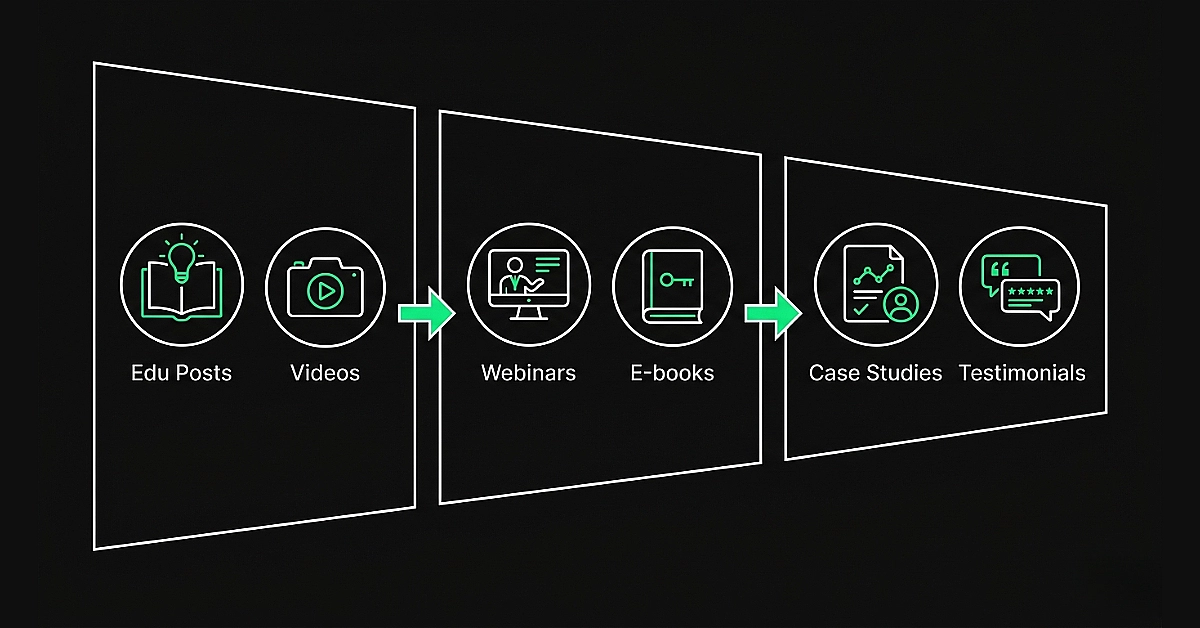
Awareness: Surface the Problem Before the Product
Awareness content reaches people who have the problem your product solves but have not yet started evaluating solutions. This includes educational posts about industry challenges, data-driven observations about how workflows are breaking, and opinionated takes on where a category is heading. The goal is not to mention the product but to make the audience feel like this account understands their world.
Examples that work: a LinkedIn post citing internal data about how long manual processes take in a specific workflow; a carousel breaking down three mistakes companies make before adopting a category of software; a short video showing what a messy version of the problem looks like before a solution is in place.
Consideration: Show the Product Solving the Problem
Consideration content bridges the gap between problem recognition and product evaluation. At this stage, the audience knows they need a solution and is comparing options. Content here should demonstrate product capability in context: short demo clips showing a specific use case, customer quotes tied to a concrete outcome, comparison posts that acknowledge where the product is strong and where it is not.
Authenticity matters at the consideration stage. SaaS buyers are research-literate. A post that pretends the product does everything better than every alternative reads as marketing noise. A post that says ‘we are the best option for this specific situation, and here is why’ reads as trustworthy. For B2B buyers, trust signals matter more than promotional language. Understanding how E-E-A-T applies to your content helps explain why authenticity in social posts converts better than polish.
Decision: Reduce Friction and Build Trust
Decision-stage content targets people who are close to starting a trial or requesting a demo. This includes content that directly removes purchase friction: onboarding time, integration options, security certifications, pricing transparency, and customer success stories with specific metrics. Social proof in this stage should be specific. A post that says ‘a team of five reduced manual reporting time by 11 hours per week using our dashboard’ outperforms any generic testimonial.
What Content Formats Work Best for SaaS Companies?
Content format determines how easy it is for a platform’s algorithm to distribute a piece and for an audience to consume it. The best-performing formats for SaaS social media in 2026 share a common trait: they make a complex, intangible product feel concrete and easy to evaluate.
| Format | Why It Works for SaaS | Platform |
|---|---|---|
| Carousel (PDF slides) | Breaks down complex concepts; highest LinkedIn engagement at 6.6% | |
| Short-form video (60-90 sec) | Shows the product interface in action; works across LinkedIn and YouTube Shorts | LinkedIn, YouTube |
| Customer story posts | Specific outcome data builds trust at consideration and decision stages | LinkedIn, X |
| Threads / multi-part posts | Works for technical explanations and product reasoning content | X (Twitter), LinkedIn |
| Live sessions / webinars | High-intent format for buyers in evaluation; creates repurposable clips | LinkedIn Live, YouTube |
| Repurposed blog content | Converts written research into platform-native formats without extra production | All platforms |
Content repurposing deserves specific attention. Publishing a long-form article on the company blog and then letting it sit there wastes most of the research investment. That same article can become five LinkedIn carousel slides, three X threads, one short YouTube explanation, and two community answers on Reddit. According to data from Kreativ Street, 60% of marketers reported that repurposed content generated more leads than original content, and 53% saw higher engagement after updating existing content.
How to Structure a SaaS Social Media Content Calendar
A content calendar for a SaaS company should follow a fixed weekly rhythm with a defined mix of post types. Ad hoc posting produces an inconsistent brand presence and makes it impossible to run controlled experiments on what content drives the most engagement or pipeline.
A practical starting framework for a B2B SaaS company posting primarily on LinkedIn and X is three to four posts per platform per week, divided across the three funnel stages. One post per week should serve awareness, one should demonstrate the product or a customer outcome, and one should publish a useful piece of content that has no sales agenda. The fourth post can be reactive: responding to an industry news item, sharing a relevant finding from the week, or participating in a trending conversation in the niche.
Consistency matters more than frequency. A company that posts three times per week every week for six months builds a more recognizable presence than one that posts 15 times in one week and goes quiet for two months. The LinkedIn algorithm in 2026 rewards consistent engagement signals over burst activity, according to Socialinsider’s platform research.
Should SaaS Companies Use Founder-Led or Brand-Led Social Media?
Founder-led content consistently outperforms brand page content on LinkedIn. Personal profiles achieve an average engagement rate of 3.85% on LinkedIn, compared to 2.1% for company pages, according to Cleverly’s 2026 benchmarks. People respond to people, not logos. Running a brand page and founder content simultaneously without a clear division of roles often creates the kind of redundant spend covered in our piece on why your marketing budget is leaking.
For early-stage SaaS companies, founder-led social is usually the most efficient use of limited content resources. The founder posting about product decisions, customer learnings, and market observations creates a more credible signal than a brand account publishing polished marketing copy. Prospects who follow a founder before they become customers often convert faster and churn less, because the relationship started with substance rather than advertising.
Larger SaaS companies benefit from a hybrid model: the brand page publishes customer stories, product news, and company milestones, while founders and key team members run their own content programs focused on their domain expertise. This approach builds both institutional credibility and individual thought leadership, which serve different buyer audiences simultaneously.
How to Measure Whether Your SaaS Social Media Strategy Is Working
Vanity metrics like follower count and post impressions tell you almost nothing about whether social media is contributing to revenue. The metrics that matter for a SaaS social media strategy connect content activity to pipeline behavior.
| Metric | What It Measures | Why It Matters |
|---|---|---|
| Engagement rate | Interactions per impression or follower | Signals whether content resonates with target audience |
| Profile visits from posts | How many people investigate your brand after seeing a post | Indicates top-of-funnel intent generated by content |
| Website traffic from social | Sessions originating from social referral links | Shows direct traffic contribution to pipeline |
| Demo or trial requests from social | Form submissions attributed to social traffic | Direct commercial impact measurement |
| Content-sourced leads | Prospects who engaged with content before converting | Measures full influence of social on revenue cycle |
| Follower-to-lead conversion rate | Percentage of followers who enter the pipeline | Audience quality indicator beyond follower count |
UTM parameters are the practical tool for connecting social media activity to website conversions. Every link shared from a social post should carry UTM tags that identify the platform, content type, and campaign. Without this tagging infrastructure, it is impossible to attribute a demo request to the LinkedIn carousel that drove it.
Brands using data-driven marketing improve their ROI by 15 to 20%, according to research cited by Kreativ Street. For SaaS companies with defined growth targets, treating social media as a measurable acquisition channel rather than a brand exercise makes the difference between a program that gets budget and one that gets cut.
Organic social and paid acquisition face the same root problem: if the funnel below the click is broken, no amount of traffic fixes it. See our breakdown of why paid ads get clicks but no conversions for a framework that applies equally to social-sourced leads. For teams running paid campaigns alongside organic content, Freako’s performance marketing practice integrates both channels into a single attribution model.
Three Things Most SaaS Social Strategies Get Wrong
Reviewing what the top-ranking articles on this topic cover, and where they stop short, surfaces three consistent gaps in how SaaS companies approach social media.
Posting About the Product Instead of the Problem
The most common error in SaaS social media is centering almost every post on the product: features, updates, pricing tiers, award wins. The people who need to be reached by awareness content have not yet decided they need the product. A feed full of product announcements is invisible to the majority of the addressable market. Content that names and describes the problem the product solves reaches a far larger, more relevant audience.
Treating All Platforms as Identical
Cross-posting identical content to LinkedIn, X, and Instagram simultaneously saves time but wastes reach. Each platform has a different audience expectation, content format, and algorithm behavior. A 1,200-word LinkedIn article reformatted as an image caption on Instagram performs badly on both. Platform-native content takes more effort to produce but generates significantly better engagement signals.
Running Social in Isolation From Sales and Product
Social media content created without input from the sales and product teams misses the most valuable raw material available: real objections, real questions, and real reasons customers chose the product. Sales calls are full of content ideas. Product decisions come with a story worth sharing. A social strategy that runs independently from these two functions produces content that sounds informed but lacks the specificity that makes B2B buyers pay attention.
Frequently Asked Questions
How many times per week should a SaaS company post on LinkedIn?
Three to five times per week is the practical range for most SaaS companies. Frequency below three posts per week limits algorithmic reach. Posting more than once per day usually diminishes per-post engagement as the audience spreads thin. Quality and consistency matter more than raw volume.
Is organic social media worth the investment for early-stage SaaS companies?
Yes, with a specific expectation. Organic social builds brand awareness and community over 6 to 12 months. It does not replace paid acquisition for short-term pipeline needs. The most efficient early-stage model is founder-led LinkedIn content, which requires time rather than budget and produces inbound pipeline from potential customers who were already researching the category. Combining social content with SEO services compounds the brand-building effect by capturing search intent from buyers already familiar with your brand.
What is the difference between SaaS social media strategy for B2B and B2C?
B2B SaaS strategy centers on LinkedIn, content that educates a multi-stakeholder buying committee, and a longer conversion timeline. B2C SaaS strategy emphasizes viral formats, Instagram, TikTok, and content designed for fast individual decision-making. The platforms, content types, and measurement approaches are substantially different across these two models.
How does influencer marketing apply to SaaS social media?
In SaaS, the highest-value influencers are niche practitioners with engaged audiences in the software’s specific domain: a finance operator with 25,000 LinkedIn followers who reviews accounting tools, or a developer advocate with an active X following who covers the infrastructure category. These micro-influencers generate more relevant pipeline than broad-reach creators. Research tracked by Kreativ Street shows businesses earn $5.78 for every $1 spent on influencer marketing, but the return depends heavily on relevance to the target buyer.
How do you track whether social media is contributing to SaaS revenue?
The foundational requirement is UTM tagging on every link shared via social platforms. With proper tagging in place, Google Analytics or your CRM can attribute website visits, trial signups, and demo requests back to specific social channels and post types. Beyond direct attribution, tracking content-influenced leads (prospects who engaged with social content before converting through another channel) gives a more complete picture of social’s contribution to pipeline.