
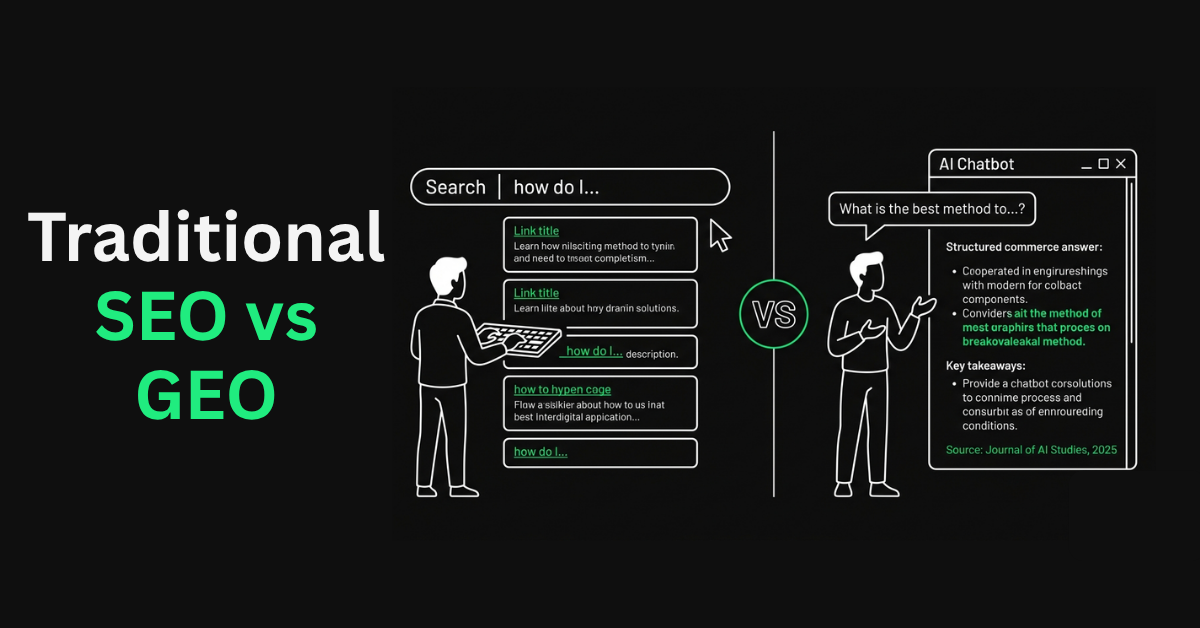
Something has shifted in how people find information online, and if your content strategy is still built entirely around Google’s blue links, you may already be losing ground without realizing it.
For over two decades, Search Engine Optimization ruled the digital marketing playbook. Get ranked on page one of Google, drive traffic, convert visitors. Simple enough.
But in 2026, that playbook has a new chapter. Millions of users are now getting answers directly from AI tools like ChatGPT, Perplexity, Google’s AI Overview, and Bing Copilot. They ask a question, get a synthesized answer, and never click a single link. This is where Generative Engine Optimization, or GEO, enters the picture.
This article breaks down what both strategies actually are, where they differ, where they overlap, and most importantly, how to run them together so your brand stays visible no matter how search continues to evolve.
What Is Traditional SEO?
Search Engine Optimization is the process of improving a website so that search engines like Google can find it, understand it, and rank it prominently for relevant queries.
At its core, SEO helps a business show up when someone searches for something related to what it offers. The goal is to earn a spot in the organic search results, which then drives clicks, traffic, and ideally, conversions.
Traditional SEO runs on three main pillars:
On-Page SEO covers everything on your actual pages: how you use keywords, how you structure your headings, how readable your content is, and whether your metadata accurately reflects the page’s purpose.
Off-Page SEO is largely about authority. When other reputable websites link back to yours, search engines treat that as a vote of confidence. Earning quality backlinks remains one of the most reliable ways to climb rankings.
Technical SEO handles the infrastructure: site speed, mobile responsiveness, crawlability, internal linking, structured data, and security. If the technical foundation is weak, even brilliant content will underperform.
The output of good traditional SEO is a high-ranking page that earns clicks from users actively searching for a topic.
What Is GEO (Generative Engine Optimization)?
Generative Engine Optimization is the practice of structuring, writing, and positioning your content so that AI-powered platforms can understand it, trust it, and use it when generating answers for users.
Instead of targeting a ranking position on a search results page, GEO targets a citation spot inside an AI-generated response.
When someone asks ChatGPT “what is the best accounting software for small businesses?” or asks Perplexity “how does content marketing drive revenue?”, these tools do not return a list of links. They generate a direct answer by drawing from sources they have indexed and evaluated. If your content is structured well, authoritative, and topically clear, it can become one of those sources.
GEO is not a replacement for SEO. It is a parallel discipline with a different target: the AI output layer that is now sitting between users and the open web.
How Traditional SEO Works
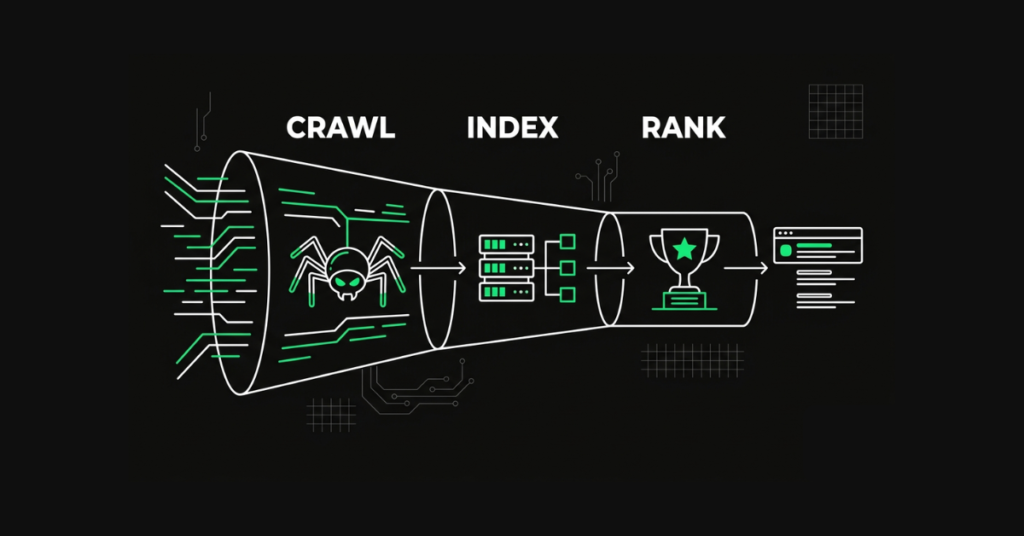
The process works in three broad stages.
Crawling is where it starts. Search engine bots discover your pages by following links across the web and revisiting known URLs. If your pages are not crawlable due to technical errors or blocked access, they will never make it into the index.
Indexing comes next. Once a bot analyzes your page, its content is stored in the search engine’s massive index, categorized by topic, keywords, intent, and other signals.
Ranking is where the algorithm steps in. Google evaluates hundreds of signals to decide which pages best answer a given query. Factors like E-E-A-T (Experience, Expertise, Authoritativeness, and Trustworthiness), backlink quality, content depth, page experience, and keyword alignment all play a role.
The better your SEO fundamentals, the more often you appear in front of people who are actively looking for what you offer.
How GEO Works
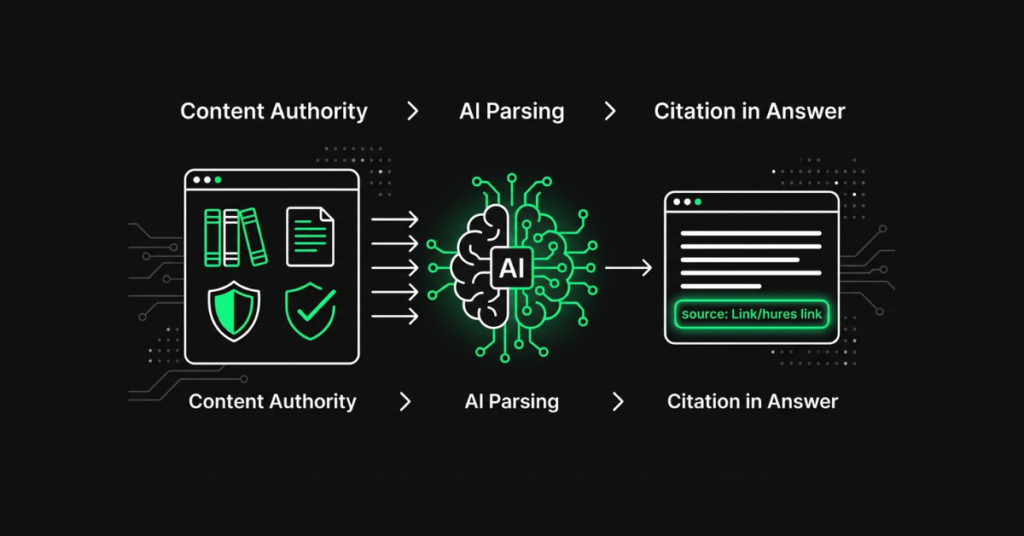
GEO operates differently because the entities processing your content are different. AI language models do not crawl and rank in the traditional sense. Instead, they are trained on large datasets from across the web and, in some tools, can also retrieve real-time information.
Here is what GEO actually requires:
Content that answers real questions directly. AI tools favor content written in a clear, conversational style that gets to the point fast. Vague, keyword-stuffed paragraphs get passed over. Concise, well-sourced answers get cited.
Structure that machines can parse. This means using descriptive headings, short paragraphs, FAQ sections, bulleted lists where appropriate, and schema markup. If an AI model cannot quickly extract a clear answer from your content, it will move on to a source that makes it easier.
Topical authority, not just keyword coverage. GEO rewards brands that have built real depth around a subject. A single well-optimized page is less valuable than a connected cluster of content that collectively establishes your brand as the go-to source on a topic.
E-E-A-T signals that extend beyond your own site. Mentions of your brand on third-party platforms, forums like Reddit, news sites, and authoritative publications all feed into how AI systems evaluate your trustworthiness. If your brand only appears on its own website, AI platforms have less to draw from.
Consistency of entity signals. In GEO, your brand name, author names, and core topics need to appear consistently across multiple platforms. This is how AI systems build an understanding of what your brand stands for and what it is an authority on.
Traditional SEO vs GEO: The Key Differences
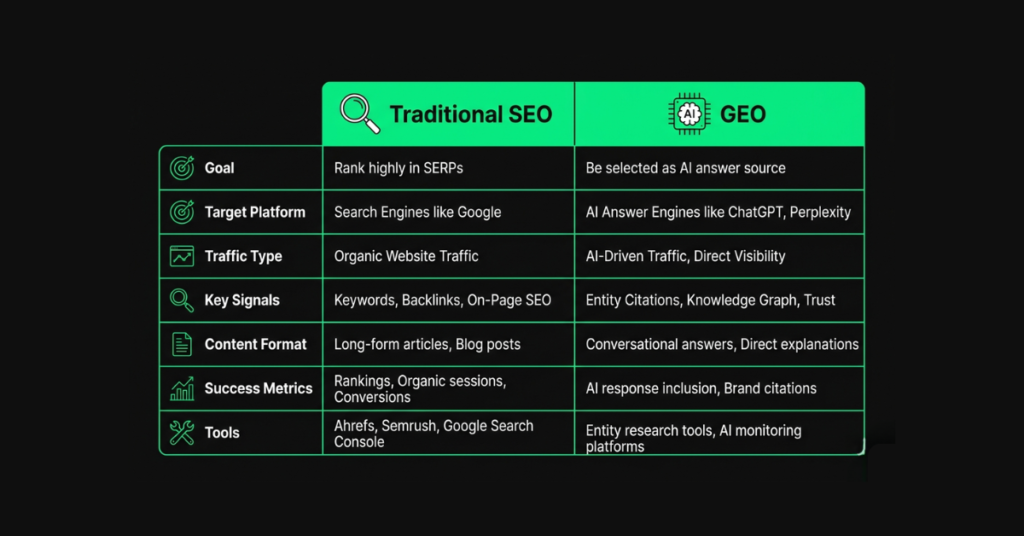
Despite sharing a foundation, these two strategies differ in some fundamental ways.
What They Are Optimizing For
Traditional SEO optimizes for a ranking position in a search engine results page. The measure of success is how high you appear when someone searches a keyword.
GEO optimizes for inclusion in a synthesized, AI-generated answer. The measure of success is whether your content is cited, referenced, or used as a source when an AI tool responds to a query.
Where the Traffic Goes
In SEO, a successful result means someone clicks your link and visits your site. Traffic is measurable through sessions, pageviews, and click-through rates.
In GEO, users may get their answer from the AI without ever visiting your site. Visibility does not always produce direct traffic. However, it does build brand awareness, authority, and indirect trust that eventually influences decisions.
What Signals Drive Visibility
Traditional SEO still places heavy weight on backlinks, on-page keyword signals, page experience metrics, and technical health.
GEO places more weight on content clarity, source credibility, structured formatting, topical depth, and entity associations. A brand that is widely mentioned and cited across the web, even without links in some cases, is more likely to be surfaced by AI.
What Platforms Are Involved
SEO primarily targets Google, with secondary consideration for Bing and other traditional search engines.
GEO targets a broader and growing set of platforms: Google’s AI Overview, ChatGPT (with and without web browsing), Perplexity, Bing Copilot, Gemini, Claude, and other LLM-based search interfaces.
How You Measure Success
SEO success metrics include keyword rankings, organic traffic, click-through rates, and conversions from search.
GEO success metrics are newer and still developing, but they include: how often your brand is cited in AI-generated answers, share of voice in AI outputs, brand mentions across third-party platforms, and referral traffic from AI search tools.
The Risk Profile
Traditional SEO risks center on algorithm updates. A Google core update can shift your rankings significantly.
GEO risks are harder to predict. AI models can change citation patterns overnight, and there is limited transparency into exactly how they select which sources to reference.
Where SEO and GEO Actually Overlap
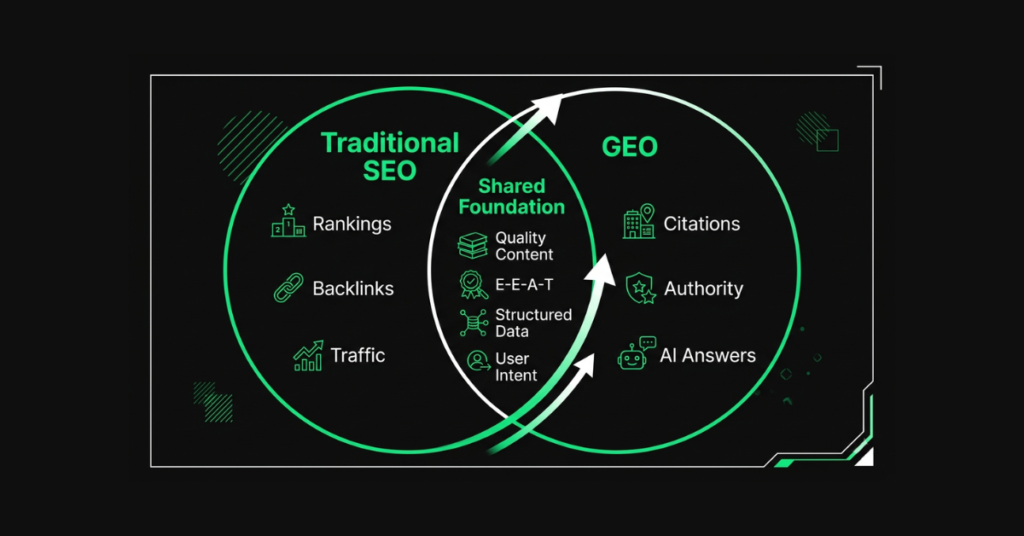
It is easy to treat these as entirely separate disciplines, but that misses something important. The strongest performing content in 2026 works well in both environments, and there are several reasons why.
Quality content is the common ground. Both search algorithms and AI models prefer content that genuinely helps people. Thin, generic, or poorly researched content gets ignored in both contexts. Detailed, original, well-structured content earns its place in both.
User intent is the starting point for both. Whether you are writing for a search result or an AI answer, you need to understand what the person on the other end is actually trying to figure out or accomplish. Match the intent well, and you perform better in both channels.
E-E-A-T signals lift both. Named authors with real credentials, transparent sourcing, case studies, and clear About pages help you rank in Google and make you a more trustworthy source for AI systems.
Structured content helps in both worlds. Clear headings, logical flow, FAQ sections, and schema markup all make your content easier for both Googlebot and AI language models to understand and use.
Technical foundations matter across both. Fast loading times, clean HTML, mobile responsiveness, and logical internal linking improve how both search engines and AI systems process your content.
The lesson here: a good SEO foundation does not go to waste in a GEO strategy. It feeds directly into it.
Why GEO Cannot Replace SEO (And Vice Versa)
A question that comes up frequently is whether one strategy will eventually make the other obsolete. The answer is no, and here is why.
Traditional SEO drives discovery at scale. Google still processes billions of searches daily, and the vast majority of commercial intent queries still result in clicks to websites. For local businesses, e-commerce, service providers, and content publishers, search traffic from traditional SERPs is still a significant and reliable channel.
GEO, on the other hand, is where informational authority is established. When someone asks an AI tool for a recommendation, a comparison, or an explanation, being cited there builds credibility. It is brand visibility without the click, but the mental impression it creates influences behavior over time.
The other reason they cannot replace each other: GEO actually depends on SEO. AI models draw from content across the web. If your SEO is weak, your content is less likely to be indexed, crawled, or even encountered by the training data and real-time retrieval systems that power AI search. A strong SEO foundation increases the surface area available for GEO to work with. If you’ve had mixed results, it’s worth understanding why SEO may not have delivered results in the past before rebuilding.
Running only SEO means you are absent from an increasingly influential layer of search. Running only GEO without SEO means you are building on a weak technical and authority base.
How to Run Both Strategies Together
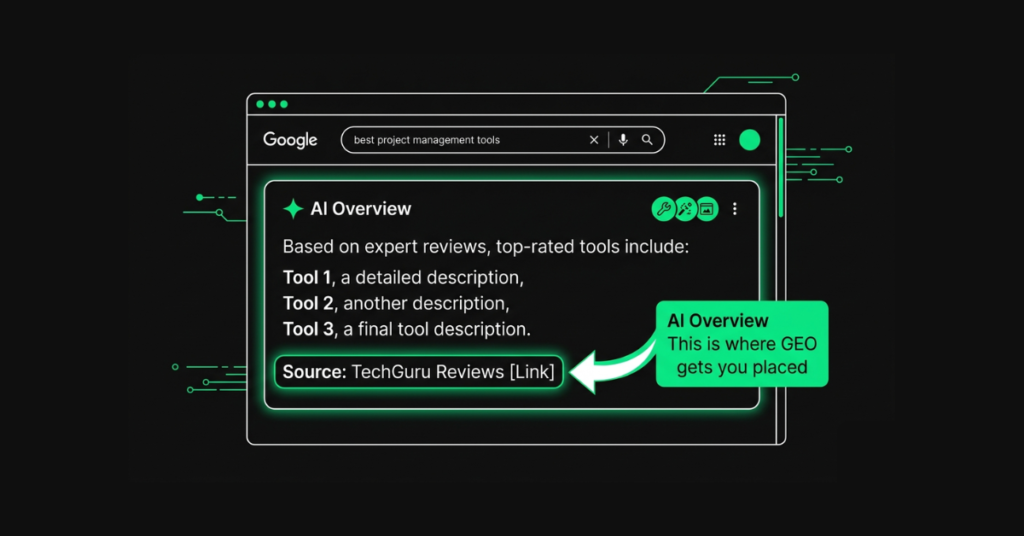
The brands that will win in search over the next few years will not be the ones that picked one strategy over the other. They will be the ones that built a system that serves both at the same time.
Here is how to approach that practically.
Step 1: Start With a Strong SEO Foundation
Before layering GEO tactics onto anything, make sure your technical SEO is solid. Site speed, crawlability, clean URL structures, mobile responsiveness, and internal linking all need to be in good shape. Without this foundation, you are building on unstable ground for both channels. If you need support building that foundation, professional SEO services that cover all three pillars on-page, technical, and link building are a practical starting point.
Then build topical depth. Rather than writing isolated blog posts targeting individual keywords, develop interconnected content clusters. Cover a topic from multiple angles, link your content internally in a meaningful way, and demonstrate to both Google and AI systems that your brand understands a subject deeply.
Step 2: Write for Questions, Not Just Keywords
GEO favors content that directly addresses how people actually speak and ask questions in conversational AI tools. Incorporate natural question-and-answer patterns into your content. Use headings phrased as questions when it makes sense. Add an FAQ section to important pages.
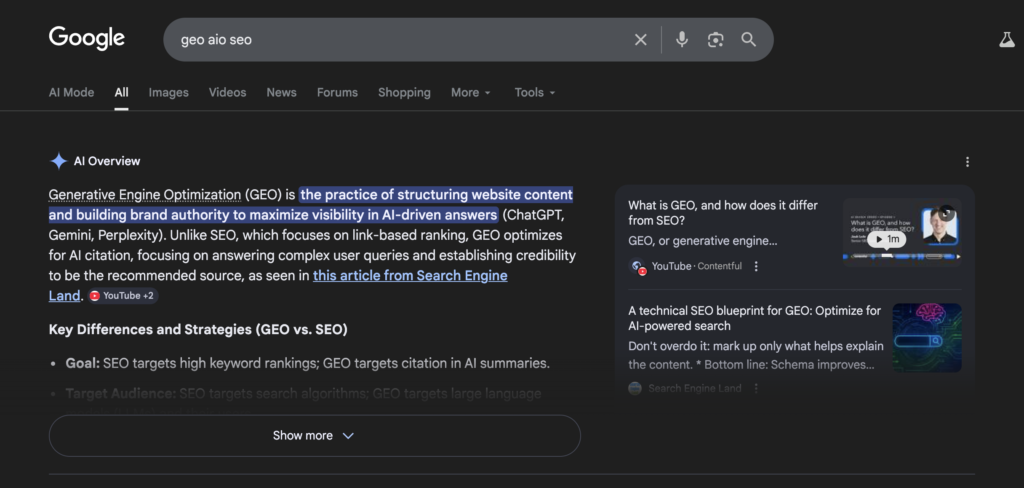
These same patterns also help with Google’s featured snippets and AI Overview inclusions, so this is genuinely cross-channel work.
Step 3: Add Schema Markup Where It Fits
FAQ schema, HowTo schema, Article schema, and Product schema all make the meaning of your content more explicit. When AI systems can see structured signals about what a section of content represents, they can incorporate it more confidently into generated answers. This is a relatively low-effort, high-return technical improvement.
Step 4: Build Brand Presence Beyond Your Own Site
AI platforms do not just pull from your website. They draw from a broad ecosystem of sources: industry publications, forums, review sites, social platforms, news outlets, and community discussions. If your brand only appears on your own properties, AI systems have a limited view of who you are.
Contribute to relevant conversations on platforms like Reddit, LinkedIn, and industry forums. Get mentioned in third-party roundups and comparisons. Earn coverage from publications in your niche. Each of these signals reinforces your brand’s authority in AI systems.
Step 5: Refresh and Maintain Your Content
Neither SEO nor GEO is static. Algorithms update. AI models update. User questions evolve. Content that performed well last year may underperform now if the information is dated or the framing no longer matches how people are asking questions.
Build a content maintenance process. Audit key pages regularly, update statistics, expand thin sections, and retire content that no longer serves a purpose.
Step 6: Track Performance Across Both Channels
Set up measurement for both SEO and GEO outcomes. For SEO, use tools like Google Search Console, Ahrefs, or SEMrush to track rankings, traffic, and click-through rates.
For GEO, start manually by querying AI tools with the questions your target audience would ask and noting whether your brand gets cited. Tools specifically built for AI citation tracking are emerging (such as Profound and Authoritas SGE Tracker) and are worth integrating into your reporting stack as they mature.
Measuring Success: SEO Metrics vs GEO Metrics
Understanding what to measure in each discipline helps you make better decisions and prove value to stakeholders.
Traditional SEO Metrics:
- Keyword rankings (position tracking for priority terms)
- Organic traffic (sessions from search engines)
- Click-through rate from SERPs
- Bounce rate and engagement quality
- Conversions attributed to organic search
- Domain authority and backlink profile growth
GEO Metrics:
- Brand citation frequency in AI-generated answers
- Share of voice across AI platforms (ChatGPT, Perplexity, Gemini, AI Overview)
- Referral traffic from AI search tools (trackable in GA4 when links are included)
- Brand mention volume across third-party platforms
- Entity authority scores (how consistently your brand is associated with core topics)
- Content reusability: how many of your pages are citation-ready for AI
A note on GEO measurement: this is still an evolving area. Many AI tools do not always provide direct links, making attribution difficult. The metrics that matter most right now are citation frequency and share of voice, which require either manual auditing or dedicated tools.
Driving more organic or AI-referred traffic only pays off if the conversion system is ready to receive it. If revenue still isn’t following traffic, how poor conversion rates affect marketing ROI may be the actual gap.
Common Mistakes Marketers Make
Treating GEO as a separate project. GEO works best when it is woven into your existing content and SEO processes, not bolted on as an add-on. The mindset should be: every piece of content we create should be structured to work in both environments.
Assuming top Google rankings guarantee AI inclusion. They do not. A page can rank number one on Google and never get cited by an AI tool if the content is not structured clearly or lacks the depth that AI systems favor.
Ignoring third-party brand presence. Many marketers focus entirely on their own site. But AI systems build a picture of your brand authority from across the web. If that picture is sparse, your GEO presence will be weak regardless of how well your site is optimized.
Chasing AI citations by writing robotic content. GEO does not mean writing in a style that sounds like it was made for machines. Human readability, genuine helpfulness, and engaging writing still matter, both for readers and for the AI systems trained on human preferences.
Not updating existing content. One of the most underutilized GEO tactics is taking your strongest existing SEO content and reformatting it for AI citation readiness. Adding FAQ sections, clearer definitions, authoritative sources, and structured data to pages you already have can significantly increase their GEO performance.
Before investing heavily in either SEO or GEO, it’s worth knowing whether your current marketing budget is already leaking elsewhere. Here’s what a complete marketing audit looks like 10 specific places to check.
The Bottom Line
The conversation around traditional SEO vs GEO is not really about which one wins. It is about understanding that search has expanded into new surfaces and that your content strategy needs to account for both.
SEO gets your content discovered through search engines. GEO gets your content used inside AI-generated answers. Run both well, and you cover the full spectrum of how your audience finds information in 2026.
The marketers and brands that adapt early will not just maintain their visibility. They will build the kind of topical authority that both search engines and AI systems continue to reward, regardless of what changes come next.
Frequently Asked Questions
Is GEO the same as SEO for AI?
Not exactly. GEO is a distinct discipline that focuses on being cited inside AI-generated answers rather than ranking in traditional search results. However, it shares many of the same foundations as SEO, including content quality, E-E-A-T, and structured data.
Will GEO replace SEO?
No. They are complementary strategies, not competing ones. Traditional SEO remains essential for driving organic traffic from search engines, which still handle billions of queries daily. GEO extends your visibility into AI-generated answer environments that traditional SEO cannot reach.
How do I know if my content is being cited by AI tools?
You can check manually by asking AI platforms the questions your audience would ask and looking for citations to your site. Dedicated tools like Profound, Authoritas SGE Tracker, and emerging AI search monitors can automate this process.
Do backlinks help with GEO?
Backlinks contribute to your overall authority and domain credibility, which AI systems consider when evaluating sources. In GEO, unlinked brand mentions also carry weight, which is a meaningful difference from traditional SEO where links dominate.
How long does GEO take to show results?
GEO can produce faster results than traditional SEO for informational content, particularly if your content is already strong and you are adding structure and schema. However, building the topical authority and third-party presence that makes GEO really work is a longer-term effort, much like SEO itself.
Can small businesses benefit from GEO?
Yes. In fact, GEO can be a faster path to visibility for smaller brands in niche topics where competition for AI citations is lower than competition for top Google rankings. Focused, authoritative content in a specific area can earn AI citations before a brand has the domain authority to rank at the top of SERPs.
What content formats work best for GEO?
Content that directly answers specific questions tends to perform well. FAQ sections, comparison articles, clear definitions, step-by-step guides with good structure, and content backed by original data or cited sources are all formats that AI systems can easily parse and reference.