

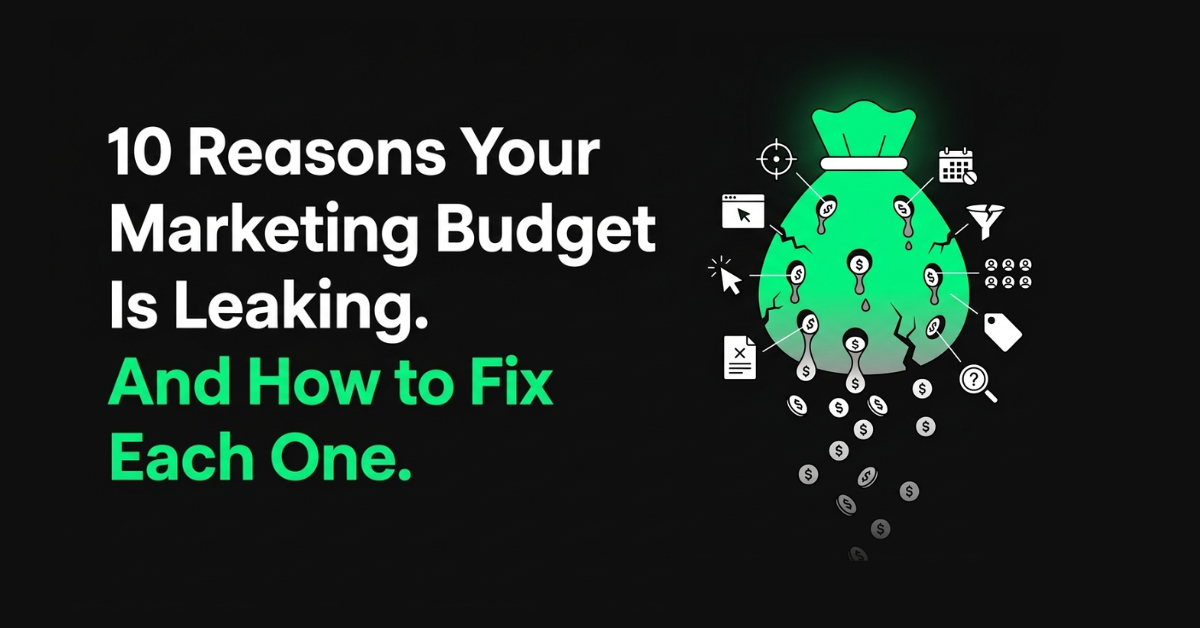
You are putting money into marketing. Some of it is coming back. But not enough, and somewhere in the back of your mind, you know it.
That feeling is worth paying attention to.
Most growing businesses are running three or four of these leaks at the same time without realising it. A few are running all ten. The tricky part is that none of them are obvious until you know exactly what to look for.
So let’s get into it.
1. You’re Targeting Everyone, Which Means You’re Reaching No One
‘Cast a wide net’ sounds like a smart strategy until you realise that marketing aimed at everyone ends up connecting with nobody.
When your messaging tries to speak to every possible customer, it doesn’t feel relevant to any specific one. Nobody reads it and thinks ‘this is exactly for me.’ So nobody takes action.
Broad targeting isn’t a safety net. It’s a budget drain.
| THE FIX: Get specific about who your best customer actually is. Not ‘business owners’ or ‘people aged 25-45.’ Think about the exact person with the exact problem your business solves better than anyone else. Build every campaign around that person. Your reach gets smaller. Your results get better. |
2. Your Ads Are Sending People to Your Homepage
This single mistake accounts for more wasted ad spend than almost anything else on this list.
Picture it: someone sees your ad for a specific service, clicks on it, and lands on your homepage, which covers everything you do, for every type of client, across every market you serve. They spend a few seconds scrolling, can’t quickly find what the ad promised, and they leave.
The ad worked. The destination let it down.
Every ad needs its own dedicated landing page that matches the exact promise of the ad. If you’re seeing clicks without conversions, read more about why paid ads get clicks but rarely convert without the right landing page.
| THE FIX: Every ad needs its own dedicated landing page that matches the exact promise of the ad that brought the visitor there. Same message, same offer, same language, one clear action. That change alone can double your conversion rate without adding a single rupee to your ad budget. |
3. You’re Optimising for Clicks, Not Customers
The dashboard looks healthy. Clicks are up. Traffic is growing. The agency is happy with the numbers.
But sales are flat.
A campaign optimised for clicks will deliver clicks, efficiently and at scale. It just won’t filter for whether those people were ever going to buy anything. Clicks from the wrong audience cost just as much as clicks from the right one, but only one of them produces revenue. This is one of the most common budget drains. Before running another lead generation campaign, read what a ‘you don’t need more leads’ audit reveals about what’s actually needed.
| THE FIX: Shift what you’re asking your campaigns to optimise for. Not clicks, not reach, not impressions. Leads that turn into customers. Revenue that can be traced back to a specific campaign. When your briefs and your agency reporting are built around those numbers, everything about how campaigns are run changes. |
4. Your Budget Was Set Once and Never Revisited
At the start of the year, someone divided the marketing budget across channels based on last year’s numbers, a gut feel, or whatever the previous agency suggested. It seemed reasonable at the time.
It’s now several months later. The market has shifted. Some channels are working well. Others are quietly burning through money. And the budget split is still exactly the same as it was on day one.
A budget that never changes is a budget based on assumptions, not evidence. If you haven’t done the audit yet, here’s why scaling your marketing budget before auditing it backfires and why the audit should come first.
| THE FIX: Review your budget allocation every month, not once a year. Move spend toward what the data shows is working. Pull it away from what isn’t. Your budget should respond to what’s actually happening, not to a prediction made at the start of January. |
5. You Have No Idea Where Visitors Drop Off
Traffic is coming in. Some of it converts. Most of it doesn’t.
But here’s the question most business owners can’t answer: where exactly are people leaving? Which page? Which section? Which point in the journey does interest flip to exit?
Without that answer, every attempt to improve conversions is a guess. You might fix the wrong page. You might add content nobody needed. You might redesign something that was already working fine.
| THE FIX: Set up funnel tracking that shows behaviour at every step, not just traffic numbers. Tools like Hotjar or Google Analytics 4 show where visitors go, where they slow down, and where they leave. Once you can see the drop-off point, fixing it becomes a focused task instead of a coin flip. |
6. Your Content Exists But It Wasn’t Built to Rank
There are blog posts. Social media is active. Someone is keeping a content calendar running.
But almost none of it was written around what people actually type into Google when they need what you offer.
Content that doesn’t match real search intent doesn’t rank. Content that doesn’t rank doesn’t get found. Content that doesn’t get found costs money to produce and sits there quietly unread. That’s not content marketing. That’s a publishing habit with no return. If you want to see what content built to rank actually looks like from keyword research through to page structure that’s the foundation of a working strategy from reliable SEO services.
| THE FIX: Before writing anything, research the specific phrase your ideal customer types when they’re dealing with the problem you solve. Write directly to that query. Structure the page to answer it better than anything currently ranking for it. That’s the gap between content that fills a calendar and content that generates traffic. |
7. You’re Running Five Channels at 20% of Their Potential
Every time something underperforms, the temptation is to add a new channel. Try a different platform. Test a new format. Launch something else.
The result? Five channels running at once, none of them getting enough budget, attention, or strategic input to actually work. Everything looks like it’s ‘sort of working.’ Nothing produces a result strong enough to justify going all in on it.
You end up spread thin across everything and committed to nothing.
| THE FIX: Narrow down. Pick one or two channels where your audience is most active and where you have real evidence of early traction. Put your full resource into those. One channel done properly will outperform five channels done half-heartedly, every single time. |
8. Your Agency Reports Activity, Not Results
The monthly report arrives. It’s packed with data: impressions, reach, engagement rate, follower growth, session duration, post performance.
And buried near the bottom, or missing entirely, is the number that actually matters: how much revenue did any of this generate?
Reporting on activity tells you what was done. Reporting on results tells you what changed. If your current reports are full of the first type and empty of the second, that’s not just an information gap. It’s an accountability gap. If you want performance marketing campaigns built around revenue, not activity, that distinction needs to be built into the brief from day one.
| THE FIX: Redefine what gets measured. Every marketing activity should connect, at least directionally, to a business outcome: leads generated, deals influenced, revenue attributed. If something can’t be tied to any of those, it either gets connected or it gets cut. Brand awareness on its own is not a result. |
9. You’re Following Advice Built for Budgets Ten Times Your Size
Most marketing playbooks and best practice guides were written by people working with budgets much larger than yours.
‘Be present on every platform.’ Easy when you have a dedicated team for each one. ‘Run always-on campaigns.’ Easy when your budget can handle a three-month learning curve. ‘Invest in brand building.’ Easy when you can afford to wait 18 months to see the payoff.
For a business with real budget constraints, that advice doesn’t just underperform. It pulls you in the wrong direction. It spreads your resources across strategies that only work at scale, and then leaves you wondering why the results don’t match what the guide promised.
| THE FIX: Build your strategy around your actual budget and your actual stage of growth, not someone else’s. The right question isn’t ‘what do the best-funded companies do?’ It’s ‘what does our data say works for a business like ours, right now, with what we have?’ Those are completely different questions with completely different answers. |
10. You’ve Never Done a Real Marketing Audit
Not a campaign review. Not a monthly report read-through. A proper audit.
A line-by-line look at every marketing activity you’re running, every channel you’re funding, and every rupee you’re spending, matched against what each one is actually producing.
Most businesses have never done this. Not because they don’t want to, but because it’s uncomfortable. It shows how much has been spent on things that were quietly producing nothing.
But it’s also the single most useful thing you can do for your marketing spend.
| THE FIX: Do the audit this month. Not to look back with regret, but to make a clear, evidence-based decision about where your next budget cycle goes. Map every activity to an outcome. Find the leaks. Close them one by one. Then scale, but only scale what the data says is worth it. |
The Common Thread Across All 10 Leaks
Ten different leaks. One underlying problem.
Spending without clarity.
Every issue in this list comes back to the same thing: marketing budget being allocated, distributed, and measured without a clear line back to what it’s actually producing.
The fix isn’t a bigger budget. It’s not a new channel, a rebrand, or switching agencies while keeping the same brief.
It’s actually knowing what your marketing is doing. Not roughly. Not based on activity reports. Actually knowing.
That level of clarity is available to any business, at any size, with any budget. Most just never stop long enough to find it.
| Key Takeaways 1. Target a specific audience, not a broad one. 2. Match every ad to a dedicated landing page. 3. Optimise for revenue, not clicks. 4. Review budget allocation every month. 5. Track exactly where visitors drop off in your funnel. 6. Build content around real search intent. 7. Go deep on fewer channels rather than shallow on many. 8. Hold your agency accountable to results, not activity. 9. Apply strategies suited to your actual budget and stage of growth. 10. Run a proper marketing audit before your next budget cycle. |