
Social media engagement rate measures how actively an audience interacts with content relative to the size of that audience or its reach. It is the most direct indicator of whether a post resonated, and it sits at the center of every serious social media performance review. A brand posting daily with low engagement is essentially talking to itself. Understanding what the number means, how to calculate it correctly, and what constitutes a good result in your specific industry is the difference between reporting numbers and actually using them to make better decisions. A well-executed social media marketing strategy uses engagement rate as a primary performance signal.Match the Metric to the Goal.
What Is Social Media Engagement Rate?
Social media engagement rate is a percentage that expresses the volume of interactions on a post or account relative to a baseline, typically followers, reach, or impressions. Interactions include likes, comments, shares, saves, clicks, and reactions, depending on the platform. The metric matters because raw engagement counts without context are meaningless: 500 likes on a post reaching 200,000 people tells a different story than 500 likes on a post reaching 2,000 people.
Engagement rate provides that context. It normalizes performance so you can compare posts across different audience sizes, compare your account against competitors, and track whether your content is becoming more or less effective over time.
How Is Social Media Engagement Rate Calculated?
There is no single, universally accepted formula. Three versions are in common use, and each answers a different question. Using the wrong one against a benchmark produces misleading results.
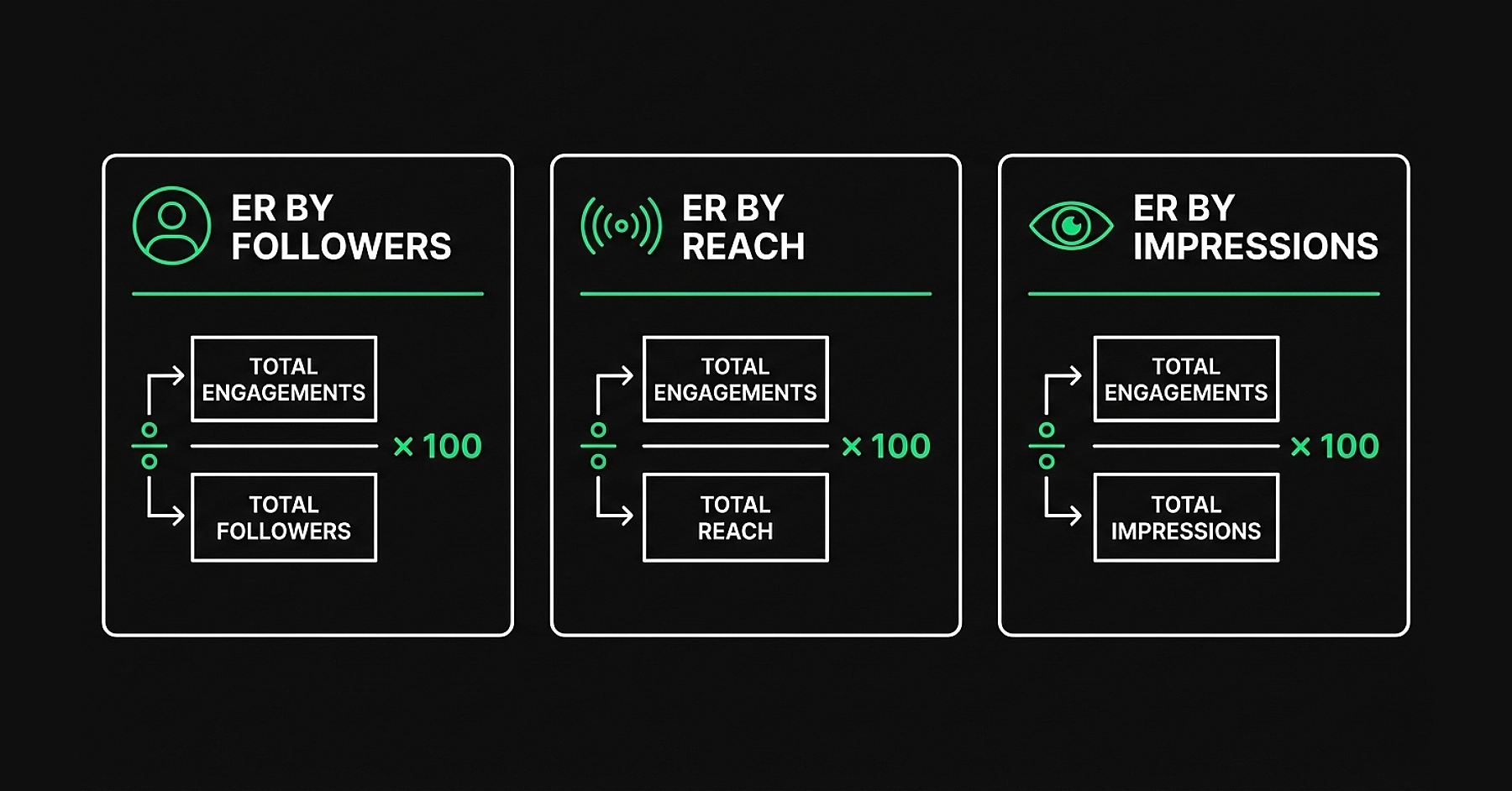
The three standard formulas are:
- Engagement Rate by Followers: (Total Engagements / Followers) x 100
- Engagement Rate by Reach: (Total Engagements / Reached Users) x 100
- Engagement Rate by Impressions: (Total Engagements / Total Impressions) x 100
For a deeper breakdown of how to apply each formula in reporting, Postoria’s engagement benchmarks guide covers the practical implications.
Which Formula Should You Use?
The choice depends on what you are measuring. Engagement rate by followers is the most common benchmark formula used in industry reports. It is useful for tracking account-level audience responsiveness over time. However, because most platforms show posts to only a fraction of followers organically, dividing by total followers can understate a post’s actual impact.
Engagement rate by reach tells you how persuasive the content was after people actually saw it. This is arguably the most useful metric for evaluating individual post performance. If a post reached 1,000 people and 80 interacted, an 8% engagement rate by reach reflects genuine content effectiveness.
Engagement rate by impressions is useful when comparing formats where a single user may see the same content multiple times, such as Stories or paid placements. It tends to produce the lowest figures of the three formulas.
When reporting to clients or internal stakeholders, always label which formula you used. Reporting “Instagram ER: 2.4%” without specifying by followers, reach, or impressions leaves the number open to misinterpretation and makes benchmark comparisons unreliable.
Engagement Rate Benchmarks by Platform
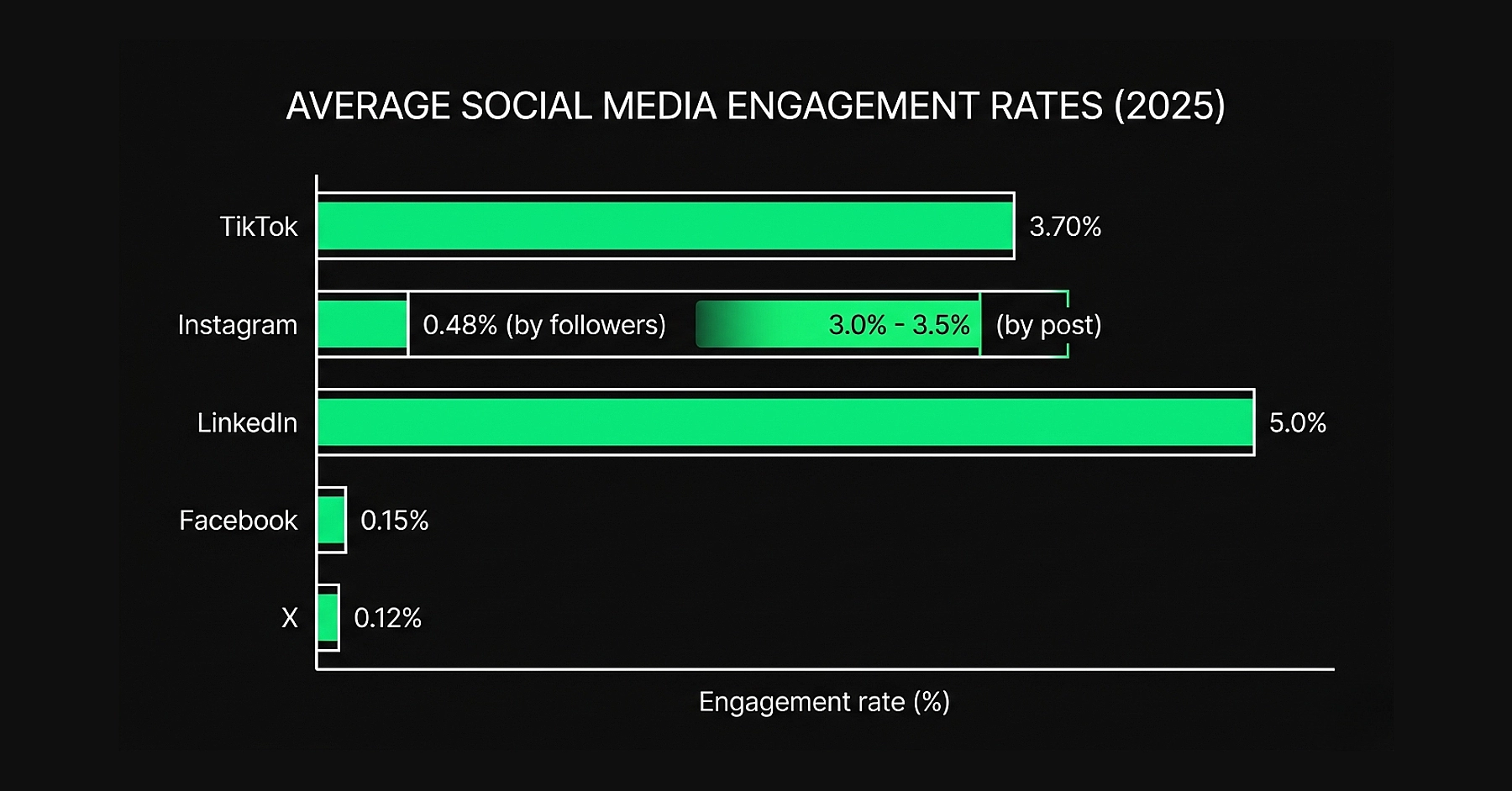
Platform benchmarks vary significantly depending on the data source, the formula used, and the types of accounts included in the sample. The figures below draw from multiple 2025 benchmark reports published by Socialinsider, Hootsuite, and Rival IQ to give a reliable working range.
| Platform | Avg. ER (by Followers/Post) | Notes |
|---|---|---|
| TikTok | 3.70% | Highest organic ER of major platforms; varies by account size |
| 0.48% (global avg); 3.0-3.5% (by post) | Formula differences explain the wide range; Reels tend lower than carousels | |
| 5.00-5.19% | Highest among B2B platforms; multi-image posts reach 6.60% | |
| 0.15% | Organic reach is limited; local/community content can exceed average | |
| X (Twitter) | 0.12% | Brand pages see below 1%; engagement quality (replies) often matters more |
These figures come from different methodologies, which is why they can appear inconsistent across sources. Socialinsider’s 2026 benchmarks analyzed 70 million posts and report platform-wide medians. Hootsuite measures average engagement per post across 12 industries. Rival IQ analyzes median interactions divided by followers across 150 companies per industry. Treat any single figure as an orientation point, not a pass/fail target.
Why LinkedIn Outperforms Other Platforms
LinkedIn’s comparatively high engagement rate reflects the nature of its audience and algorithm. The platform favors content that generates comments and meaningful reactions, and its feed surfaces content more broadly than Facebook pages. Multi-image posts on LinkedIn generated the highest average engagement in 2025 at 6.60%, followed by native documents at 5.85% and video posts at 5.60%. Text-only posts and single images typically sit in the 4-4.8% range. One factor worth noting: including an external link in a LinkedIn post can reduce reach by 25-35%, which indirectly suppresses engagement counts.
TikTok’s Position in the Benchmark Landscape
TikTok consistently leads major platforms on engagement rate because its discovery algorithm distributes content to non-followers at high volume. TikTok can reach non-followers at 50-200% of a creator’s follower count, which means even accounts with modest following can generate strong absolute engagement. The platform average of 3.70% reflects this reach advantage. However, watch time and rewatches are often stronger performance signals than likes alone, since TikTok’s algorithm weights those behaviors more heavily in subsequent distribution.
Industry Average Engagement Rates in 2025
Industry context is essential when evaluating engagement rate. A 3% Instagram engagement rate can be strong for a large retail brand and unimpressive for a niche education account. Hootsuite’s January 2025 benchmark data, covering 12 industries across Instagram, LinkedIn, TikTok, Facebook, and X, shows the following averages:
| Industry | TikTok | |||
|---|---|---|---|---|
| Agencies | 3.4% | 3.7% | 0.7% | 1.7% |
| Education | 4.2% | 2.8% | 2.3% | 2.2% |
| Financial Services | 3.8% | 3.2% | 1.6% | 1.8% |
| Healthcare / Pharma | 3.7% | 3.3% | 1.0% | 1.9% |
| Dining and Hospitality | 3.1% | 3.9% | 1.3% | 1.3% |
| Consumer Goods and Retail | 3.0% | 3.9% | 1.6% | 1.0% |
| Technology | 3.3% | 3.6% | 0.7% | 0.9% |
| Media and Entertainment | 3.0% | 2.0% | 1.8% | 0.8% |
| Construction and Manufacturing | 4.4% | 4.0% | 2.6% | 1.7% |
Source: Hootsuite Average Engagement Rate Benchmarks, January 2025 (per post, by followers).
A few patterns stand out. Education accounts consistently produce above-average Instagram engagement because student communities interact heavily with campus content. Construction and manufacturing brands perform surprisingly well across all platforms, likely because niche content attracts a highly relevant audience with strong purchase intent. Technology brands show strong LinkedIn numbers but weaker TikTok figures, reflecting where their professional audiences spend time.
What Is a Good Engagement Rate on Social Media?
A good social media engagement rate is one that is improving over time and outperforming your own historical baseline, measured with a consistent formula. Platform-wide averages are a useful starting reference, but they are built from accounts of all sizes, posting all content types, in all industries. They are not performance standards.
As a practical working guide for 2025 and 2026:
- Instagram: 1.5-3% engagement rate by reach is a healthy range for most brand accounts. Smaller niche accounts may exceed this comfortably. Accounts with over 100,000 followers typically see lower percentages due to audience breadth.
- LinkedIn: 3% or above indicates strong B2B engagement. Comment quality, profile visits, and qualified clicks matter as much as raw reaction counts.
- TikTok: 3-4% can serve as a useful brand-level reference. Watch time and follower conversion usually explain TikTok performance better than likes.
- Facebook: 0.1-1% is common for broad brand pages. Community-oriented and local content can perform significantly above this range.
- X (Twitter): Below 1% is standard for most brand accounts. Replies, reposts, and link clicks often carry more strategic value than the engagement rate figure itself.
Account Size Changes Everything
Nano-influencer accounts (under 10,000 followers) routinely achieve Instagram engagement rates of 5-8% because the audience is small, tight-knit, and highly responsive. Accounts with over 100,000 followers typically see rates of under 1% by the followers formula, even when the absolute number of interactions is much larger. This is why comparing engagement rates across vastly different account sizes produces misleading conclusions. A national retail brand at 0.8% Instagram engagement is not necessarily underperforming compared to a micro-influencer at 6%.
Why Benchmark Reports Disagree
If you have pulled engagement benchmarks from multiple sources and noticed contradictory figures, the discrepancy is almost always explained by one of five factors.
First, different formulas. Engagement rate by followers is lower than engagement rate by reach, because a post typically reaches only a subset of the follower base. Dividing by all followers makes performance look smaller.
Second, different content formats. Instagram Reels, carousels, feed images, and Stories perform differently within the same platform. A report that averages these together produces a figure that accurately represents none of them.
Third, different account sizes. Smaller accounts inflate platform averages because their percentage engagement is structurally higher. Reports that include a large proportion of small accounts will show higher averages than reports drawing primarily from enterprise brands.
Fourth, different industries. A B2B software company and a food and beverage brand are not competing for the same audience behavior. Comparing their engagement rates as if they are on equal footing is analytically meaningless.
Fifth, different time periods. Rival IQ’s 2025 data shows year-over-year engagement declines across every major platform: Facebook down 36%, Instagram down 16%, TikTok down 34%, and X down 48%. A benchmark from 2022 will produce a materially different reference point than one from 2025.
How to Use Engagement Rate Data to Improve Performance
Engagement rate data produces useful decisions only when the analysis follows a consistent method. A few practical principles apply regardless of platform or industry.
Track Trends, Not Snapshots
A single engagement rate number tells you almost nothing. A trend line over 90 days tells you whether your content strategy is moving in the right direction. Calculate average engagement rate per post for each platform, segment by format (Reels, carousels, text posts, videos), and compare the current 30-day average against the prior period. If the rate is declining despite consistent posting volume, something in the content mix, timing, or audience targeting has changed.
Separate Format Performance
Averaging all Instagram content together hides what is actually happening. Carousels typically outperform static images. Reels drive reach but can generate lower percentage engagement on some accounts. Native LinkedIn documents outperform link posts significantly. Splitting performance by format reveals which content types deserve more production investment and which are diluting your overall numbers.
Match the Metric to the Goal
A post designed to drive link clicks should not be evaluated primarily on engagement rate. A brand awareness post should not be judged the same way as a product launch. Saves are a stronger indicator than comments for content people want to revisit. Comments indicate depth of audience interest more reliably than likes. Treat engagement rate as one input in a broader performance picture, and pair it with the metrics that match your specific campaign objective. Brands running performance marketing campaigns alongside organic social use engagement rate to identify which organic content themes also perform in paid environments.
Common Myths About Social Media Engagement Rate
Several widely repeated claims about engagement rate deserve pushback.
The myth that higher follower counts always improve total engagement is false in percentage terms. Large accounts nearly always see lower engagement rates by the followers formula, because the audience is broader and less cohesive. Growth comes with an engagement rate tradeoff that most brands underestimate.
The myth that engagement rate is the primary indicator of social media ROI is also overstated. A campaign generating high engagement but zero conversions has not delivered business results. Engagement rate measures content resonance, not revenue impact. It is a leading indicator, not a bottom-line metric.
The myth that posting more frequently increases engagement rate is unsupported by current data. Posting frequency and engagement rate are not positively correlated across most platforms. Sprout Social’s 2025 Content Benchmarks Report found that industries posting above average frequency do receive more total inbound engagements, but that does not translate to a higher per-post rate. Consistency matters more than volume.
Frequently Asked Questions: Social Media Engagement Rate
What is a good social media engagement rate in 2026?
On Instagram, a rate of 1.5-3% by reach is a reasonable benchmark for brand accounts. LinkedIn accounts targeting B2B audiences should aim for 3% or above. TikTok brand accounts commonly see 3-4%. Facebook and X typically see below 1% for broad pages. These ranges shift significantly based on account size and industry.
How do I calculate engagement rate on Instagram?
The most useful formula for individual posts is engagement rate by reach: divide total interactions (likes, comments, saves, shares) by the number of accounts that reached the post, then multiply by 100. For account-level trending, divide total interactions by follower count and multiply by 100.
Why is my engagement rate dropping?
Declining engagement rate typically reflects one of several causes: reduced content relevance for the current audience, posting frequency changes that create either fatigue or visibility gaps, algorithm shifts deprioritizing your content format, or audience growth outpacing content quality. Segment your performance by format and compare top-performing posts against underperforming ones to identify the pattern.
Does engagement rate affect how platforms distribute content?
Yes, on most platforms. Instagram, TikTok, and LinkedIn use early engagement signals to determine whether content gets distributed more broadly. Posts that receive strong engagement within the first hour are typically surfaced to larger audiences. This creates a compounding effect where high-engagement content earns more reach, which in turn generates more absolute interactions.
What counts as engagement on social media?
The definition varies by platform. Instagram counts likes, comments, saves, and shares. LinkedIn counts reactions, comments, reposts, and clicks. TikTok counts likes, comments, shares, and saves. Facebook counts reactions, comments, shares, and link clicks. Some platforms also count profile visits and follows triggered by a post as engagement signals within their native analytics.